
 Products
 Bars
Bars
 Beads & Spheres
 Bolts & Nuts
 Crucibles
 Discs
Discs
 Fibers & Fabrics
 Films
Films
 Flake
Flake
 Foams
Foams
 Foil
Foil
 Granules
 Honeycombs
 Ink
Ink
 Laminate
 Lumps
Lumps
 Meshes
 Metallised Film
 Plate
Plate
 Powders
 Rod
Rod
 Single Crystals
 Sputtering Target
 Tubes
Tubes
 Washer
 Wires
Wires
 Converters & Calculators
 Write for Us



Boron Carbide Powder for Abrasives and Cutting Tools

Introduction
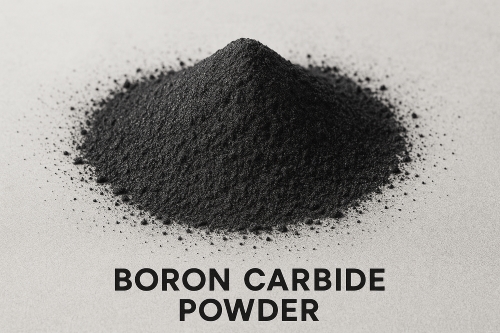
Few industrial materials are as strong, durable, and precise as boron carbide powder. Referring to one of the hardest substances on planet Earth—after diamond and cubic boron nitride only—this black, gritty powder humbly fuels some of manufacturing and engineering's most demanding applications.
But what makes boron carbide unique in abrasives and cutting tools? Let's take a closer look.
What Is so Special about Boron Carbide?
Boron carbide (chemical formula B₄C) is a ceramic material with an impressive array of physical properties:
• Hardness – It has a hardness of around 9.5 on the Mohs scale, which makes it ideal for grinding, cutting, and polishing the hardest surfaces.
• Lightweight – Although boron carbide is hard, it is incredibly light, and this is a big advantage when tool weight is a concern.
• Heat resistance – It retains its shape even at temperatures over 1000°C.
• Chemical inertness – Resistant to acids and aggressive chemicals, so it survives longer under tough conditions.
These are the reasons why boron carbide powder is a first-line material in high-performance abrasives and cutting tools.
Shaping the Unshapable: Abrasive Applications
Whether polishing a sapphire lens or grinding a hard alloy, boron carbide powder is often the first choice for abrasive machining. Here's why and how:
--Lapping and Polishing
For applications in optics, electronics, and semiconductors, ultra-smooth surfaces are essential. Boron carbide powder is mixed with liquid to create a slurry that polishes surfaces to micron-level precision—perfect for glass, ceramics, or even silicon wafer finishing.
--Grinding Wheels and Belts
When used in grinding wheels or abrasive belts, boron carbide can readily cut through tungsten carbide, ceramics, or steel. It wears very slowly, keeps its sharp edges, and cuts evenly under pressure.
--Sandblasting and Surface Prep
Boron carbide is also used as a blasting medium for material cleaning, etching, or prepping hard materials before coating or welding. It effectively strips material without degrading too quickly, compared to softer media.
Cutting-Edge Cutting Tools
Boron carbide is utilized not only in shaping and smoothing. It also comes a long way in tools needed to cut with amazing accuracy and resistance.
--Wire Sawing
Boron carbide particles are embedded into thin wires utilized to cut hard but fragile materials like sapphire or silicon in the solar and electronics industries. The saws reduce waste and give clean, precise cuts.
--Water Jet Nozzles
Boron carbide nozzles are a silent hero within water jet cutting systems. The nozzles withstand continuous pounding from high-velocity abrasive particles, but due to the hardness and chemical resistance of boron carbide, they last longer compared to other alternatives such as tungsten carbide.
--Saw Blades and Cutting Discs
In cutters employed to cut ceramics, stone, or composites, boron carbide extends blade life and maintains them sharp. To the construction and aerospace companies, that translates into considerable cost savings and efficiency.
Why Use Boron Carbide rather than Traditional Abrasives?
You might wonder why not just stick with tried-and-true favorites such as silicon carbide or aluminum oxide. The answer is performance:
• Increased speed of cutting and grinding – Boron carbide cuts more effectively.
• Lower wear rates – Equipment lasts longer, reducing downtime and cost.
• Unvarying performance in tough conditions – Heat, pressure, chemicals – boron carbide gets the job done when others fail.
That is, it's not a matter of making it happen—it's how to make it happen smarter, faster, and cheaper.
Innovation on the Horizon
The history of boron carbide is not set in stone. Engineers and scientists continue to find new ways to grow and use it:
• Sub-micron and nano powders offer still smoother finishes for delicate pieces.
• Composite materials mix boron carbide with polymers or metals to create hybrid tools with unique performance traits.
• Coated particles create greater adhesion in newer manufacturing technologies, which offers new possibilities for specialty tools and custom abrasives.
Final Thoughts
Boron carbide powder is not well known, perhaps, but its influence on contemporary industry is gigantic. Whether it's polishing a cutting-edge lens, slicing through a ceramic tile, or extending the life of a water jet nozzle, boron carbide is working behind the scenes to build our world with toughness and accuracy. As industries keep pushing for quicker, cleaner, and harder solutions, boron carbide will be a reliable—and necessary—fixture in the advanced manufacturing toolbox. For more ceramic materials, please check Stanford Advanced Materials (SAM).
 Chin Trento