Products
 Bars
Bars
 Beads & Spheres
 Bolts & Nuts
 Crucibles
 Discs
Discs
 Fibers & Fabrics
 Films
Films
 Flake
Flake
 Foams
Foams
 Foil
Foil
 Granules
 Honeycombs
 Ink
Ink
 Laminate
 Lumps
Lumps
 Meshes
 Metallised Film
 Plate
Plate
 Powders
 Rod
Rod
 Single Crystals
 Sputtering Target
 Tubes
Tubes
 Washer
 Wires
Wires
 Converters & Calculators
 Write for Us



Catalytic Applications of Vanadium Powder in Chemical Processes

Introduction
Vanadium Powder works by speeding up chemical reactions. It helps in changing the course of reactions without being consumed by them. Over time, researchers have noted that its variable oxidation states make it useful in a wide range of catalytic cycles.
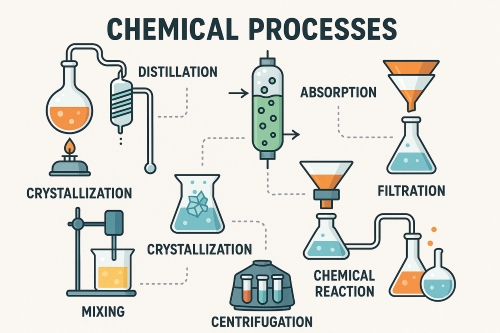
Chemical and Physical Properties Relevant to Catalysis
Vanadium is a transition metal. It offers several oxidation states such as +3, +4, and +5. This trait makes the material flexible for participating in redox reactions. When used in powder form, the surface area is high. The high surface area improves its interaction with other chemicals during reactions. This is a vital factor in a catalyst.
The particle size of Vanadium Powder also matters. Smaller particle sizes lead to higher reactivity. In many cases, powders with particle sizes ranging from tens to hundreds of nanometers are favorable. Recent industrial data show that when the overall surface area increases, the catalytic performance improves. The powder can be mixed with other materials as a support to improve its durability and resistance to harsh conditions.
From a physical point of view, Vanadium Powder has a crystalline structure that can be altered by treatment methods. This adjustment helps tailor the powder to work under specific temperature ranges or conditions. In addition, the powder is used in both homogeneous and heterogeneous catalytic systems. In homogeneous systems, it mixes in the reaction solution. In heterogeneous schemes, Vanadium Powder sits on the surface where reactions occur. Both setups benefit from its ability to change oxidation states rapidly.
The chemical makeup of the powder remains consistent compared to its bulk form. However, the high surface area permits a more efficient interaction with reactants. In many oxidation reactions, Vanadium Powder assists in breaking down molecular bonds. This yields more efficient reaction rates and improved yields. The materials used in the catalytic process are often combined with acids or bases to optimize performance. The well-known example is its use in oxidation processes in the chemical industry where temperature ranges from 150°C to 300°C are common.
Major Catalytic Applications
Vanadium Powder is well established in several catalytic applications. One notable example is its role in selective oxidation reactions. In these reactions, the powder helps convert organic compounds to their oxygenated forms. This is helpful in the production of fine chemicals and pharmaceuticals.
Another key area of use is the selective catalytic reduction of nitrogen oxides in exhaust gases. In this application, Vanadium Powder is used to reduce harmful gases. The powder works at moderate temperatures. This has made it a popular choice in environmental control systems for vehicles and industrial smokestacks.
The material is also used in petroleum refining. Its catalytic properties help in the breaking down of heavy oil fractions into lighter, more useful products. Engineers have found that vanadium-based catalysts show stability and resistance to deactivation over long usage periods. Common processes include hydrocracking and fluid catalytic cracking. In these operations, the catalyst is essential for quality and yield of fuels.
Vanadium Powder is useful in oxidation processes in chemical production. For example, its use in converting sulfur dioxide to sulfur trioxide has long been a benchmark in catalyst application. This reaction is crucial for the production of sulfuric acid. Sulfuric acid remains one of the most widely used chemicals in the world. The role of vanadium in this process is a fine example of industrial catalysis done right.
Some research cases show that Vanadium Powder can also assist in polymerization reactions. Its controlled performance leads to better molecular weight distribution in polymers. The results have practical benefits in polymer production, where consistency is important.
Conclusion
Vanadium Powder is a valuable catalyst. Its chemical and physical properties help drive many industrial reactions. With its ability to shift oxidation states and high surface area, it has been a trusted material for oxidation, reduction, and polymerization reactions. Industries from petrochemicals to environmental engineering rely on its performance. For more information, please check Stanford Advanced Materials (SAM).
Frequently Asked Questions
F: What makes Vanadium Powder an effective catalyst?
Q: Its variable oxidation states and high surface area boost reaction rates.
F: Which industrial process uses Vanadium Powder in
environmental control?
Q: It is used in selective catalytic reduction to lower harmful nitrogen oxide
levels.
F: Does Vanadium Powder work in both homogeneous and
heterogeneous systems?
Q: Yes, it is effective in both types of catalytic systems.

 Chin Trento