Products
 Bars
Bars
 Beads & Spheres
 Bolts & Nuts
 Crucibles
 Discs
Discs
 Fibers & Fabrics
 Films
Films
 Flake
Flake
 Foams
Foams
 Foil
Foil
 Granules
 Honeycombs
 Ink
Ink
 Laminate
 Lumps
Lumps
 Meshes
 Metallised Film
 Plate
Plate
 Powders
 Rod
Rod
 Single Crystals
 Sputtering Target
 Tubes
Tubes
 Washer
 Wires
Wires
 Converters & Calculators
 Write for Us



Vanadium vs Chromium in Thermal Spray Coating Systems

Introduction
Thermal spray coating systems protect components from corrosion and wear. Vanadium and chromium are key components of such coatings. They have different properties, which affect their behavior under extreme conditions. Here in this article, we look at how vanadium is different from chromium.
Material Properties Overview
Vanadium is a ductile, lightweight metal. It has a density of about 6.0 grams per cubic centimeter, lower than the about 7.2 grams per cubic centimeter of chromium. Vanadium melts at about 1910°C. The metal has a good mix of strength and toughness. Its microstructure, in most cases, maintains hard coatings with some ductility.
Chromium has a melting point of around 1907°C. Chromium is an extremely hard, corrosion-resistant metal. Its oxide forms a protective layer that prevents metal surfaces from further corroding. In thermal spray applications, chromium produces coatings that are long-lasting and robust. Its high temperature application behavior is very reliable.
Findings from various studies indicate that as thermal spray feedstock, vanadium would tend to create wear-resistant coatings with a lower density. Meanwhile, chromium coatings would be slightly thicker with an extremely smooth and even structure. These become critical in deciding which best material to suit a particular industrial use.
Thermal Spray Processing Considerations
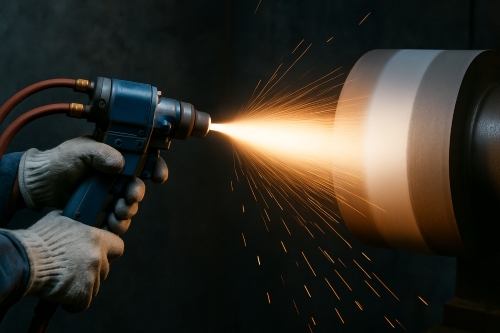
The thermal spray process relies on melting a powder feedstock and blowing it onto a surface. Here, the physical characteristics of the feedstock are significant. Vanadium particles can be more easily melted in some systems. They are less prone to premature oxidation. One should be careful, however, not to apply too high a flame temperature.
Chromium powders also need to be carefully controlled. They are more prone to form an oxide layer before reaching the substrate. This oxide layer can promote or prevent adhesion of the coating, depending on the process parameters. Operators often adjust the particle size and kinetic energy to improve the quality of the coating for both metals.
Temperature control and spray distance are important factors. Practically, technicians use process conditions that maintain optimum temperature. They use calibrated gas flows and particle velocities. For instance, a flame temperature of about 2500°C and controlled spray distance can help generate a uniform coating with fewer oxides in both metals. Such factors help ensure more predictable performance when the coating is put into service.
Performance Comparison
Vanadium and chromium both have their own benefits when utilized in thermal spray coating. Vanadium coatings are typically good at resisting wear. They work nicely in applications where the surface will come in contact with erosion caused by particles or liquid splashing. Vanadium coatings have been shown in laboratory testing to reduce wear by up to 20 percent compared to uncoated surfaces.
Chromium coatings often offer better corrosion resistance. They are favored in applications where moisture and aggressive chemicals destroy the substrate. Chromium coatings stand the test of time when applied to components in industrial ovens or marine hardware. Performance testing indicates that chromium's protective oxide layer can cut corrosion rates by up to 30 percent under severe conditions.
The relative performance of the coatings is substrate- and environment-dependent. At high friction, vanadium can offer reduced thermal stress. For chemical resistance under long-term exposure to acids, chromium remains a very good choice. With the knowledge of the performance of each metal, one can make a practical choice.
Industrial Applications
Industries choose these metals based on the issues they face on a daily basis. Vanadium coatings are common in industries where wear is the main concern. For example, hydraulic turbine parts, cutting tools, and high-wear devices often feature vanadium thermal spray coatings. In auto and aerospace components, minimum weight and acceptable wear resistance are some of the primary concerns.
Chromium coatings find application where corrosive environments are encountered. The typical applications include parts for chemical plants, marine hardware, and furnace parts at elevated temperatures. In most cases, the formation of a stable oxide film of chromium improves the life of the part under aggressive environments. Both metals have also been utilized in turbine blades and industrial compressors where reliability is of concern.
Engineers and technicians refer to case studies wherein vanadium coatings reduced downtime due to abrasive wear. In similar applications, chromium coatings have reduced maintenance costs through resistance to corrosion. These detailed lessons from many real-world applications have allowed industries to match material properties to specific requirements.
Comparison Table
|
Property |
Vanadium Coating |
Chromium Coating |
|
Density |
Approximately 6.0 grams/cubic centimeter |
Approximately 7.2 grams/cubic centimeter |
|
Melting Point |
Around 1910°C |
Around 1907°C |
|
Hardness |
Moderately hard with good ductility |
Very hard with high resistance to abrasion |
|
Oxidation Behavior |
Lower oxidation risk under controlled conditions |
Forms a protective oxide layer for corrosion resistance |
|
Wear Resistance |
Excellent under abrasive conditions |
Good, but performance is best for corrosion resistance |
|
Industrial Focus |
Hydraulic turbines, cutting tools, high friction applications |
Chemical plants, marine equipment, high-temperature environments |
|
Process Consideration |
Even melting, lower risk of premature oxidation |
Careful control needed to manage oxide formation |
For more information, please check Stanford Advanced Materials (SAM).
Conclusion
Both chromium and vanadium give positive attributes to thermal spray coating systems. Vanadium is a light metal with excellent wear resistance that's well-suited to mechanical components and reducing friction. Chromium has good corrosion resistance with a smooth, hard surface. Your choice will depend on the specific needs of the application and the environment.
Frequently Asked Questions
F: What is one benefit of vanadium coatings?
Q: They provide excellent wear resistance in abrasive environments.
F: How does chromium help in corrosive environments?
Q: It forms a protective oxide layer that reduces corrosion.
F: What industries commonly use these thermal spray coatings?
Q: Industries like automotive, aerospace, and chemical processing use these coatings.
 Chin Trento