
 Products
 Bars
Bars
 Beads & Spheres
 Bolts & Nuts
 Crucibles
 Discs
Discs
 Fibers & Fabrics
 Films
Films
 Flake
Flake
 Foams
Foams
 Foil
Foil
 Granules
 Honeycombs
 Ink
Ink
 Laminate
 Lumps
Lumps
 Meshes
 Metallised Film
 Plate
Plate
 Powders
 Rod
Rod
 Single Crystals
 Sputtering Target
 Tubes
Tubes
 Washer
 Wires
Wires
 Converters & Calculators
 Write for Us



The Strengthening Effect of Vanadium Powder in Steel Alloys

Introduction
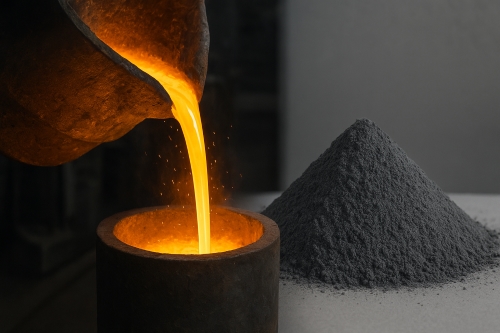
Alloys of steel are applied in numerous day-to-day applications. Increasing their strength can result in more durable products. Vanadium powder is among the microalloying elements that can enhance steel performance. In this paper we explore vanadium's role in strength and durability improvement.
Strengthening Mechanisms of Vanadium in Steel
1. Solid Solution Strengthening
When a portion of the iron atoms in the steel lattice is replaced by vanadium atoms, the crystal structure becomes more resistant to the movement of dislocations. This is known as solid solution strengthening. Vanadium atoms produce local lattice distortions within the crystal lattice. Such distortions are barriers to dislocations. The degree of strengthening depends on the amount of vanadium and its solubility in steel.
2. Precipitation Hardening
One of the primary strengthening mechanisms is precipitation hardening. On cooling after heat treatment, the very fine carbides of vanadium are precipitated. Vanadium carbides are typically small in size, usually ranging from 10 to 50 nanometers. This pins the dislocations, thereby inhibiting their movement. The hardness and the yield strength of the alloy are improved with this effect. Steel with vanadium carbides has, in practice, been utilized in the construction of buildings and also in automobile parts where high strength is needed.
3. Grain Refinement
Vanadium also refines the steel grain size by heat treatment. The smaller grain size gives a better balance of strength and toughness. The addition of vanadium promotes more uniform nucleation on recrystallization. The resulting fine grain structure improves mechanical stability. Structural steels nowadays tend to utilize vanadium grain refinement where a combination of strength and toughness is needed.
4. Dispersion Strengthening in Powder Metallurgy
In powder metallurgy, vanadium powder is mixed with other metal powders to create a homogeneous mixture. Controlled blending disperses the vanadium carefully. The uniform distribution creates a dispersion of hard vanadium particles. The particles act as small-scale reinforcements within the steel matrix. This results in enhanced resistance to deformation under load. The process is particularly useful for the production of complex shapes with enhanced performance properties.
Conclusion
Vanadium powder has a clear edge in strengthening and reinforcing steel alloys. Its intrinsic properties validate its role in solid solution strengthening, precipitation hardening, grain refining, and dispersion strengthening. Processing methods, either via powder metallurgy or direct alloying, ensure vanadium's effective contribution to final products.
Frequently Asked Questions
F: Does vanadium strengthen steel?
Q: Yes, vanadium increases yield strength and toughness in steel alloys.
F: What do vanadium carbides do in steel?
Q: Vanadium carbides seal off dislocations and harden the steel by precipitation hardening.
F: Is powder metallurgy used for vanadium alloying?
Q: Yes, powder metallurgy ensures homogeneous dispersion of vanadium for better reinforcement.
 Chin Trento