
 Products
 Bars
Bars
 Beads & Spheres
 Bolts & Nuts
 Crucibles
 Discs
Discs
 Fibers & Fabrics
 Films
Films
 Flake
Flake
 Foams
Foams
 Foil
Foil
 Granules
 Honeycombs
 Ink
Ink
 Laminate
 Lumps
Lumps
 Meshes
 Metallised Film
 Plate
Plate
 Powders
 Rod
Rod
 Single Crystals
 Sputtering Target
 Tubes
Tubes
 Washer
 Wires
Wires
 Converters & Calculators
 Write for Us



Catalytic Uses of Niobium Materials

1. Introduction
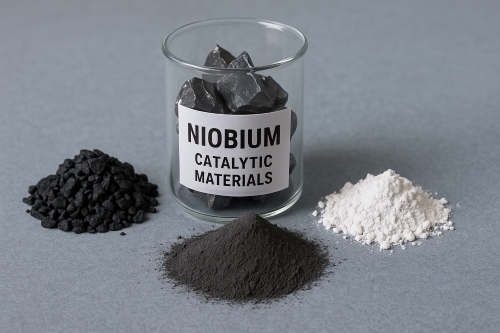
Niobium has a very rich metallurgical and chemical engineering history. It has played a vital role in governing catalytic processes in many industries. In this article, we feel the charm of niobium materials.
2. Catalytically Important Properties of Niobium
Niobium is marked by a series of advantageous properties. Its stability in terms of heat leads it to be satisfactory under reactions at high temperatures. Acid-base equilibrium at the surface has a tendency to enhance reaction rates. Niobium has unique redox character that is effective in oxidation-reduction reactions. Its poisoning resistance by contaminants in most circumstances distinguishes it from other materials. For instance, some information show that niobium-based catalysts remain active even after long usage at high temperatures. That reliability is why most industries turn to niobium.
3. Niobium-Based Catalysts
3.1 Niobium Pentoxide
Niobium pentoxide has been used as a catalyst for many years. Surface properties allow it to facilitate acid-catalyzed reactions. Some processes, including hydrocarbon cracking, are improved by its resistance. Hardness is the reputation of niobium pentoxide, but it can also get the job done under harsher conditions. This capability makes it ideally suited for continuous industrial operations.
3.2 Niobates
Niobates are niobium alkali metal compounds. They are very common in various chemical conversions. Sodium niobate and potassium niobate are two such typical examples. They have a very excellent balance of acid and base sites. Their amenability is well suited for redox reactions as well as condensations. Often, they are used in fine chemical synthesis and environmental catalysis. Many real-life examples show better yields when these materials are used.
3.3 Niobium-Doped Oxides
If a small amount of niobium is added to ordinary metal oxides, the compound has superior traits. Doped niobium oxides show higher activity in chemical reactions. They dominate the application of methanol conversion and hydrocarbon oxidation. The doping process typically stabilizes the catalyst. Researchers have cited that even a small percentage of niobium can modify the surface of the catalyst, which results in greater performance. These modifications function well in a broad variety of industrial applications.
3.4 Supported Niobium Catalysts
Supported niobium catalysts use a support material as a carrier for niobium complexes. Silica and alumina are common supports. The catalysts possess the advantages of both niobium and support. The support provides high surface area and stability. The combination imparts high dispersion and easier access to the sites of reaction. Industrial research shows that the catalysts are cheaper and stable in long-term operation.
4. Industrial Applications
Niobium materials are widely used in chemical and petrochemical industries. The catalysts find use in reforming, cracking, and oxidation reactions. They find their influence in the production of fine chemicals and drugs as well. Niobium catalysts are helpful for waste stream purification and emission reduction in environmental processes. Some recent efforts are there to use them in fuel cells and biofuel production. Process reliability and catalyst durability are crucial in all these applications. Experience demonstrates that the industries record lower downtime when niobium-based catalysts are employed. This is based on data from European and Asian plants which have implemented the catalysts over decades.
Conclusion
Niobium use in catalysts is a viable choice for the majority of industries. Its unique properties are a serious advantage against hostile conditions. Materials based on niobium in various forms offer support to satisfy different reaction demands. The acceptable behavior of niobium pentoxide, niobates, niobium-doped oxides, and supported catalysts is shown. The materials show their worth in traditional and prospective industrial applications. For more information, please check Stanford Advanced Materials (SAM).
Frequently Asked Questions
F: Why are niobium materials suitable for high-temperature reactions?
Q: Their high thermal stability and robust surface chemistry allow them to meet high-temperature demands.
F: How do niobium-doped oxides contribute to catalyst performance?
Q: They alter the surface properties to enhance activity and provide enhanced stability in reactions.
F: What are typical uses of supported niobium catalysts?
Q: They have wide applications in hydrocarbon reforming, oxidation reactions, and pollution treatment processes.


 Chin Trento