
 Products
 Bars
Bars
 Beads & Spheres
 Bolts & Nuts
 Crucibles
 Discs
Discs
 Fibers & Fabrics
 Films
Films
 Flake
Flake
 Foams
Foams
 Foil
Foil
 Granules
 Honeycombs
 Ink
Ink
 Laminate
 Lumps
Lumps
 Meshes
 Metallised Film
 Plate
Plate
 Powders
 Rod
Rod
 Single Crystals
 Sputtering Target
 Tubes
Tubes
 Washer
 Wires
Wires
 Converters & Calculators
 Write for Us



Advanced Vanadium Powder Made Next-Generation VRFB Materials

Introduction
Vanadium redox flow batteries are a promising component of our energy future. They exhibit long cycle life and safe operation. Vanadium powders utilized in our battery systems can be made to improve performance.
Fundamentals of Vanadium Redox Flow Batteries
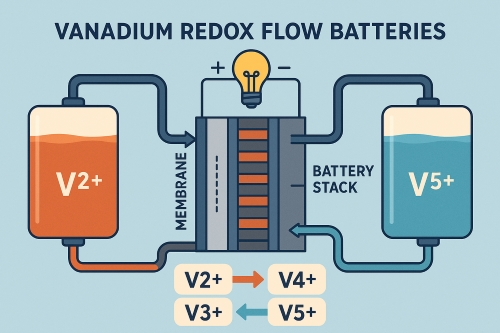
Vanadium redox flow batteries use liquid electrolytes. The battery stores energy in the form of vanadium ions. These ions interchange their oxidation state to store or release electricity. The battery has two tanks connected through a flow system. When one needs energy, the fluid flows through a cell stack where the reaction produces electricity.
The structure has several benefits. The batteries are easily scalable by increasing the sizes of the tanks. They have low safety risks because the liquids are in containment. In standard conditions, a vanadium battery can endure over 10,000 cycles. They are used in grid storage programs in many countries. Companies typically give examples of situations where these batteries stabilize renewable energy supply. The method is tested and proven to be safe and effective.
Vanadium Powder as Source Material
Vanadium powder also forms an essential part in the production of these batteries. The powder is a source material for vanadium electrolyte. The powder establishes the purity and performance of the final battery. In most cases, higher grade vanadium powder yields a more stable battery reaction. For example, research shows that 99.5% pure vanadium powder has improved battery efficiency in comparison to lower grades of powders.
On the manufacturing level, raw vanadium ore is utilized. That raw vanadium ore is purified into powder. Then the powder undergoes further processing to realize the required oxidation states required in the battery reaction. A good example is the utilization of vanadium pentoxide (V2O5). That is reduced to generate the lower oxidation states. In our research, purification methods such as calcination and reduction are not rare.
Evidence indicates that treatment of vanadium powder with care increases the surface area and reactivity. Increased reactivity means that vanadium species will move at higher rates while discharging and charging. In practical cases, laboratory reports from battery labs showed higher efficiency by as much as 5% with highly optimized vanadium powders. Such evidence suggests that improved powders directly affect overall battery performance.
Advanced Vanadium Powder Material Types
A number of types of vanadium powder are utilized nowadays. There are powders that are chemically purified and there are those that are produced through physical means. One of these is high-purity vanadium oxide powders. Such type of powder has a homogeneous chemical constitution. These type of powders produce consistent battery reactions. They are usually found in large research laboratories.
There is another form, which is mechanically milled vanadium powder. Mechanical milling breaks down particles to a very fine extent. This increases the surface area available for chemical reactions. In some examples in the real world, this fine powder increased reaction transmission rates. This has implications for battery function over a large number of cycles.
Additives are used in certain high-tech materials. The particle shape and size are regulated by the use of additives. Spherical particles are responsible for more stable battery performance. A particular instance in a battery factory that is comparable to this stated adding nanostructured additives inhibited particle agglomeration. That equated to higher current densities when used and more stable battery performance.
Both chemically created and mechanically purified vanadium powders are important. Both have a specific function to serve to enhance the properties of the electrolyte. The proper one to use would be determined by what the application requires and the architecture of the battery system. Simply put, better powders mean better vanadium systems.
Conclusion
New vanadium powder materials hold great promise for the next generation of vanadium redox flow batteries. They help enhance the chemical reactions that are crucial to storing energy. Small steps forward in processing are already delivering better performance and longer battery life. Small adjustments to the powder obviously make a big difference.
Frequently Asked Questions
F: What are vanadium redox flow batteries used for?
Q: They are used in energy storage and backup power systems on a large scale.
F: Why is vanadium powder purity important?
Q: High purity enhances battery stability and efficiency on discharge and charge.
F: What's the enhancement with mechanical milling?
Q: It increases surface area, which increases reaction rate and battery performance.
 Chin Trento