Products
 Bars
Bars
 Beads & Spheres
 Bolts & Nuts
 Crucibles
 Discs
Discs
 Fibers & Fabrics
 Films
Films
 Flake
Flake
 Foams
Foams
 Foil
Foil
 Granules
 Honeycombs
 Ink
Ink
 Laminate
 Lumps
Lumps
 Meshes
 Metallised Film
 Plate
Plate
 Powders
 Rod
Rod
 Single Crystals
 Sputtering Target
 Tubes
Tubes
 Washer
 Wires
Wires
 Converters & Calculators
 Write for Us



Niobium-Based Materials for Ultra-High Temperature Uses

Introduction
Niobium compounds have established a strong place within high-temperature materials. They function quite effectively even under extremely high temperatures. We shall keep a keen eye on these materials.
Types of Niobium-Based Compounds
There exist several different types of niobium-based compounds that are utilized for ultra-high temperature applications. Most notable among them are niobium carbides, niobium nitrides, and mixed types such as niobium carbonitrides.
Niobium carbide has an extremely high melting point and hardness. Niobium nitride has excellent thermal stability and is typically applied in coatings. Mixture compounds combine the benefits of carbides and nitrides. Engineers prefer combining these compounds under practical application for the sake of satisfying some high-temperature uses. Material
Properties Relevant to Ultra-High Temperature Applications
The key feature of these compounds is their high material properties. They offer extremely high melting points with some reaching as high as 3500°C. They also maintain strength at temperatures that many metals would fracture at. For example, the melting point of niobium carbide is about 3610°C.
Many tests have confirmed that such materials have good oxidation resistance. They can withstand thermal shock when the temperature is changing suddenly. Niobium nitride coatings on substrate metals have shown low weight gain on oxidation in laboratory tests. Such properties help the materials to remain stable for long durations in extreme conditions.
Synthesis and Processing Techniques
We use various synthesis techniques to obtain high-quality niobium compounds. Some of the most used are sintering and hot pressing. They allow us to blend powders under high pressure and temperature.
There are other techniques that involve chemical vapor deposition. Thin films of niobium compounds are deposited on substrates in this instance. The process provides excellent adhesion and uniformity of thickness. The right method needs to be chosen as proper processing improves the overall material quality.
Applications of Niobium-Based Compounds in Ultra-High Temperature Situations
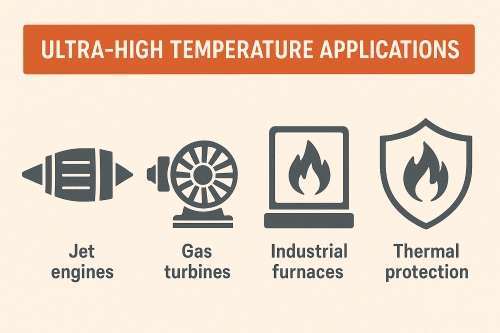
They are found in space, especially in rocket nozzles and heat shields. An example is a rocket nozzle, which can pass temperatures of over 3000°C during operation.
Niobium nitride coatings are used in turbine blades and other engine parts. In industries involving metallurgy, the compounds are used to provide the components with integrity at extremely high heat. With good properties, they are a wonderful choice for lasting parts that do not fail.
Performance is also enhanced when niobium compounds are employed in composite materials. Niobium compounds are mixed with other compounds like titanium or carbon-based materials by engineers. The result is toughness-enhanced composite and enhanced thermal resistance.
Niobium nitride coatings or as additions to layers can be employed for protecting base metals. They reduce oxidation and wear. Results of industrial tests in many instances prove that coated materials are 20% more effective in thermal shock resistance. The benefit is crucial to articles such as engine components and protective barrier layers.
Comparison with Other Ultra-High Temperature Materials
With respect to other ultra-high temperature materials, niobium compounds possess some advantages. Some of these materials, such as tungsten and zirconium diboride, also have some uses in extreme conditions.
Tungsten offers high melting points but is heavy and may not be as oxidation-resistant as niobium compounds. Zirconium diboride is promising but is expensive and hard to process. Niobium compounds in many actual applications have been shown to provide an ideal balance between performance and cost. This balance is paramount in aerospace and industrial usage.
Current Research and Future Directions
Current work in this field is moving further toward niobium compound structure and processing. Researchers are experimenting with new composite materials combining niobium compounds with other temperature ceramics.
Nanocomposite coatings are also a research topic which can further improve oxidation resistance. Others are creating more advanced chemical vapor deposition techniques. These studies aim at creating materials which are more durable even in extreme environments. Consistent improvement in such directions is opening the door to greater industrial applications in the coming years.
Conclusion
Niobium compounds offer many benefits in uses at ultra-high temperatures. They possess high melting points, good thermal stability, and oxidation resistance.
Frequently Asked Questions
F: How is the temperature resistance of niobium carbide?
Q: It can withstand over 3500°C in some applications.
F: How are niobium nitrides applied in engine parts?
Q: They form an oxide shield that reduces oxidation and thermal shock.
F: Do composites raise the toughness of niobium compounds?
Q: Yes, composites add toughness and extend the material service life.
 Chin Trento