
 Products
 Bars
Bars
 Beads & Spheres
 Bolts & Nuts
 Crucibles
 Discs
Discs
 Fibers & Fabrics
 Films
Films
 Flake
Flake
 Foams
Foams
 Foil
Foil
 Granules
 Honeycombs
 Ink
Ink
 Laminate
 Lumps
Lumps
 Meshes
 Metallised Film
 Plate
Plate
 Powders
 Rod
Rod
 Single Crystals
 Sputtering Target
 Tubes
Tubes
 Washer
 Wires
Wires
 Converters & Calculators
 Write for Us



Something regarding Strontium Barium Niobate

Introduction
Strontium Barium Niobate is a compound that has been of interest to many scientists. It has been used in devices that play with light and electricity. Many industries and laboratories use it in sensors and optical circuits. This short paper shows how its structure leads to desirable behaviors and how changes of composition can change its function.
Physical and Chemical Properties
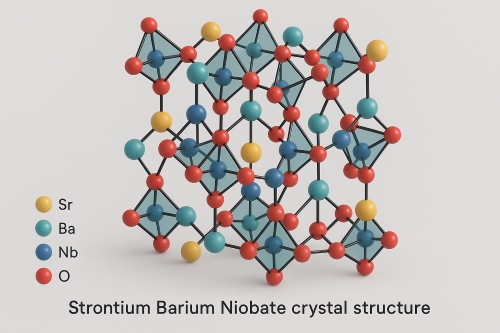
Strontium Barium Niobate has a unique tungsten bronze type structure. Its chemical composition is represented as SrₓBa₁₋ₓNb₂O₆. The ratio of strontium to barium is in most cases made to vary for maximising particular properties. For instance, it is ferroelectric as well as having a high dielectric constant. Its dielectric constant has been found to be approximately 1000 at room temperature under exact conditions. Its crystal structure gives it an anisotropic refractive index, which is generally as high as 2.3. These numbers work if the material is used in optical circuits.
The material is also highly optically nonlinear. This is common in materials found in dynamic holography and in fast light switching. Some experiments have shown that the electro-optic coefficient can be maximized with proper control of the ratio of Sr/Ba. The light-modulating behavior is critical in devices that deal with optical signal processing. By the fundamental chemistry and physics of Strontium Barium Niobate, it is stable to use when stability and transparency are required.
Synthesis and Fabrication Methods
Preparation of Strontium Barium Niobate is done through a combination of old methods and modern techniques. Researchers use the method of solid state reaction as it offers a simple technique. In this method, powders of oxide of barium, strontium, and niobium are mixed together. The mixture is subsequently melted at temperatures often over 1200°C. Most laboratories use the molten salt method instead. This process possesses the capability of lowering processing temperature and achieving better crystallinity. I have observed that chemical solution deposition is another very promising process. It yields good composition control at a microscopic scale.
These methods yield crystals with less defects. This is important where the material is to be used in important optical devices. Each method has its benefits and drawbacks. For most industrial machinery, dependence on communal experience is utilized in choosing the optimal procedure. Fabrication consistency has been found to be crucial, especially when the material is integrated into sensors and dynamic display components.
Applications
Strontium Barium Niobate is used extensively in technical applications. It is a light modulation medium in optical data storage. Strontium Barium Niobate is applied in devices controlling light beams in dynamic holography. Strontium Barium Niobate is used by certain microwave and mobile communication filters due to its dielectric properties. It is also a common application when used in electro-optic modulators. In these devices, its ferroelectric properties ensure better performance and stability.
This material has also been investigated for photorefractive applications. They are used in light processing circuits. In a majority of high-speed optical circuits, the tunability of the refractive index becomes a valuable asset. Real-life applications include beam steering of light and arrays for optical switching. Stable performance over long times have been pointed out by my colleagues as an advantage for Strontium Barium Niobate in a number of practical devices.
Effect of Strontium to Barium Ratio on Material Properties
The ratio of strontium to barium is the key for material calibration. Higher concentrations of strontium tend to strengthen ferroelectric characteristics. Higher composition of barium can shift the balance toward enhanced pyroelectricity. In practice, researchers tend to have a Sr/Ba ratio that is in the vicinity of 0.6 to 0.4. This ratio gives a calibrated response. When the composition is diversified, the optical and dielectric properties change considerably. In the majority of experiments, outcomes change by minor alterations in the proportion. This tells us that control should be exerted while production takes place. Even expert scientists are cautious regarding this balance, ensuring device performance meets some standards.
Development in Strontium Barium Niobate-Based Products
There have been advancements in Strontium Barium Niobate-based products recently. Advances in processing technologies have yielded fewer defective crystals and better uniformity. New processes involve the utilization of small dopants. These dopants help in modulating the optical and electrical properties further. Investigations on nano-scale structures have provided new information on its functionality. Some of the recent tests display more stable switching behavior of the optical devices. These advancements have generated increased interest among engineers working in telecommunications and photonics.
All these technological developments have made us better understand the material. They have illustrated how small design adjustments can lead to significant improvements in performance. Greater knowledge has encouraged further research and development. It is great to know that even an established material can surprise us with new things when given respect and attention.
Conclusion
Strontium Barium Niobate remains a functional and effective material in modern technology. It offers significant physical and chemical characteristics that are essential in various optical, electronic, and ferroelectric applications.
Frequently Asked Questions
F: What are the main applications of Strontium Barium Niobate?
Q: It is found in optical modulators, dynamic holography, sensors, and microwave devices.
F: How is Strontium Barium Niobate usually processed?
Q: It is conventionally prepared by solid state reaction, molten salt method, and chemical solution deposition.
F: What happens if the ratio of strontium to barium is changed?
Q: Alteration in the ratio changes its ferroelectric, dielectric, and optical characteristics for a specified application.
 Chin Trento