Products
 Bars
Bars
 Beads & Spheres
 Bolts & Nuts
 Crucibles
 Discs
Discs
 Fibers & Fabrics
 Films
Films
 Flake
Flake
 Foams
Foams
 Foil
Foil
 Granules
 Honeycombs
 Ink
Ink
 Laminate
 Lumps
Lumps
 Meshes
 Metallised Film
 Plate
Plate
 Powders
 Rod
Rod
 Single Crystals
 Sputtering Target
 Tubes
Tubes
 Washer
 Wires
Wires
 Converters & Calculators
 Write for Us



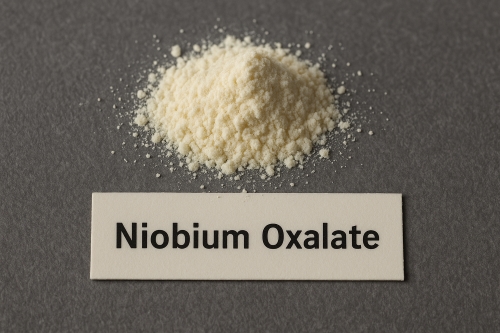
Niobium Oxalate for Nanomaterials and Composites

Properties of Niobium Oxalate
Niobium oxalate is a stable compound under normal conditions. It has a typical crystalline structure that makes it beneficial as a precursor in nanomaterial production. Decomposition takes place in the compound when it is subjected to heat treatment to produce niobium oxide. The resulting oxide is excellent regarding mechanical strength and electric conductivity. The compound also has an excellent surface area. This characteristic makes its application possible in catalysts and sensors. For example, technical reports tell us that niobium oxalate possesses thermal stability up to 600°C. That data supports its use in high-temperature applications. It is in fact a stable compound for industrial and lab processes.
Role in Nanomaterial Synthesis
The compound is used as a starting material for the synthesis of various nanoscale materials. Niobium oxalate is used as a precursor to niobium oxide nanoparticles. The clean decomposition under conditions of protection is essential. This is the process that is credited with the formation of nanomaterials of uniform sizes. Reproducible experiments have proven that the resulting particles are 20 to 80 nanometers in size. Many producers use niobium oxalate to achieve specific particle distributions. The process is simple and reproducible. Use of niobium oxalate facilitates the achievement of targeted morphologies and uniform phases in the final product. This enhances the functionality of multifunctional composites and electronic devices.
Advanced Applications of Niobium Oxalate
Uses of niobium oxalate extend far beyond being applied as a precursor. Current practice includes its use for designing the nanostructure of multifunctional composites. Scientists have fabricated composites with improved dielectric properties as well as higher thermal conductivity. In one case, a blend of niobium oxide nanoparticles, derived from niobium oxalate, was filled into polymer matrices. This improved the strength and wear and tear resistance of the composite. Sensors developed with such nanoparticles, in one other application, have registered high sensitivity towards chemical changes. The material is used in energy storage devices, such as lithium-ion batteries. It has been proven that adding niobium oxide enhances battery life and performance. I have found that these developments are due to intense particle-particle interactions and substantial active surface area. These developments impact daily life by enhancing the life of consumer electronics and industrial appliances.
Further reading: Applications of Niobium Oxalate in Fine Functional Materials
Processing Routes from Niobium Oxalate to Functional Materials
There exist several routes for processing from niobium oxalate to functional materials. Thermal decomposition is among the most common routes. In this procedure, the compound is thermally decomposed under controlled conditions. Decomposition of niobium oxalate is done by heat to produce niobium oxide. The procedure is carried out at temperatures ranging from approximately 500°C to 700°C. The second process is the sol-gel process. In this procedure, a sol of niobium oxalate is formed and then gelled to produce a network structure. The gel formed is dried and then calcined to produce the desired functional material. Both processes have their benefits. The process of thermal decomposition is faster. The sol-gel process offers better control over the pore structure of the product. With time and use in industrial settings, the two processes have been found to work. They allow for the fabrication of composites carefully tailored to satisfy specific performance requirements in electronics and structural applications.
Conclusion
Niobium oxalate is a key to higher nanomaterials and multi-functional composites. Its universal thermal and chemical nature is useful in making nanomaterials with enhanced properties. For more niobium products, please check Stanford Advanced Materials (SAM).
Frequently Asked Questions
F: What is the primary use of niobium oxalate in material synthesis?
Q: It serves as a precursor for niobium oxide nanoparticles.
F: In what ways does the application of niobium oxalate improve composite materials?
Q: It increases thermal stability and electrical conductivity.
F: What is the most common process for converting niobium oxalate into useful materials?
Q: Thermal decomposition is most commonly used to convert niobium oxalate.
 Chin Trento