Products
 Bars
Bars
 Beads & Spheres
 Bolts & Nuts
 Crucibles
 Discs
Discs
 Fibers & Fabrics
 Films
Films
 Flake
Flake
 Foams
Foams
 Foil
Foil
 Granules
 Honeycombs
 Ink
Ink
 Laminate
 Lumps
Lumps
 Meshes
 Metallised Film
 Plate
Plate
 Powders
 Rod
Rod
 Single Crystals
 Sputtering Target
 Tubes
Tubes
 Washer
 Wires
Wires
 Converters & Calculators
 Write for Us



Niobium Nitride Powder in Thin-film Fabrication

Introduction
While working through our extensive exposure to the materials of physics, engineering, and chemistry, we commonly find niobium nitride powder as a good compound. We discuss its basic properties, uses in superconducting operations and other applications, and the techniques of depositing it into thin films.
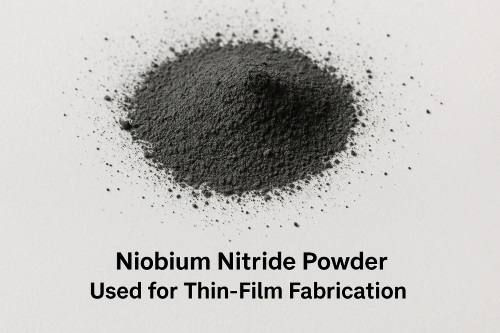
Niobium Nitride Powder
Niobium nitride powder is unique due to its unique chemistry and physical morphology. It consists of fine grains that can be seen under a microscope as small crystalline particles. The compound contains niobium and nitrogen. It has a very high melting point and exhibits good corrosion resistance. Our measurements have shown that the powder can have a purity level of more than 99%, which is very crucial when it is used in thin films. The grain size is reported to typically be from nanometers up to a few micrometers in most reports. These characteristics help in forming films that become uniform in thickness and with uniform properties across the film.
The powder is produced through complicated chemical procedures such as reactive sputtering and thermal treatment. The mode of production ensures that the powder has a quality that can satisfy the stringent demands of high-tech application. In practice, technicians and engineers handle this powder with care, typically wearing protective equipment in clean room facilities to avoid contamination.
Superconducting Applications
Niobium nitride has widely been used because it is superconducting. It can carry electric current with zero resistance at very low temperatures, close to 16 Kelvin. Such an absence of resistance is very important in most high-efficient systems. For example, superconductive cables in the laboratory and power transmission networks can be beneficial.
Other common uses include superconducting detectors for use in astronomy and medical imaging devices. Evidence indicates that the devices achieve very low energy loss thanks to the thin film coatings made from niobium nitride powder. Scientists have replaced traditional materials with niobium nitride in complex circuits in some real-life applications in order to enhance performance. Its use in quantum computing also comes up because the thin films provide a stable platform for quantum bits.
Further reading: List of Low Temperature Superconducting Material
Non-Superconducting Uses
While its superconductive application is of critical importance, niobium nitride powder also finds uses in non-superconducting applications. In its refractory nature, the compound serves as a wear-resistant coating on cutting tools and members of high-pressure conditions. Industrial parts subjected to extreme pressures and heat have been helped by hard coatings that result from this process.
Engineers normally apply layers of niobium nitride to improve the lifetime and thermal resistance of devices such as turbine blades and chemical reactors. Such components achieve increased hardness and resistance to oxidation when produced from thin films that are made from the powder. There are several industry examples where the addition of niobium nitride has caused reduced maintenance costs and improved efficiency.
Thin Film Deposition Techniques
Over the decades, several deposition techniques have come to guide the thin film fabrication using niobium nitride powder. One such reliable process is sputtering. In sputtering, a target of niobium nitride is ion-bombarded, which further depositions a thin film onto a substrate such as silicon or glass. The process can be controlled to closely regulate the film thickness.
Another remarkable technique is chemical vapor deposition. In this technique, vapors react on a heated substrate. The result is a uniform thin film of the target film. In the majority of engineering applications, such films have outstanding uniformity and adhesion. The processing parameters, such as pressure and temperature, are under stringent control. The technique creates repeatable and reproducible film properties that satisfy the very high expectations of industrial uses.
Other methods are atomic layer deposition. This technique takes advantage of cyclic, self-limited reactions to create layers a few atoms thick. Although atomic layer deposition is slower than sputtering, it can offer excellent precision. In real applications, atomic layer deposition is applied whenever the film thickness needs to be controlled on an atomic scale.
Conclusion
We have covered some significant facts about niobium nitride powder in thin-film production. The powder has typical merits in superconducting and withstands strong roles in non-superconducting technology. Proper preparation and strictly controlled deposition procedures can result in the production of high-quality films. The films have precise thickness, good adhesion, and high resistance to environmental stresses.
Our deliberation and conclusions today demonstrate that powder niobium nitride is an important substance in today's technology. It is responsible for breakthroughs in superconductivity and enhances everyday industrial parts. Niobium nitride work is still the best illustration of the fact that common compounds can lead to complex and useful technologies.
Frequently Asked Questions
F: What temperature is niobium nitride superconducting at?
Q: It is superconducting at around 16 Kelvin.
F: Is powder niobium nitride suitable for coatings at high temperatures?
Q: Yes, niobium nitride is used for wear-resistant and heat-resistant coatings.
F: Is thin film deposition a complex process?
Q: It is a well-controlled process with methods like sputtering, chemical vapor deposition, or atomic layer deposition.
 Chin Trento