Products
 Bars
Bars
 Beads & Spheres
 Bolts & Nuts
 Crucibles
 Discs
Discs
 Fibers & Fabrics
 Films
Films
 Flake
Flake
 Foams
Foams
 Foil
Foil
 Granules
 Honeycombs
 Ink
Ink
 Laminate
 Lumps
Lumps
 Meshes
 Metallised Film
 Plate
Plate
 Powders
 Rod
Rod
 Single Crystals
 Sputtering Target
 Tubes
Tubes
 Washer
 Wires
Wires
 Converters & Calculators
 Write for Us



Spherical Copper Powder and Additive Manufacturing

Introduction
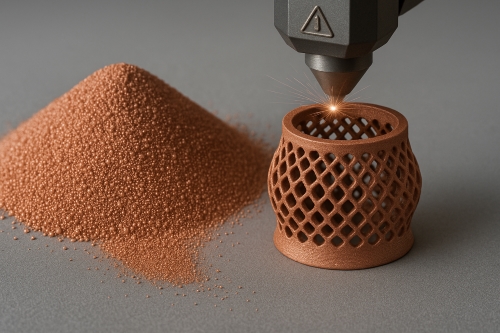
Spherical copper powder is a dominant material used in today's fabrication methods. Its spherical shape prevents agitation flow during the manufacturing process. We will examine the copper challenges, processes to build parts, and the industry's day-to-day uses.
Pure Copper Manufacturing Challenges
Pure copper has high thermal as well as electrical conductivity. Working with pure copper, however, is not easy. The material has high reflectivity and high thermal conductance, and the heat dissipation is extremely fast. In welding or laser processing, the energy can be transferred to the surroundings. This makes it difficult to sustain a uniform melt pool. Copper also oxidizes very quickly. This has implications for the final quality of parts. Other metals are not always prone to these issues. A second challenge is copper density. Spherical particles must be produced carefully. Traditional atomization methods sometimes create elongated particle shapes and impurities. The slightest shape deviation of the particles results in unforeseen behavior during the formation of the layer. Frequent quality control is essential to guarantee that powder meets strict standards. These challenges pressure engineers to develop techniques and equipment to best implement copper in additive manufacturing.
Additive Manufacturing Techniques for Copper Powder
There are various technologies for additive manufacturing. Laser powder bed fusion is one of them. In this technology, a laser beam is precisely controlled to melt each copper layer. Spherical shape allows it to spread the powder evenly in the bed. The manufactured parts have improved density and uniformity.
Electron beam melting is another technology that is used with copper. It uses an electron beam instead of a laser as its source of energy. It is useful in vacuum conditions and can reduce oxidation.
Gas atomization is another common way of producing spherical copper powder. In this process, molten copper is forced through a nozzle and broken into droplets by high-pressure gas. When cooled, these droplets form nearly perfect spheres. Typical particle sizes are 20-100 microns.
Process selection depends on the end product. Process parameters in all cases must be carefully controlled for a stable and reproducible result.
Applications of Spherical Copper Powder in Additive Manufacturing
There are several industrial uses of spherical copper powder.
Because of the high thermal and electrical conductivity of copper, it can be used where high electrical or thermal conductivity is required. For example, components used in heat exchangers and electronic housings are beneficiated by the thermal conductivity of copper. Copper-based components that replace other metals enhance the performance of the majority of industrial cases. In aerospace industries, copper components act to regulate high thermal loads on turbine engines. Copper, in medical implants, is valued for its strength and biocompatibility after alloying with other metals. Output from several industrial trials proved that parts made using copper powder achieved a density of as high as 98%, rendering them almost as resilient as wrought copper.
Another use is the utilization of copper in motor vehicle components. Components utilized in engine cooling can be produced with high precision using additive manufacturing. The spherical size of particles ensures that critical areas avoid formation of weak bonds. Under tests, research has confirmed that parts made using spherical copper powder have lower porosity and better mechanical properties. The findings confirm the shift to additive manufacturing in most industries. The uses in real world are an assurance that ideal processing of copper powder can overcome traditional production obstacles.
Conclusion
Spherical copper powder has excellent potential in additive manufacturing. Copper is used by various industries to electrical, thermal, and structural applications.
Frequently Asked Questions
F: What are common particle diameters of spherical copper powder?
Q: They usually range from 20 to 100 microns.
F: How does copper powder contribute to additive manufacturing?
Q: Its round shape facilitates free flow and even layering.
F: Why is pure copper so hard to work with in manufacturing?
Q: Control is necessary because of high thermal conductivity and quick oxidation.
 Chin Trento