
 Products
 Bars
Bars
 Beads & Spheres
 Bolts & Nuts
 Crucibles
 Discs
Discs
 Fibers & Fabrics
 Films
Films
 Flake
Flake
 Foams
Foams
 Foil
Foil
 Granules
 Honeycombs
 Ink
Ink
 Laminate
 Lumps
Lumps
 Meshes
 Metallised Film
 Plate
Plate
 Powders
 Rod
Rod
 Single Crystals
 Sputtering Target
 Tubes
Tubes
 Washer
 Wires
Wires
 Converters & Calculators
 Write for Us



Thermally Conductive Materials: Spherical Alumina and More

Introduction
Thermal problems are common for many devices and systems. Heat has to be managed appropriately: overheating may lead either to performance losses or to the destruction of equipment. We will review several types of thermally conductive materials. We also closely look at spherical alumina powder.
Thermal Management in Modern Industries
Modern devices generate much heat. The electronic gadgets, engines, and LED lighting units require efficient cooling. In factories and plants, the excess heat lowers efficiency. Industries are concerned with taking away heat from hotspots. Such a process is called thermal management. It employs materials that conduct heat efficiently. It also involves design techniques to dissipate heat. Many industries, such as the automotive industry, aerospace, and electronics industries, depend on good thermal management.
Types of Thermally Conductive Materials
There are several different materials known to carry heat. Common choices include metals. They have a high thermal conductivity. Ceramic materials are another type. They are stable at high temperatures. Other examples include diamond and carbon materials. Each type has strengths and weaknesses. Below are some common types of thermally conductive materials.
|
Type |
Thermal Conductivity (W/m·K) |
Advantages |
Typical Applications |
|
Metals (Copper, Aluminum) |
High (200–400) |
Fast heat transfer, good mechanical strength, easy to process |
Heat sinks, electronic cooling, heat exchangers |
|
Carbon-based Materials (Graphite, Carbon Nanotubes) |
Very high (100–2000) |
Ultra-high thermal conductivity, lightweight, low thermal expansion |
Electronic packaging, composites, aerospace |
|
Oxide Ceramics (Alumina, Zinc Oxide) |
Moderate (20–40) |
Good electrical insulation, high temperature resistance, chemical stability |
Electronic substrates, high-temperature sensors |
|
Nitride Ceramics (Silicon Nitride, Aluminum Nitride) |
High (70–180) |
Strong electrical insulation, thermal stability, high mechanical strength |
High-power electronics cooling, microwave devices |
|
Polymer Composites |
Low to moderate (1–10) |
Lightweight, easy to shape, electrical insulation, low cost |
Electronic packaging, thermal interface materials, thermal pastes |
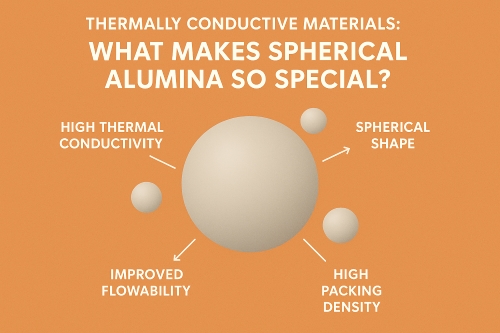
What Makes Spherical Alumina So Special As A Thermally Conductive Material?
Among the ceramic materials, spherical alumina powder is distinctive in its morphology and properties:
- The spherical form provides uniform particle size and shape; better packing density with less voids in composites will enhance heat transfer paths.
- High Purity and Chemical Stability: The intrinsic chemical inertness of alumina provides very good resistance to oxidation and corrosion under severe conditions.
- Good Thermal Conductivity: At a typical conductivity of about 20-30 W/m·K, spherical alumina supports good heat dissipation while allowing electrical insulation.
- Mechanical Strength and Hardness: The rigid structure enhances durability and wear resistance in composite materials.
- Ease of Processing: Its flowability and packing behavior facilitate uniform dispersion in polymeric matrices and ceramic composites.
These characteristics make spherical alumina an ideal candidate for thermal interface materials, insulating substrates, and composite fillers.
Applications of Spherical Alumina Powder
Spherical alumina powder has numerous applications.
One common area of application is electronic packaging. In such cases, it serves to dissipate heat from chips and circuit boards. It is applied in the manufacture of high-performance LED modules.
The same material is used in cars, aircraft, and modern appliances. Spherical alumina is employed in ceramics and insulators to maintain strong structures while efficiently allowing heat to flow out. A device maker mentioned once that their units lasted longer with the switch to spherical alumina components. Another example is the reduction in failure occurrence reported by an LED lighting supplier, in return for increased light output.
The powder can be added to composites for the purpose of improved thermal performance. Some specialized adhesives that require good thermal conduction even use the powder. Spherical alumina is one such material whose demand has gone up in production lines. They are used as an important ingredient when safety and durability are required.
Conclusion
Thermal management is an important concern for many contemporary industries. Among the options, thermal filler materials have long proven that spherical alumina powder is the best option. Its evenly shaped form, purity, and high thermal conductivity make it a well-liked material in engineering. With obvious advantages in the fields of electronic packaging, LED technology, and ceramics, it has earned a place in the modern market.
Frequently Asked Questions
F: For what is the spherical alumina powder used?
Q: It finds applications in electronic packaging, high-performance LED modules, ceramics, and composites for efficient heat management.
F: How does spherical alumina improve thermal management?
Q: Its uniform, round shape increases packing density for better heat flow and consistent thermal conductivity.
F: Is spherical alumina stable at high temperatures?
A: Indeed, it is chemically stable and can maintain its performance under high-temperature conditions.
 Chin Trento