Products
 Bars
Bars
 Beads & Spheres
 Bolts & Nuts
 Crucibles
 Discs
Discs
 Fibers & Fabrics
 Films
Films
 Flake
Flake
 Foams
Foams
 Foil
Foil
 Granules
 Honeycombs
 Ink
Ink
 Laminate
 Lumps
Lumps
 Meshes
 Metallised Film
 Plate
Plate
 Powders
 Rod
Rod
 Single Crystals
 Sputtering Target
 Tubes
Tubes
 Washer
 Wires
Wires
 Converters & Calculators
 Write for Us



What Does A BBO Crystal Do

What Is A BBO (Beta-Barium Borate) Crystal?
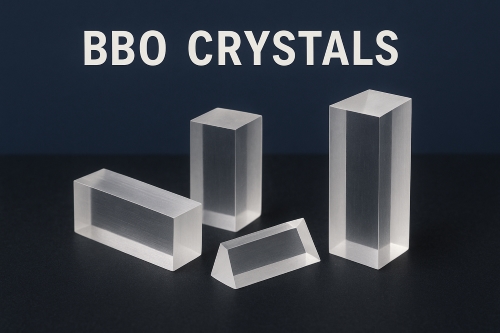
A beta-barium borate crystal is a special optical material. It is made of barium, boron, and oxygen. It has a specific structure that allows it to perform frequency conversion of light. The crystal is cultivated in high-standard laboratories. It is special because its structure makes frequency conversion processes efficient for most processes.
Key Optical and Nonlinear Properties
BBO crystals have properties that make them the favorite of most optical applications. Their transparency ranges from about 189 nanometers in the ultraviolet to 3500 nanometers in the infrared. These ranges make them useful for any application. They have a high damage threshold. That means they are able to handle intense laser beams. They also have a broad phase-matching bandwidth. In other words, such crystals are able to handle diverse kinds of lasers without much tweaking. For instance, in second-harmonic generation, the crystal efficiently transforms the input laser light into half the wavelength. Engineers depend on this crystal for reliable performance in circulating pulses of high energy.
How BBO Crystals Are Used in Frequency Conversion
BBO crystals are of important use when it comes to methods of frequency conversion. Their nonlinear optical properties allow light to mix and alter frequencies. One of its more common applications is in second-harmonic generation, where the wavelength of a laser beam is shortened by a factor of two. Optical parametric amplification processes also make use of BBO crystals. As an example, light which enters the crystal is influenced by the organized atoms present in the crystal. A new light beam with a changed frequency is produced. Most ultrafast laser systems make use of this characteristic. The wavelength-shifting ability allows for the generation of pulses necessary in time-resolved measurements. The capability has made beta-barium borate crystals a critical component of research and industrial laser systems.
Applications in Laser and Photonics
In laser and photonics circuit applications in laboratories, the beta-barium borate crystal stands out. It finds use in ultraviolet light generation devices. It also applies to tunable laser devices and frequency mixing stages. In spectroscopy, the crystal is used to provide light sources for the production of which measurement of different materials becomes feasible. In high-speed optical communication systems, engineers use it too. In both cases, the crystal is used to convert normal laser beams into suitable forms for specific applications. It performs well with high-intensity beams and thus is highly sought after for research purposes as well as for applied use. Small research labs and large industrial labs both have much to benefit from using BBO crystals in their optical systems.
Advantages over Other Nonlinear Crystals
BBO crystals have clear advantages over some other nonlinear materials. They function within a wider range of wavelengths. Their performance remains constant even when high-intensity lasers are applied. This means that the crystal will be less likely to shatter with heavy use. Its phase matching functions within a broader range of wavelengths. In addition, BBO crystals are easier to incorporate in a broad range of optical designs. Engineers often choose them for systems where flexibility and reliability are key. While other materials have some benefits, BBO crystals provide the resilience and efficient frequency conversion that so many real-world applications require.
Further reading: From Structure to Application: Is BIBO or BBO the Better Crystal?
Conclusion
Generally speaking, beta-barium borate crystals are an essential element in many modern-day optical systems. They convert light frequencies, enhance the capability of lasers, and operate well in harsh environments. Their large transparency as well as high nonlinear response position them well for application in a wide variety of applications in laser technology and photonics. For employees in optical laboratories or individuals in the photonics industry, the BBO crystal is a dependable element that brings high performance and flexibility to optical frequency conversion applications.
Frequently Asked Questions
F: What wavelengths can a beta-barium borate crystal handle?
Q: It can handle from roughly 189 nanometers in the ultraviolet to 3500 nanometers in the infrared.
F: How does a beta-barium borate crystal enable frequency conversion?
Q: It uses its nonlinear nature to mix light and convert its frequency, such as reducing the wavelength by half in second-harmonic generation.
F: Why is a beta-barium borate crystal used rather than other nonlinear crystals?
Q: It has a large transparency range, high damage threshold, and broad phase-matching characteristics for efficient use with high-intensity lasers.
 Chin Trento