
 Products
 Bars
Bars
 Beads & Spheres
 Bolts & Nuts
 Crucibles
 Discs
Discs
 Fibers & Fabrics
 Films
Films
 Flake
Flake
 Foams
Foams
 Foil
Foil
 Granules
 Honeycombs
 Ink
Ink
 Laminate
 Lumps
Lumps
 Meshes
 Metallised Film
 Plate
Plate
 Powders
 Rod
Rod
 Single Crystals
 Sputtering Target
 Tubes
Tubes
 Washer
 Wires
Wires
 Converters & Calculators
 Write for Us



Niobium C103 for Space Applications

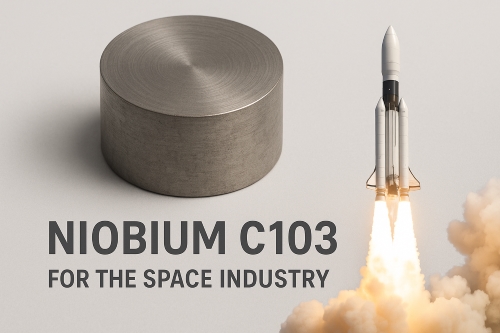
Niobium C103 is a special alloy with some outstanding properties. It is an alloy with great potential to be applied in our space missions. Its strength, lightness, and high-temperature resistance make it well suited for a diverse range of aerospace applications.
What Makes Niobium C103 Suitable for Space Missions?
Meaning of the alloy Niobium C103: This alloy is characterized by good properties at extremely high-temperature applications. Its melting point is about 2,470 °C, and it maintains sufficient properties above 2,000 °C. These temperature properties are typically beyond those of other nickel- or titanium-based alloys, which degrade rapidly in the 2,000 °C range.
It is also noteworthy, though, that its weight-to-strength ratio is exactly what makes this material desirable. Indeed, its density, which is approximately 8.9 g/cm³, makes this alloy significantly more desirable in comparison to metals containing tungsten, given that this value is much lower while its high-temperature strength is still undeniable. In space, any weight savings is a win, given that this can improve payload capacity as well as fuel efficiency. Moreover, this alloy also proves to have a desirable level of creep resistance, which means that a workpiece can withstand a given level of deformation under mechanical stress.
Several decades of experimental verification have confirmed these characteristics, further enhancing the reputation of C103 as an attribute-rich material for extreme aerospace environments.
Typical Uses in Rocket Engines and Rocket Thrusters
One of the toughest environmental conditions in engineering is provided by rocket propulsion systems. The combustion temperature is often above 3,000 degrees, and there are also large internal pressures and intense mechanical vibration. Niobium C103 is frequently used in rocket engine nozzles, combustion chambers, and thrust mount components, in which service at high temperatures is absolutely essential.
Within operational design, parts produced from the use of Niobium C103 have proven highly effective in terms of thermal fatigue during cycles of heating and cooling. Testing procedures have highlighted that cracking is reduced and wear is significantly decreased compared to other materials subjected to similar operational conditions. This allows for the design of thinner parts, thus increasing the efficiency of heat transfer.
In the control systems of Space Vehicles and the maneuver thrusters for Orbits, Niobium C103 has shown reliable operation for short repeated firings. Its capability to withstand continuously high temperatures and high thermal transients ensures the reliability of thrusts that are critical for Orbits, Course Corrections, and re-Entry.
Comparison with Other High-Temperature Alloys
Several high-temperature alloys compete for use in aerospace propulsion systems, including nickel-based superalloys, titanium alloys, and tungsten-based materials. Each offers distinct advantages, but Niobium C103 occupies a unique balance point between thermal capability, weight, and mechanical performance.
|
Material |
Maximum Service Temperature (°C) |
Density (g/cm³) |
High-Temperature Strength |
Key Limitations |
Typical Aerospace Uses |
|
Niobium C103 |
> 2,000 |
~8.9 |
Excellent |
Oxidation sensitivity (requires coating) |
Rocket nozzles, combustion chambers, thrusters |
|
Inconel (Ni-based) |
~1,100 |
~8.4 |
Very good |
Limited extreme-temperature capability |
Turbine components, exhaust systems |
|
Titanium Alloys |
~600–700 |
~4.5 |
Good |
Poor high-temperature stability |
Airframes, compressor components |
|
Tungsten Alloys |
> 3,000 |
~19.3 |
Exceptional |
Very high density, difficult processing |
Specialized heat shields, research applications |
Conclusion
Niobium C103 has gained a reputation for being one of the most capable alloys when it comes to space applications that demand both extreme heat and high stresses. Its high melting point, excellent creep resistance, and relatively low density enable aerospace engineers to design efficient propulsion components that are thoroughly reliable. By retaining strength and structural stability above 2,000 °C, the alloy enables advanced engine designs that would become impractical with more conventional materials.
FAQs
F: What's so special about Niobium C103?
Q: Niobium C103 combines high-temperature strength and creep resistance with relatively low density, which allows it to maintain mechanical integrity above 2,000 °C where many other alloys fail.
F: How does Niobium C103 resist thermal stress?
The good thermal conductivity and stable microstructure of the material will distribute the heat evenly, reducing gradients in temperature and minimizing thermal shock during rapid cycles of heating and cooling.
F: Does Niobium C103 take part in the construction of rocket engines?
A: Yes, it is used very commonly in nozzles of rocket engines, combustion chambers, and mounts of thrusters that have to cope with extreme temperatures, pressure, and repeated stress cycles.
 Chin Trento