Products
 Bars
Bars
 Beads & Spheres
 Bolts & Nuts
 Crucibles
 Discs
Discs
 Fibers & Fabrics
 Films
Films
 Flake
Flake
 Foams
Foams
 Foil
Foil
 Granules
 Honeycombs
 Ink
Ink
 Laminate
 Lumps
Lumps
 Meshes
 Metallised Film
 Plate
Plate
 Powders
 Rod
Rod
 Single Crystals
 Sputtering Target
 Tubes
Tubes
 Washer
 Wires
Wires
 Converters & Calculators
 Write for Us



High-Temperature Niobium C103 Alloy: Why It Matters

What Is Niobium C103 Alloy?
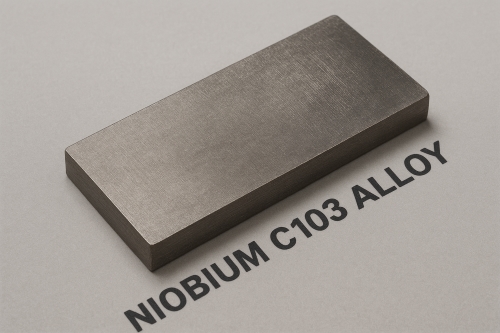
Niobium C103 is a refractory metal alloy consisting of niobium with small additions of tungsten (10%), zirconium (1%), and carbon (0.1%). It is designed for high-temperature applications where strength and thermal stability are critical.
Key Properties of C103
C103 has a high melting point, normally above 2400°C. It retains strength within the range of 1200°C. It has excellent thermal stability and acceptable oxidation resistance. For instance, it is able to sustain a yield strength of about 240 MPa at room temperature. The alloy is relatively low in density compared to other metals like tungsten. This is a desirable characteristic in applications where weight is a concern.
| Property | Value |
|---|---|
| Density | 8.9 g/cm³ |
| Melting Point | >2400°C |
| Yield Strength (RT) | 240–280 MPa |
| Yield Strength (1200°C) | ~100 MPa |
| Tensile Strength (RT) | 550–650 MPa |
| Elastic Modulus | 105 GPa |
| Thermal Expansion (RT–1000°C) | 7.2 × 10⁻⁶ /°C |
C103 retains usable strength up to 1200°C, making it suitable for sustained high-temperature service.
Advantages over Other Refractory Metals
Niobium C103 is one of the most widely used refractory metals for high-temperature applications. Compared to molybdenum and tungsten, C103 offers better ductility and thermal fatigue resistance. Molybdenum and tungsten become brittle at low temperatures and are difficult to form; C103 remains workable at room temperature and can be welded without preheating. Its coefficient of thermal expansion (7.2 × 10⁻⁶ /°C) is closer to that of common steels and superalloys, reducing thermal stress in multi-material assemblies. Designers prefer its stability and reliability under heavy-duty cycles.
Normal Applications in Aerospace and Industry
This alloy finds many uses. In aerospace engineering, it is used in jet engine afterburners and rocket engine nozzles, where temperatures exceed 1000°C. In industry, C103 finds application in furnace and chemical process equipment parts. A typical example is turbine blades in jet engines that must operate at around 1000°C. Another use is in high-temperature industrial furnaces where strength is the main consideration.
Challenges in Manufacturing and Processing
It is not without difficulty to process C103. The alloy requires controlled conditions when processing. Specialized techniques are needed to weld C103. Specialized tools are needed to machine the metal due to its hardness. Casting and forging can be difficult because of its high melting point. Heat treatments must be done carefully in order to maintain the uniformity of the alloy. All these steps add up to manufacturing time and cost.
Why Niobium C103 Matters in High-Temperature Engineering
Engineers count on C103 alloy in the most severe applications. It provides high-temperature safety and performance that are hard for most alloys to match. Its strength stability and low expansion rate reduce fatigue issues to a minimum. It is this reliability that makes the alloy a first choice for critical aerospace components and industrial equipment. Using C103 enables engineers to design for efficiency and durability even in extreme environments.
Related Materials from Stanford Advanced Materials
Stanford Advanced Materials (SAM) supplies C103 alloy in various forms:
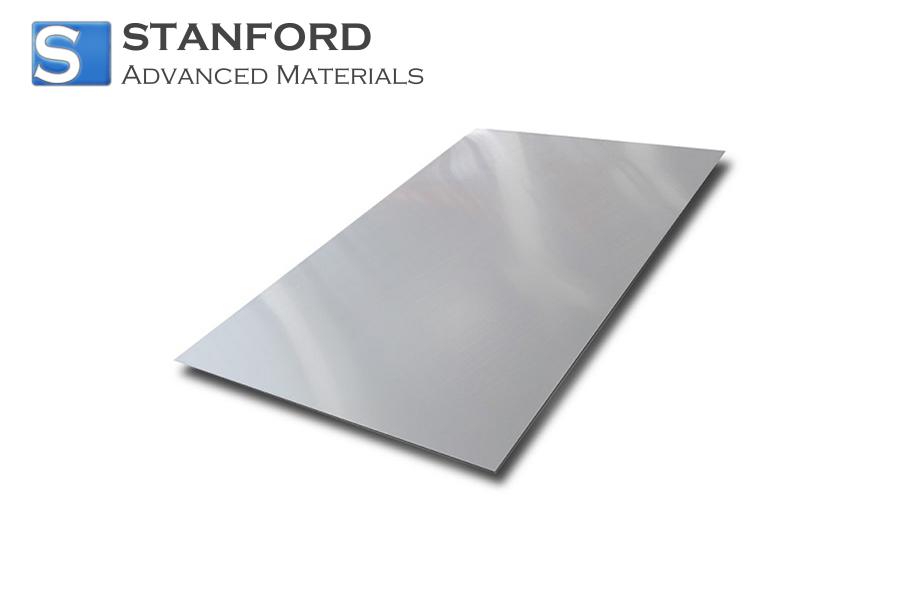
- Sheet and plate: for structural components and heat shields
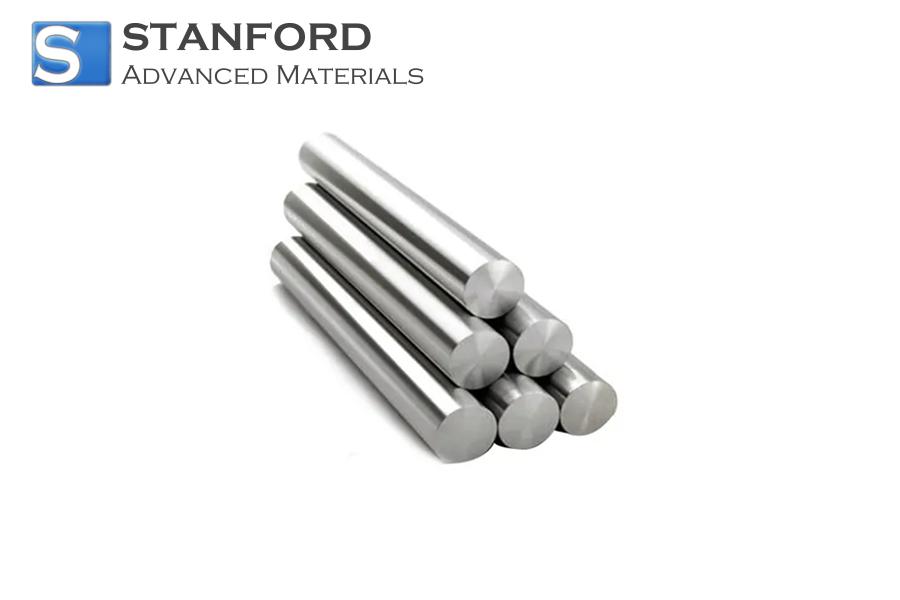
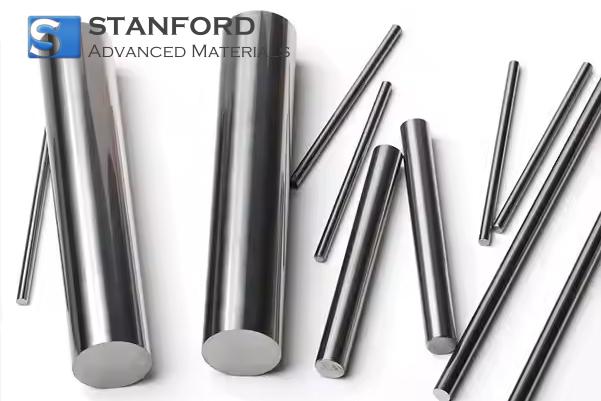
- Rod and bar: for machined parts and fasteners
- Custom machining: to customer specifications
All materials are supplied with certifications and traceability. [Browse our products] or [contact us] for specifications.
Frequently Asked Questions
Q: What is the composition of niobium C103 alloy?
A: Niobium with approximately 10% tungsten, 1% zirconium, and 0.1% carbon.
Q: What is the maximum service temperature for C103?
A: C103 can be used up to 1200°C for sustained applications. With protective coatings, short-term exposure can be higher.
Q: How does C103 compare to Cb103?
A: They are the same material. Cb is the former symbol for niobium; modern designation uses Nb (C103).
Q: Does C103 require oxidation protection?
A: Yes. At temperatures above 600°C, C103 oxidizes rapidly. Aerospace applications typically apply silicide coatings (e.g., R512E) for oxidation resistance.
Q: What forms of C103 does SAM supply?
A: Sheet, plate, rod, bar, and custom-machined components. Contact us for specific requirements.
 Chin Trento