Products
 Bars
Bars
 Beads & Spheres
 Bolts & Nuts
 Crucibles
 Discs
Discs
 Fibers & Fabrics
 Films
Films
 Flake
Flake
 Foams
Foams
 Foil
Foil
 Granules
 Honeycombs
 Ink
Ink
 Laminate
 Lumps
Lumps
 Meshes
 Metallised Film
 Plate
Plate
 Powders
 Rod
Rod
 Single Crystals
 Sputtering Target
 Tubes
Tubes
 Washer
 Wires
Wires
 Converters & Calculators
 Write for Us



Types and Applications of Alnico Magnets

Introduction to Alnico Magnets
Alnico magnets are among the oldest permanent magnets. They were first used a few decades ago in various industries. These magnets got their name based on the major components: Aluminum, Nickel, and Cobalt. With the passage of time, trace amounts of copper and iron were also added. All these components worked together to give Alnico magnets their unique characteristics. These magnets transformed smoothly even when temperatures rose.
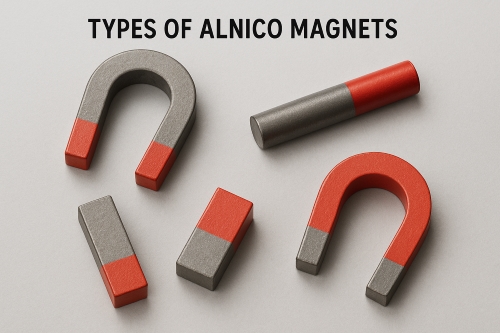
Types of Alnico Magnets
Different types of Alnico magnets have been produced over time. Engineers primarily refer to them by numbers. Some of the most common types are Alnico 2, Alnico 3, Alnico 4, Alnico 5, and Alnico 8. Every type has a distinct composition of ingredients. For instance, Alnico 2 will have a higher concentration of iron. On the other hand, Alnico 5 comprises an even composition with minor proportions of copper. The variations have differences in magnetic strength and temperature levels.
Alnico 3 and Alnico 4 have less demanding conditions of stability. Alnico 8 gains an advantage by having a higher value of saturation. It is used when the situation involves warmer temperatures. Small changes in composition affect how they perform. This variety allows engineers to choose the right magnet for a given scenario.
Magnetic Properties and Performance Characteristics
The elegance of Alnico magnets is their magnetic properties. They have high coercivity. They are resistant to demagnetization even in challenging environments. For example, most types of Alnico are resistant to demagnetizing fields of about 3,000 to 5,000 Oersteds. Their energy product is typically around 5 to 9 MGOe. This energy product is lower than some other newer magnets but is adequate for most applications in practice.
Temperature performance is one of its outstanding characteristics. Alnico magnets have a high Curie temperature. It is most often about 550°C. That implies that they can operate in hot conditions. This makes them useful in applications like windings and sensors operating under thermal stress. Mechanical strength is another positive aspect. Although not so strong as some of the newer composite varieties, they have operated well in industrial circumstances for many decades now.
Utilized in equipment like electric guitars, the signals are clear. Technological instruments can also depend on their stable performance under heat. Even in braking systems, the stable magnetic field of Alnico magnets guarantees performance. Their stable responses allow engineers to integrate them into designs with tight tolerances.
Applications of Alnico Magnets
Alnico magnets are applied very widely. They are usually found in electric motors. In these motors, the magnets are used to deliver a consistent magnetic field. They are found in sensors too. There are many older control systems that depend on them. Thermostats, for example, use such magnets to adjust things.
In electric guitars, Alnico magnets give a warm tone. Alnico magnets are used by most old guitars to produce their tone. Trains' magnetic braking and amusement park magnetic braking are other uses in our lives. Alnico's consistent operation at elevated temperatures is worth it in such uses.
Certain power generation devices utilize Alnico magnets. They bring reliability to the system. Where there is a need for an electronic device to have a magnetic reference, Alnico magnets occupy that position. In measuring devices, their stability provides for accurate measurements. Their thermal endurance makes them the go-to in most applications.
Alnico Magnets vs Neodymium Magnets
Neodymium magnets are a new class of permanent magnets. Neodymium magnets contain very high magnetic energy. Neodymium magnets can generate stronger fields in smaller volumes. But these magnets also have issues. They are less ductile than Alnico magnets. Neodymium magnets are susceptible to damage in case of mechanical shock.
Alnico magnets, on the other hand, possess higher temperature resistance due to their high Curie temperature. They remain magnetically stable in temperatures where neodymium magnets would begin to lose their functionality. Second, Alnico magnets possess a less rough demagnetization process. While their maximum energy product is lower, their consistent dependability has made them a choice for longer periods of operation. Where heat and vibration are causes of concern, Alnico magnets can offer a safer alternative.
The choice of using Alnico or neodymium will depend on the requirement of each project. In high-performance use in compact devices, there is a benefit in employing neodymium magnets. But if reliability at heat is important, experienced engineers still prefer Alnico magnets.
Conclusion
Alnico magnets remain to be a significant material of use in industry as well as consumers. Their reliability of performance for many decades is the signature of their design. The different Alnico grades, namely Alnico 2 to Alnico 8, all offer a range of benefits based on applications. They have good coercivity and high temperature resistance as magnetic characteristics. These make them of utility in applications such as electric motors, sensors, and musical instruments. For more types of permanent magnets, please check Stanford Advanced Materials (SAM).
Frequently Asked Questions
F: What are Alnico magnets composed of?
Q: They are mostly made up of aluminum, nickel, and cobalt with traces of iron and other minor constituents.
F: Which Alnico magnet is the most common in industry?
Q: Alnico 5 is usually employed as it finds a good compromise between stability and strength.
F: How do Alnico magnets compare to neodymium magnets?
Q: Alnico magnets are highly temperature resistant while neodymium magnets produce a stronger magnetic field.
 Chin Trento