
 Products
 Bars
Bars
 Beads & Spheres
 Bolts & Nuts
 Crucibles
 Discs
Discs
 Fibers & Fabrics
 Films
Films
 Flake
Flake
 Foams
Foams
 Foil
Foil
 Granules
 Honeycombs
 Ink
Ink
 Laminate
 Lumps
Lumps
 Meshes
 Metallised Film
 Plate
Plate
 Powders
 Rod
Rod
 Single Crystals
 Sputtering Target
 Tubes
Tubes
 Washer
 Wires
Wires
 Converters & Calculators
 Write for Us



Halbach Array: What Is It and How Is It Used

Introduction to Halbach Arrays
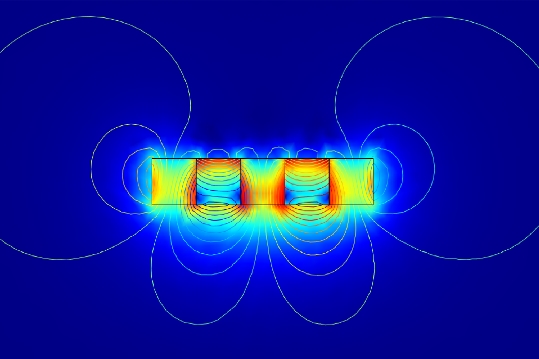
A Halbach array is an uncommon configuration of permanent magnets. It is designed so that one face of the device presents a very strong magnetic field and the opposite face presents a very weak magnetic field. The design has been used in numerous engineering applications. The idea is simple but effective. Through reversal of the magnetization of each magnet within an arrangement, the array directs the magnetic field in one direction. This is the design that helps in reducing undesirable magnetic interference in nearby equipment. Usually, the functional side is the dominant side that is used to transfer energy or create motion.
Principles of Halbach Array Magnetization
The key to the Halbach array is in how the magnets are arranged.
Each of the magnets in the array is pointing in a specific direction. When the magnets are arranged side by side, their fields add up on one side and cancel out on the other side. This produces a strong magnetic field in the required direction. Think of it as a practiced line dance in which each step is positioned to create the right movement. The strength of the output field depends on the size, shape, and orientation of the magnet. In the design phase, the engineers have to come up with the angles necessary for each magnet. The arrangement minimizes the need for added magnetic shielding in devices. From a scientific perspective, the array enhances magnetic flux density on one side but reduces it on the other side. The setup is valuable in the majority of areas of physics and mechanical engineering design.
Halbach Arrays: Linear and Cylindrical
There are two main types of Halbach arrays that designers utilize: linear arrays and cylindrical arrays. In linear Halbach array, magnets are lined up in a linear fashion. This is typically used in flat or one-dimensional applications. For instance, in the application of transport systems or conveyor belts, where the linear array guides magnetic forces under management.
A cylindrical Halbach array, on the other hand, aligns magnets in a circular orientation.
This is common for electric generators and motors. The circular orientation produces an evenly balanced field outside the cylinder while still converging the field on a single point. The cylindrical arrangement can easily be translated to systems where rotation is the main component. In either configuration, accurate magnet orientation is the determinant of the creation of wanted field effects. The kind is determined by engineers depending on the specific application demands and the available space.
Magnetic Field Properties and Benefits
The magnetic field generated by a Halbach array has some important properties.
Firstly, it is heavily directional. One side of the array produces a powerful and focused magnetic field. The other side has a reduced field. This is a beneficial characteristic in most designs as it reduces stray magnetic forces. To have a concentrated field means better performance in equipment such as electric motors. Another advantage is that this design can reduce energy losses in magnetic coupling systems. The convenience of having a single-side strong field allows engineers to design equipment that is both efficient and compact.
For example, in the majority of modern generators, a Halbach array provides for a reduced demand for external magnetic shielding. Evenness of the field on the active side means that there will be less wasted energy. In some applications, this arrangement enables devices to run cooler and with higher power output. These characteristics qualify the Halbach array as a preferred solution in high-precision environments where the magnetic field needs to be managed.
Halbach Arrays in Everyday Devices
Halbach arrays are found in many common scientific and engineering devices.
They form a significant component of most electric motors. In the devices, magnetic field is utilized in the development of rotational force. Cylindrical Halbach arrays are found in generators where steady electrical output is required. In magnetic levitation transport systems like some advanced train systems, linear arrays are tasked with smooth, contactless travel. High magnetic field on one side suspends the train and the lower field at the bottom minimizes friction. Magnetic bearings, under which components can rotate with very little resistance, also rely on Halbach arrays.
The single-sided field helps maintain the system in balance and keep energy loss in the systems low. The medical fraternity from time to time uses Halbach arrays in imaging equipment to generate concentrated but focused fields. Even research labs use these arrays in experimental setups needing contained magnetic areas for accurate measurements. With benefits such as reduced stray fields and increased energy concentration, the Halbach array is fulfilling its promise in a wide range of applications in the real world.
Conclusion
A Halbach array is a lovely example of how a simple idea can lead to a variety of beneficial uses. By precise orientation of magnets, a strong, single-sided field results, being energy conserving and efficient. This arrangement has apparent benefits in magnetic levitation systems, electric motors, and the majority of research equipment. The structure keeps the need for extra magnetic shielding to a minimum and enhances the overall device performance.
Frequently Asked Questions
F: How does a Halbach array work?
Q: Magnets are arrayed in an alternating sequence that nulls one side of the field and increases the other.
F: What are the typical uses of Halbach arrays?
Q: They are used in motors, generators, magnetic levitation, and imaging devices.
F: Can a Halbach array increase efficiency in a system?
Q: Yes. The alignment maximizes an energy conserving function and reduces stray magnetic field interference.
Reference:
[1] Ham, Chan & ko, Won & Lin, Kuo & Joo, Young Hoon. (2013). Study of a Hybrid Magnet Array for an Electrodynamic Maglev Control. Journal of Magnetics. 18. 10.4283/JMAG.2013.18.3.370.
 Chin Trento