
 Products
 Bars
Bars
 Beads & Spheres
 Bolts & Nuts
 Crucibles
 Discs
Discs
 Fibers & Fabrics
 Films
Films
 Flake
Flake
 Foams
Foams
 Foil
Foil
 Granules
 Honeycombs
 Ink
Ink
 Laminate
 Lumps
Lumps
 Meshes
 Metallised Film
 Plate
Plate
 Powders
 Rod
Rod
 Single Crystals
 Sputtering Target
 Tubes
Tubes
 Washer
 Wires
Wires
 Converters & Calculators
 Write for Us



What Are the Main Uses of Beryllium Copper Alloys

Introduction to Beryllium Copper Alloys
Beryllium copper alloys are a niche class of copper alloys with a very small composition of beryllium. Combined, they create an incredibly hard and wear-resistant alloy. Beryllium copper alloys have been used in critical applications for decades where non-sparking performance and strength are essential. They have a decades-old history of use in engineering and are now relied upon by engineers for demanding applications.
This alloy is special in that it possesses high strength and good electrical conductivity. The pure copper, however, may be more malleable and soft, but the inclusion of beryllium gives these alloys hardenable properties when heat treated. This renders the beryllium copper alloys suitable for parts that undergo stress or precise machining. We find these alloys used in tools and parts in our line of work where sparks pose danger to us.
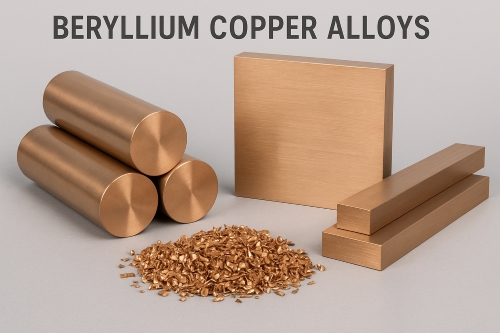
Main Features of Beryllium Copper Alloys
Beryllium copper alloys have several characteristics that make them extremely useful. They have high tensile strength. For example, after optimal heat treatment, they can attain over three times the normal copper when it comes to their yield strengths. They also have excellent fatigue resistance, in the sense that they can bend and flex dozens of times without cracking.
Their second major attribute is their non-sparking nature. This becomes extremely relevant in environments with combustible dust or gases. Their high thermal and electrical conductivity enables them to suit effectively in equipment circuits and connectors. They are also corrosion-resistant, hence capable of being utilized for long periods of time under extreme conditions. Some are precision equipment utilized in hostile environments and electrical contacts in severe equipment. Their superior reliability under stress and under sudden changes in temperature is well proven.
How Are Beryllium Copper Alloys Used in Aerospace and Aviation?
Aerospace and aviation prioritize safety and reliability. Beryllium copper alloys are utilized where there is a need for a spark-free situation and components experience high stress. For instance, they find application in pilot instrument panels, connectors, and secure fasteners. Due to their high, non-sparking strength, they are particularly well suited for use in fuel systems or near explosive atmospheres.
A plane will have thousands of minute components. Beryllium copper alloys are favored by engineers because they are light, strong, and secure. The history attests to the strength of these alloys in withstanding vibrations and harsh temperatures when used in air space. They boast an established track record of integrity that allows them to be trusted.
How Are Beryllium Copper Alloys Used in Electronics and Vacuum Systems?
Electronics are preferred by beryllium copper alloys because they can resist both mechanical stress and electrical loads. Under connectors, relays, and switches, the alloy's hardness ensures a sound and stable contact. They are commonly used in circuit boards and components that have high-performance usage and repeated movement or vibration.
Vacuum devices and other precision equipment often rely on the combination of conductivity and strength found in the alloy. Their low magnetic permeability is also an advantage. This results in the fact that in applications such as high-vacuum chambers or sensitive measuring equipment, there will be minimal magnetic field interference. Many applications within the electronics industry take advantage of the unique combination of properties of the alloy for better performance.
How Are Beryllium Copper Alloys Used in Medical and Specialized Equipment?
Medical and specialized instruments require materials that strike a balance between strength and precision. Beryllium copper alloys are manufactured to produce surgical instruments, dental equipment, and components in imaging devices. The wear-resistance of the alloy creates long-lasting instruments that function consistently even when under heavy use. In some diagnostic equipment, the alloy creates connectors and moving parts ensure the precision required for accurate measures.
Specialized tools in fields like instrumentation also depend on the reliability of beryllium copper. Its toughness and low friction characteristics render it a prized asset to components that have to work continuously under vibration or motion. Engineers find the strength of the alloy to work in aggressive or sensitive conditions indispensable in responding to the need of contemporary technology.
Conclusion
Beryllium copper alloys have proven to be a reliable and versatile material in many applications. Their high strength, high fatigue resistance, and non-sparking properties have established them as a consistent choice of material in aerospace, electronics, energy, and medicine. From complex systems to simple tools, engineers favor the consistent performance offered by these alloys. With decades of safe and consistent application under their belt, beryllium copper alloys continue to be major contributors to modern engineering designs. For more advanced materials, please check Stanford Advanced Materials (SAM).
Frequently Asked Questions
F: What makes beryllium copper alloys special?
Q: They are of high strength, fatigue life, and non-sparking nature, which distinguishes them.
F: Where are they used most commonly?
Q: Aerospace, electronics, energy systems, and medical specialty equipment.
F: What is one of the strengths of beryllium copper in hazardous environments?
Q: Their non-sparking quality reduces the risk of ignition in explosive conditions.
 Chin Trento