
 Products
 Bars
Bars
 Beads & Spheres
 Bolts & Nuts
 Crucibles
 Discs
Discs
 Fibers & Fabrics
 Films
Films
 Flake
Flake
 Foams
Foams
 Foil
Foil
 Granules
 Honeycombs
 Ink
Ink
 Laminate
 Lumps
Lumps
 Meshes
 Metallised Film
 Plate
Plate
 Powders
 Rod
Rod
 Single Crystals
 Sputtering Target
 Tubes
Tubes
 Washer
 Wires
Wires
 Converters & Calculators
 Write for Us



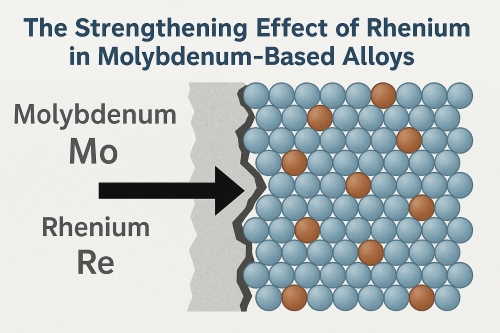
The Strengthening Effect of Rhenium In Molybdenum-Based Alloys

Molybdenum is known for its high melting point and excellent resistance to wear. The combination is used in industries where performance matters. It can be found in high-stress applications and high-temperature environments. The mix of molybdenum and rhenium is a fine example of how minor elements can greatly improve a base metal.
Mechanical Properties of Molybdenum-Rhenium Alloy
The mechanical strength of these alloys is remarkable. Rhenium is added to the alloy to increase the hardness of the alloy. Laboratory tests have proven that the addition of rhenium increases the yield strength of the alloy by up to 30%. The tensile strength of the alloy is also higher than that of plain molybdenum. For example, the addition of 25 percent rhenium to a typical alloy of molybdenum increases its performance, according to the test data. These alloys are used by engineers to create materials that are resistant to bending and deformation. In simpler words, the alloy is able to withstand more stress before it starts to deform. Therefore, it is used to create aircraft parts, heavy machinery, and high-performance tools. Rhenium increases the alloy's performance by improving the grain structure of the metal. In simpler words, the addition of rhenium reduces the weak points in the alloy, and the stress is evenly distributed throughout the alloy. According to various studies, the alloy is able to withstand more stress and extreme conditions.
Thermal and Physical Properties of Molybdenum-Rhenium Alloy
The alloy excels in its ability to handle heat. The addition of rhenium increases the melting point, adding to the already high melting point of molybdenum. This makes the alloy more thermally stable. This makes the alloy useful for applications that need to withstand high temperatures, such as blades used in turbines or parts used in rocket engines. The alloy was able to pass tests that demonstrated stability at temperatures over 2000 degrees Celsius. The alloy also balances the coefficient of thermal expansion. This makes the alloy steady and less prone to warping. The alloy is a little heavier, but the advantages make the difference worth the cost. The alloy is still the same color as pure molybdenum but with a sharper edge. Users have reported that parts made out of the alloy last longer.
Irradiation Performance of Molybdenum-Rhenium Alloy
The performance in terms of irradiation is an important factor for applications in nuclear reactors. The alloy has a high level of resistance to neutron damage. The data from the test results for irradiation show that there is no deterioration in the microstructure. The results from controlled exposure to radiation indicate that there is no damage to the grain boundaries. This level of performance is important for ensuring that there is a high level of reliability. In other words, the material can withstand harsh conditions in terms of irradiation without losing its strength. The better state of the structure means that it will not crack easily. The industrial sector appreciates the performance of molybdenum-rhenium alloys when exposed to radiation.
Applications of Molybdenum-Rhenium Alloy
The alloys are used in many high-end applications. The improved mechanical properties allow engineers to use this alloy in the construction of jet engines. The parts of the jet engine are required to withstand extreme temperature changes and stress. The alloy is also preferred in nuclear reactor technology. The alloy can withstand irradiation better than many other metals. The alloy is also used in the field of electronics. The stability and longevity of the alloy are important in high-precision instruments. The alloy has been used in manufacturing companies for heavy-duty components and high-power devices. One of the most common uses of this alloy is in the turbo-machinery parts of machines. Machine shops claim that there are fewer breakdowns when parts of this alloy are used in the machines.
Conclusion
We have looked at how rhenium strengthens molybdenum alloys. The added rhenium increases yield strength and improves hardness. Thermal properties see a boost with added stability and a high melting point. The alloy also shows good performance under irradiation.
Frequently Asked Questions
F: How does rhenium improve molybdenum-based alloys?
Q: Rhenium refines the grain structure. It raises the yield strength and hardness.
F: What is the main benefit in high-temperature applications?
Q: The alloy shows enhanced thermal stability. It can sustain stability beyond 2000 degrees Celsius.
F: Why is the alloy used in nuclear reactor technology?
Q: It resists neutron irradiation and maintains its structure under harsh conditions.
 Chin Trento