
 Products
 Bars
Bars
 Beads & Spheres
 Bolts & Nuts
 Crucibles
 Discs
Discs
 Fibers & Fabrics
 Films
Films
 Flake
Flake
 Foams
Foams
 Foil
Foil
 Granules
 Honeycombs
 Ink
Ink
 Laminate
 Lumps
Lumps
 Meshes
 Metallised Film
 Plate
Plate
 Powders
 Rod
Rod
 Single Crystals
 Sputtering Target
 Tubes
Tubes
 Washer
 Wires
Wires
 Converters & Calculators
 Write for Us



Common High-Temperature Materials for Single Crystal Growth

Introduction
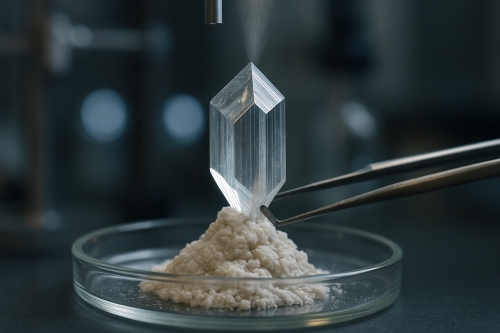
All high-quality single-crystal growth by the Czochralski, Bridgman, and other processes requires furnaces operating at very high temperatures in steep thermal gradients. These conditions create unusual demands on the materials selected for use in furnace construction.
Components such as crucibles, heaters, and structural supports not only have to withstand temperatures above 2000 °C, but also have to withstand chemical attack, thermal stress, and mechanical deformation. Selecting the right material is therefore the most important consideration, since it directly affects crystal quality, process performance, and equipment lifespan.
Material Requirements of Note
When deciding on furnace materials, there are several performance demands that must be balanced delicately:
•High melting point: Materials should not become soft or degrade at operating conditions. Tungsten (3422 °C), molybdenum (2623 °C), and graphite (sublimation above 3600 °C) are top candidates.
• Thermal conductivity: Efficient heat transfer keeps thermal gradients to a minimum; Mo, W, SiC, and graphite excel in this regard.
• Thermal expansion: Low expansion reduces thermal stress and improves component compatibility. For example, W (~4.5 × 10⁻⁶ K⁻¹) and Mo (~5.1 × 10⁻⁶ K⁻¹) are relatively stable.
• Creep resistance: Stability of size under stress for prolonged periods is extremely important for load-bearing components. The refractory metals and their alloys excel in this aspect.
•Chemical stability: The materials should withstand oxidation, carbide formation, and spurious reaction with the melt. This is often controlled by working in vacuum or inert gas atmospheres.
•Mechanical strength: Parts like crucible supports and heaters are required to withstand heavy loads without deformation; tungsten-molybdenum alloys and graphite composites are commonly employed.
Common High-Temperature Materials for Single Crystal Growth
Tungsten (W)
Tungsten remains the gold standard material in single crystal furnaces. It has an outstanding 3422 °C melting point, extremely low coefficient of thermal expansion (~4.5 × 10⁻⁶ K⁻¹), and satisfactory creep strength under high-temperature conditions. All these reasons make tungsten an essential commodity for heaters, support rods, and other furnace parts that must withstand harsh thermal loads. Its major flaw is oxidation: at high temperatures above ~400 °C in air, tungsten degrades very quickly. Due to this, it is always operated under high vacuum or inert environments like argon.
Molybdenum (Mo)
Molybdenum is highly balanced in both high-temperature characteristics. Molybdenum melts at 2623 °C and has a thermal conductivity of ~138 W/m·K that provides favorable mechanical stability and excellent machinability compared to tungsten. Molybdenum is widely used by engineers for crucible supports, shielding, and furnace parts where welding or shaping must be done. Like tungsten, molybdenum oxidizes easily—over ~600 °C in air—and its use also requires controlled environments.
Graphite
Graphite is prized for its unique combination of mechanical and thermal properties. It is a good conductor of heat (in-plane values of up to 200 W/m·K), can withstand temperatures above 3600 °C, and may be machined to intricate shapes with relative ease. For these applications, it is extensively employed for crucibles, susceptors, and thermal insulation. Graphite is highly reactive with oxygen, oxidizing at ~500 °C, which limits use to vacuum or inert gas environments.
Ceramics
Ceramic materials such as alumina (Al₂O₃, melting point ~2072 °C), yttria (Y₂O₃, ~2430 °C), and zirconia (ZrO₂, ~2700 °C) are used where chemical stability is of concern. They resist attack by molten material, so are well-suited to crucibles, liners, and insulation components in crystal growth equipment. Their own brittleness, however, makes them susceptible to thermal shock and mechanical stress, so their use is restricted to lower-stress applications.
How to Select
Selecting proper materials for growth in single crystals at high temperature is the balancing act of chemical, mechanical, and thermal performance.
The heavy horses for high-temperature, high-strength components are molybdenum and tungsten, with graphite and ceramics being useful, tried-and-true solutions for crucibles, liners, and insulation. Refractory metal alloys offer additional extension of performance where creep strength and ductility are critical. Finally, close congruence of materials properties with furnace design ensures consistent crystal quality, longer equipment life, and better operation. For more information, please check Stanford Advanced Materials (SAM).
 Chin Trento