
 Products
 Bars
Bars
 Beads & Spheres
 Bolts & Nuts
 Crucibles
 Discs
Discs
 Fibers & Fabrics
 Films
Films
 Flake
Flake
 Foams
Foams
 Foil
Foil
 Granules
 Honeycombs
 Ink
Ink
 Laminate
 Lumps
Lumps
 Meshes
 Metallised Film
 Plate
Plate
 Powders
 Rod
Rod
 Single Crystals
 Sputtering Target
 Tubes
Tubes
 Washer
 Wires
Wires
 Converters & Calculators
 Write for Us



Indium Foil: A Thermal Interface Material

Introduction
Indium foil is a thin and soft metal sheet. Owing to its malleability and high thermal conductivity, it takes the lead as a material for heat transfer in various devices. Indium foil has been used over the decades in many areas of electronics and mechanical devices. The metal offers a stable and uniform way to lower temperature in power devices. We provide you with a brief explanation of its applications and characteristics.
Key Features of Indium Foil in Thermal Management
Indium foil has a number of features that make it very well-suited for thermal management. To begin with, the thermal conductivity is high. Indium typically boasts a thermal conductivity of approximately 86 watts per meter Kelvin. This means that it is capable of dissipating heat quickly from hot sources. Secondly, the foil itself is very soft and ductile. This enables it to mold itself snugly into spaces between surfaces. It forms an even contact area. For small, rough surfaces, this feature is very useful.
In addition, indium foil has a low melting point compared to the majority of other metals. The melting point is around 157 degrees Celsius. In real terms, this means that the foil will perform safely under normal conditions. Indium foil tends to be between 25 and 50 micrometers in thickness. This is a satisfactory compromise between being flexible and the level of material for conducting heat.
Another very important property is that it is resistant to multiple thermal cycles. Even under repetitive heat and cool conditions, indium foil maintains stable performance. Most engineers prefer this material when they are working on high reliability electronics with wide temperature ranges of operation. Its toughness and softness minimize the stress in other components of the assembly.
Applications as a Thermal Interface Material
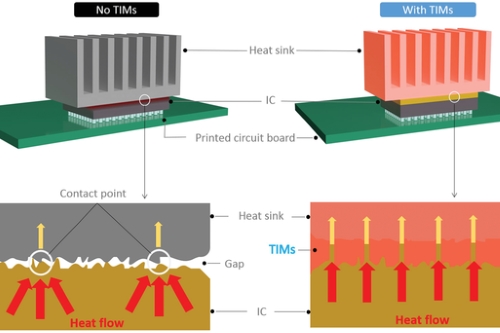
Indium foil is common in the majority of applications where there is a controlled heat transfer. In electronic devices with high power such as computer processors and power amplifiers, the foil serves to fill the gap between the heat source and heat sink. This allows for more even heat distribution and improved device performance overall. Indium foil has been utilized by engineers in lighting LED where heat management is an important factor. Often, the foil is placed between the cooling housing and the semiconductor.
One of the other uses is aerospace and high-reliability military equipment. These uses require a material that does not degrade over time. Indium foil offers longevity and still functions after repeated temperature cycles. Another use in medical devices is when exact temperature control is important. Indium foil can bridge small gaps in the systems to offer efficient heat transfer.
One of the best examples is the use of indium foil on the cooling system of satellites. In this instance, proper heat management is required due to the extreme environment of space. Electronics in harsh environments also benefit from the unique properties of indium foil. It enables sensitive components to remain in safe temperature levels despite harsh conditions.
Advantages over Other Thermal Interface Materials
Indium foil offers a number of advantages compared to other thermal interface materials. One of the main benefits is that it offers consistent performance over time. Indium foil does not dry out or settle like some greases and pastes do across several usage cycles. It offers reliability, especially for devices that generate high levels of heat.
Another benefit of the metal is that it will conform to rough surfaces. Other materials are hard and may leave air gaps. Air gaps lower the heat transfer efficiency. The softness of indium foil allows it to seal and conform these gaps. This brings about enhanced thermal conduction between the surfaces.
Indium foil is also chemical-curing free. There is no need to wait for a paste to cure, hence time saved on assembly. The foil is ready to use the moment it is put between surfaces. Its stable long-term performance and consistency allow designers to design systems with fewer variables to worry about.
Conclusion
Indium foil has already proven to be a trustworthy thermal interface material. Its high thermal conductivity, softness, and reliability upon thermal cycling make it excellently adapted to electronics, aerospace, and other mission-critical use. The flexibility of the metal to conform to surface defects and its facile inclusion in assembly make it superior to any other material. Indium foil remains a reliable tool in the tool belt of the engineer as technology continues to evolve, providing better temperature control and device performance.
Frequently Asked Questions
F: What is the main benefit of indium foil in thermal management?
Q: It possesses high thermal conductivity and can be conformable to rough surfaces.
F: What is the typical thickness of indium foil used for thermal applications?
Q: It is usually 25 to 50 micrometers thick.
F: In what applications is indium foil usually used as a thermal interface material?
Q: It is used in high-power electronics, LED lighting, aerospace applications, and satellites.
Reference
[1] Wang, Zhengfang & Wu, Zijian & Weng, Ling & Ge, Shengbo & Jiang, Dawei & Huang, Mina & Mulvihill, Daniel & Chen, Qingguo & Guo, Zhanhu & Jazzar, Abdullatif & He, Ximin & Zhang, Xuehua & Xu, Ben. (2023). A Roadmap Review of Thermally Conductive Polymer Composites: Critical Factors, Progress, and Prospects. Advanced Functional Materials. 33. 10.1002/adfm.202301549.
 Chin Trento