Products
 Bars
Bars
 Beads & Spheres
 Bolts & Nuts
 Crucibles
 Discs
Discs
 Fibers & Fabrics
 Films
Films
 Flake
Flake
 Foams
Foams
 Foil
Foil
 Granules
 Honeycombs
 Ink
Ink
 Laminate
 Lumps
Lumps
 Meshes
 Metallised Film
 Plate
Plate
 Powders
 Rod
Rod
 Single Crystals
 Sputtering Target
 Tubes
Tubes
 Washer
 Wires
Wires
 Converters & Calculators
 Write for Us



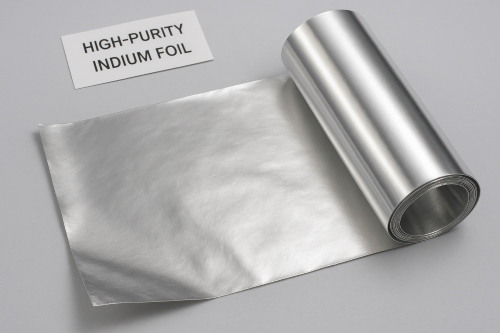
High-Purity Indium Foil for Aerospace and Electronics

Introduction
Indium foil has continued to be one of the leading materials in the electronics and aerospace industries. It helps in the bonding, soldering, and solving heat issues. This paper gives a brief overview of its properties and uses.
Key Properties of High-Purity Indium Foil
High-purity indium foil is virtually pure at 99.99 percent. Due to its softness, it is simple to shape. The foil's melting point is 156.6°C. Its thermal conductivity is excellent. It can resist corrosion very well. In one case, an indium joint of the smallest size assisted a circuit board in its ability to withstand heat. Its excellent ductility and stability lead engineers to feel confident about using it. Various studies indicate that it works satisfactorily even under extreme temperatures.
Applications in Electronics
Indium foil has a significant use in electronics. It can be utilized in chip packaging to act as a heat management tool. A common use is including it in semiconductor bonding. The foil helps to bond small devices with minimal stress. During printed circuit board assembly, it makes uniform electrical and thermal contacts. Indium foil is widely used by businesses in solar panel and LED light assembly. These illustrate its capability for enabling miniaturization within the industry.
Applications in Aerospace
Indium foil also has applications in aerospace. It can be utilized to seal and cushion delicate components due to its flexibility. A good example is its usage in components of space shuttles. The foil is used to eliminate thermal stress during landing and flight. Satellite interfaces utilize occasionally a thin sheet of indium foil to support harsh temperature variations. Its proven track record of performance in those high-stress environments is comforting.
Advantages of High-Purity Indium Foil
The advantages of indium foil are derived from its straightforward properties. It provides low stress join with other materials. Its thermal conductivity is high, which enables heat management in small circuits and large aerospace panels. The low melting point ensures that reflow soldering becomes a seamless task. It exhibits excellent corrosion resistance. Most companies cite cost savings in the long run because the foil has a longer lifespan. These benefits ultimately eliminate assembly time and enhance product reliability.
Fabrication and Handling
Handling indium foil demands caution. Operators will require the use of clean tools to prevent contamination of the foil. Due to the soft nature, they handle it gently to prevent creasing or wrinkling. Fabricators have mechanical or laser cutting to create clean edges. During my experience, maintaining the foil in a dry, controlled environment is extremely crucial. It avoids damage from moisture. Simple processes ensure quality at each stage of production.
Conclusion
High-purity indium foil is a valuable product for electronics and aerospace. It enjoys high ductility and purity due to which it has achieved prominence in many applications. It provides thermal management and reliable bonding. The instances and figures prove to be positive consistently. For more iridium products, please check Stanford Advanced Materials (SAM).
Frequently Asked Questions
F: What is the normal purity of indium foil?
Q: 99.99 percent pure.
F: Is indium foil resistant to high thermal stress?
Q: Yes, it is good at thermal conductivity and ductility.
F: How should indium foil be stored?
Q: It should be stored in clean and dry state to prevent contamination.
 Chin Trento