
 Products
 Bars
Bars
 Beads & Spheres
 Bolts & Nuts
 Crucibles
 Discs
Discs
 Fibers & Fabrics
 Films
Films
 Flake
Flake
 Foams
Foams
 Foil
Foil
 Granules
 Honeycombs
 Ink
Ink
 Laminate
 Lumps
Lumps
 Meshes
 Metallised Film
 Plate
Plate
 Powders
 Rod
Rod
 Single Crystals
 Sputtering Target
 Tubes
Tubes
 Washer
 Wires
Wires
 Converters & Calculators
 Write for Us



6 Things to Know About Silicon Carbide (SiC)

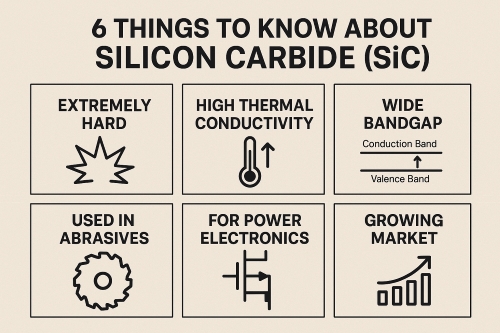
1.Silicon Carbide Is Extremely Hard and Durable
Silicon carbide is well known for its exceptional hardness. It is a material that stands up well to abrasion and wear. In industry, tools like sandpapers and cutting wheels use silicon carbide because of its durability. When used in car parts and other machinery, it lasts longer than many metals. This strength helps reduce the need for frequent replacements. Even under rough handling, silicon carbide holds its shape.
2.Silicon Carbide Has Excellent Thermal Conductivity
This material does a good job of transferring heat. Its thermal conductivity is very high compared to many standard materials. For example, silicon carbide is common in high-power devices and industrial heating systems. It carries heat away quickly, which is important when parts are used for power conversion. In many cases, better thermal conductivity means safer and more reliable operation of engines and electronics.
3.Silicon Carbide Offers A Wide Bandgap
A wide bandgap is a technical term that in simple words means silicon carbide can work under extreme conditions. With a wide bandgap, the material tolerates high voltages. Devices built with silicon carbide can turn on and off much faster than those made with older materials like silicon. This leads to smaller losses in energy. Many modern systems, especially in electric cars and renewable energy installations, make good use of silicon carbide's fit for high voltage situations.
4.Silicon Carbide Improves Power Efficiency
Using silicon carbide in power devices leads to better efficiency. This is because silicon carbide allows systems to lose less power when converting energy from one form to another. For example, in power supplies for computers or electric cars, even a small reduction in energy loss can have a big effect over time. Improved efficiency means lower power bills and less waste heat. In simple words, equipment lasts longer and works more cleanly with silicon carbide in play.
5.Silicon Carbide Withstands Very High Temperatures
Rising temperatures have little effect on silicon carbide. Even when temperatures get very high, silicon carbide manages to hold up. This quality makes it ideal in areas like furnaces, turbine engines, or any place where heat is intense. For example, parts in jet engines and industrial heaters sometimes use silicon carbide because of its ability to resist very high temperatures. This heat tolerance protects equipment and makes maintenance easier.
6.Silicon Carbide Production Is Challenging but Growing
Producing silicon carbide can be tricky. The process involves high heat and precision control. For many years, the output of silicon carbide was limited due to these challenges. Today, more advanced methods are being used to improve the quality and yield. These improved methods have led to a steady increase in the production of silicon carbide parts for electronics, vehicles, and industrial equipment. Companies are investing more resources into silicon carbide production, which means it will become even more common in everyday applications.
Conclusion
Silicon carbide is a standout material because of its strength, heat conduction, safe handling of high voltages, and energy efficiency. It works well in many hard and cool conditions. Using silicon carbide can improve the lifespan and performance of everyday devices. For more ceramic materials, please check Stanford Advanced Materials (SAM).
Frequently Asked Questions
F: Why is silicon carbide used in industrial cutting tools?
Q: It is very hard and resistive, lasting long even under harsh conditions.
F: How does silicon carbide help in power supplies?
Q: It transfers heat quickly and reduces energy loss in power conversion.
F: Can silicon carbide work in very high temperature environments?
Q: Yes, it withstands extreme heat and is used in engines and heaters.
 Chin Trento