Products
 Bars
Bars
 Beads & Spheres
 Bolts & Nuts
 Crucibles
 Discs
Discs
 Fibers & Fabrics
 Films
Films
 Flake
Flake
 Foams
Foams
 Foil
Foil
 Granules
 Honeycombs
 Ink
Ink
 Laminate
 Lumps
Lumps
 Meshes
 Metallised Film
 Plate
Plate
 Powders
 Rod
Rod
 Single Crystals
 Sputtering Target
 Tubes
Tubes
 Washer
 Wires
Wires
 Converters & Calculators
 Write for Us



Understanding 316L Stainless Steel Powder

Introduction
316L stainless steel powder is used in many industries such as medical devices, marine hardware, and additive manufacturing. Here we have a simple explanation of its attributes and uses.
Features of 316L Stainless Steel Powder
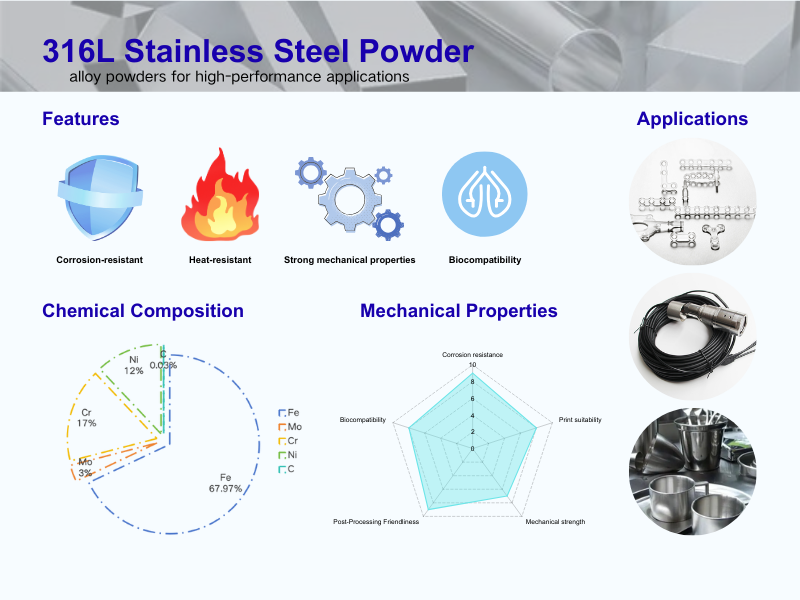
This powder contains a variety of strong properties. It is very resistant to heat and corrosion. It works well in harsh environments. The low carbon level prevents unnecessary carbide formation. This keeps it strong over a long period of time. The material has a smooth surface and free flow, which makes it good for precision use. Engineers and machinists are comfortable working with it and find it reliable.
Chemical Composition
Chemically, 316L stainless steel powder is mainly iron with a small amount of chromium (approximately 16 to 18 percent). Molybdenum is added at approximately 2 to 3 percent. A small trace of nickel, approximately 10 to 14 percent, enhances its strength. Its low carbon content is generally less than 0.03 percent. They are in combination chemically. They form an alloy with a robust corrosion resistance and strength. Writing schemes are well recorded in technical manuals, and outcomes are comparable between suppliers.
Physical and Mechanical Properties, Thermal Properties
Now, let us talk about this powder's mechanical arms. It possesses excellent strength and ductility. Tensile strength is generally between 485 and 620 megapascals. Its yield strength is also uniform. Physical properties of the powder are also impressive. It is extremely dense with a value of nearly 7.98 grams per cubic centimeter. Thermally, it is very stable even at high temperatures. The usual melting point range is from 1370 to 1390 degrees Celsius. It is essential in high-temperature applications and welding. Engineers use these values to design parts that will be distortion-free and never lose strength when stressed.
Powder Characteristics
It is simple to handle. It also possesses a consistent particle size distribution and spherical morphology in cutting-edge production facilities. The particles are 15 to 100 microns for the vast majority of uses. That means they print well in 3D printing machinery. They also closely pack during sintering processes to produce dense structures. The free-flowability facilitates precise layering in additive manufacturing. Most production lines incorporated its application without major adjustments. Its character is best described as being reproducible and easy to handle.
Applications of 316L Stainless Steel Powder
The powder finds applications in various industries. Additive manufacturing employs it to print structures with complicated geometry. Selective laser sintering and melting are popular techniques where it showcases its best qualities. Medical implants and surgical devices generally use this powder. The ability of the powder to resist body fluids makes it the ideal candidate. Additionally, powder is used under marine and aerospace environments. Parts exposed to high humidity and salt conditions exhibit greater durability. 316L stainless steel powder helps achieve the sanitation standards required in chemical processing and equipment in food handling. The cases above show the material's wide usage in modern industries.
Benefits of 316L Stainless Steel Powder
There are many benefits for this powder. Its corrosion resistance minimizes the need for constant replacement. That is a cost saver in the long term. Its good weldability and formability provide manufacturing flexibility. The material's low carbon content negates the issues of heat treatment. All engineers talk well of its time stability. Industries also benefit through the use of this powder since it provides reproducibility of performance. It is available in varied particle sizes, which makes it usable in varied processes. The powder's flexibility makes it widely used by manufacturers as well as designers.
Conclusion
316L stainless steel powder has a great reputation in modern manufacturing. It is famous for its superior corrosion and temperature resistance. The flow and powder properties also suit it well for additive manufacturing and many other applications.
Frequently Asked Questions
F: What is the typical range of this powder's particle size?
Q: It usually varies between 15 and 100 microns, making it to flow well in production.
F: How is powder used in additive manufacturing?
Q: It is used in selective laser melting and sintering for the production of complex parts.
F: Is 316L stainless steel powder safe for use in medical applications?
Q: Yes, it is biocompatible and does well in medical devices and implants.
 Chin Trento