Products
 Bars
Bars
 Beads & Spheres
 Bolts & Nuts
 Crucibles
 Discs
Discs
 Fibers & Fabrics
 Films
Films
 Flake
Flake
 Foams
Foams
 Foil
Foil
 Granules
 Honeycombs
 Ink
Ink
 Laminate
 Lumps
Lumps
 Meshes
 Metallised Film
 Plate
Plate
 Powders
 Rod
Rod
 Single Crystals
 Sputtering Target
 Tubes
Tubes
 Washer
 Wires
Wires
 Converters & Calculators
 Write for Us



Applications of Perovskite Powder

Introduction
Perovskite powder is a versatile material with unique electrical and optical properties. Its structure makes it useful in many modern applications. Many researchers and engineers have used it in various devices.
Solar Cells and Photovoltaic Devices
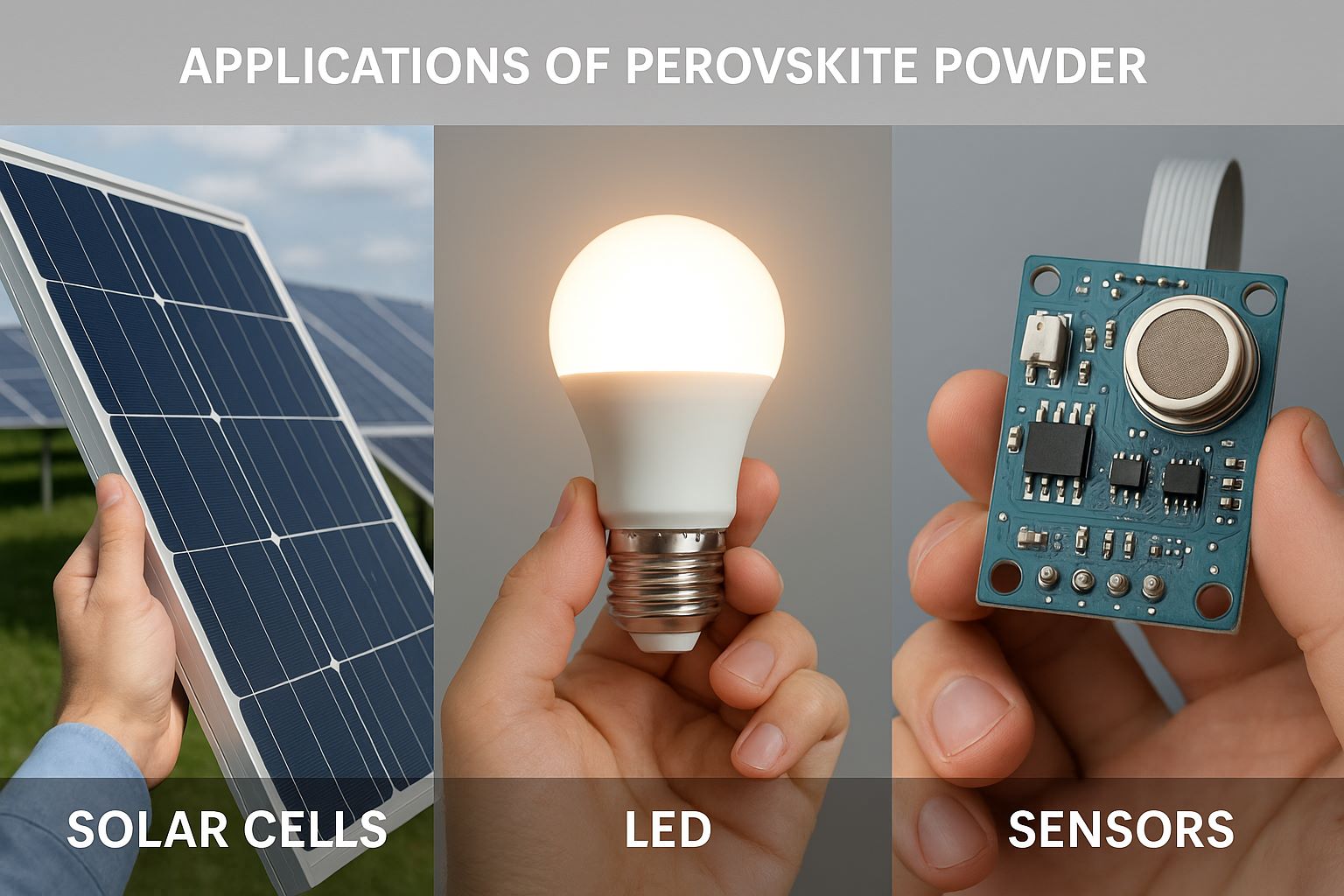
Perovskite powder plays an important role in solar cells. Its use in photovoltaic devices has been one of the most studied areas. Researchers have created cells where perovskite films can convert sunlight into electricity. Efficiency over 20 percent has been achieved in some reports. This is a promising improvement compared to older materials. The preparation of perovskite powders is simple and cost-effective. For example, a layer of perovskite in a cell can be made in a low-temperature process. This process is easier than the high-temperature methods needed for traditional silicon-based cells. The work on these cells is ongoing in many labs around the world.
Light-Emitting Devices and Light Emitting Diodes
Perovskite powder has also found a home in light-emitting devices. Light emitting diodes using perovskite can present bright and tunable colors. The material offers narrow emission peaks which yield purer colors. Engineers have used perovskite for display technology. Some cases show improved brightness and energy efficiency. The powder can be incorporated in layers of the device in a similar way to other semiconductor materials. The cost and ease of fabrication offer an edge over conventional systems. These devices are a good match for modern lighting needs.
Photodetectors and Sensors
Perovskite powder shows high sensitivity to light. This makes it an excellent candidate for photodetectors and sensors. When light hits the material, it causes measurable changes in its properties. In some examples, perovskite-based sensors are able to detect even low light levels. This property is useful in security and environmental monitoring. The combination of speed and sensitivity places perovskite powder-based photodetectors as strong rivals to silicon devices. Laboratories have reported rapid response times and excellent signal-to-noise ratios. Such attributes are important for applications in both industry and research.
Catalysis and Energy Storage
The characteristics of perovskite powder also benefit catalysis and energy storage systems. The material structure provides active sites that can speed up reactions. In catalysis, this means reduced reaction times and lower energy use. Researchers have observed improved oxygen evolution in some electrochemical cells. In energy storage, the powder contributes to batteries and supercapacitors that hold charge well. Concrete examples include electrodes with stable cycling performance over several hundred cycles. These cases show perovskite powder can help make energy devices more efficient and durable. Simple processing methods further add to its appeal in these areas.
Advanced Electronic Devices
Advanced electronic devices benefit from the special traits of perovskite powder. The material can be used in transistors, sensors, and memory devices. Its ionic conductivity and good charge transport properties help build smaller, faster components. Some case studies indicate faster response times than those seen in conventional semiconductors. The powder is easy to process by standard wet chemistry methods. Such methods offer quick turnaround times for experimental prototypes and low production costs. Overall, perovskite powder gives an edge to a range of electronic devices. Its performance and low-cost synthesis continue to interest engineers and designers.
Conclusion
Perovskite powder is a material with many applications in modern technology. Its role in solar cells shows promise for efficient, next-generation photovoltaics. Light emitting devices that use perovskite offer improved color and energy efficiency. Photodetectors and sensors made from perovskite powder are sensitive and fast. Catalysis and energy storage benefit from its active sites and stable structure. Advanced electronic devices are moving forward with perovskite’s added performance. With simple processing and cost benefits, the material is a strong candidate for future innovations.
Frequently Asked Questions
F: What makes perovskite powder special in solar cells?
Q: It converts light to electricity efficiently and can be processed at low
temperatures.
F: How does perovskite powder improve light emitting
devices?
Q: It offers narrow emission peaks and bright, tunable colors for improved
displays.
F: Can perovskite powder help in energy storage devices?
Q: Yes, it improves electrode performance and offers stable cycling in
batteries and supercapacitors.
 Chin Trento