
 Products
 Bars
Bars
 Beads & Spheres
 Bolts & Nuts
 Crucibles
 Discs
Discs
 Fibers & Fabrics
 Films
Films
 Flake
Flake
 Foams
Foams
 Foil
Foil
 Granules
 Honeycombs
 Ink
Ink
 Laminate
 Lumps
Lumps
 Meshes
 Metallised Film
 Plate
Plate
 Powders
 Rod
Rod
 Single Crystals
 Sputtering Target
 Tubes
Tubes
 Washer
 Wires
Wires
 Converters & Calculators
 Write for Us



Case Study: Cracking of Alumina Crucibles in High-Temperature Dehydration

Introduction
A customer reported complete failure of a batch of large alumina crucibles during high-temperature dehydration runs. The crucibles, originally intended as insulation components, were used to hold powder materials during heating. Once exposed to rapid temperature changes and steam, the crucibles fractured.
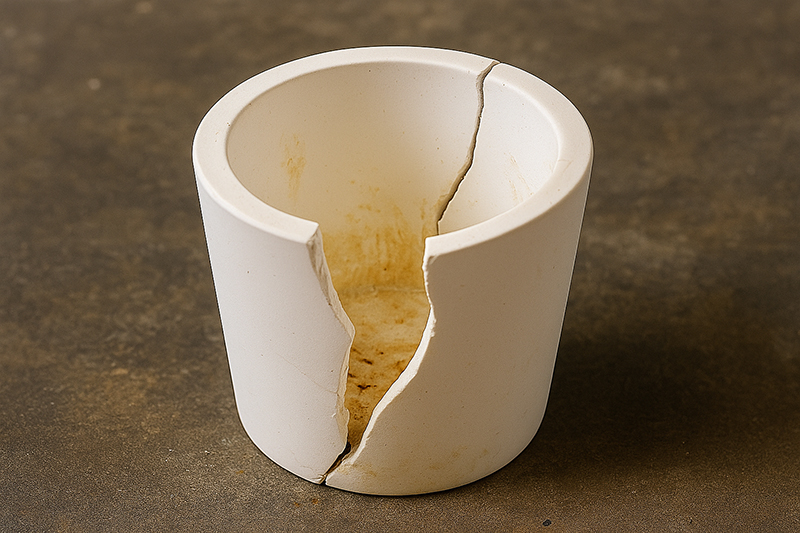
After reviewing the customer's process, engineers at Stanford Advanced Materials (SAM) identified thermal shock in a humid environment as the root cause. Alumina, while highly temperature-resistant, isn't ideal for applications involving steam and fast heating. SAM proposed several alternative materials, ultimately helping the customer transition to a solution with better thermal stability.
Background
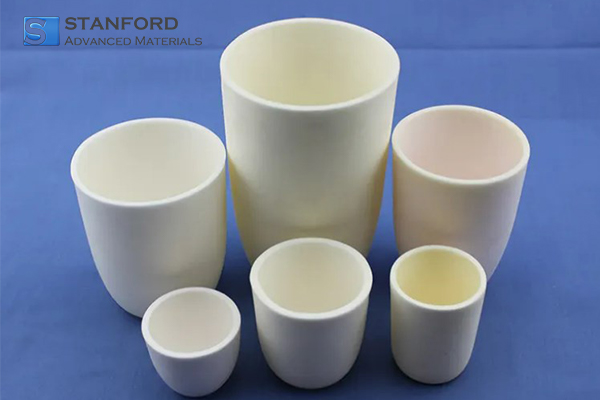
The customer had been utilizing high-purity alumina crucibles, taking advantage of their high thermal resistance (as high as 1750°C). Used in practice, nonetheless, the crucibles were exposed to a high-temperature furnace atmosphere with substantial amounts of steam. The process involved heating powdered material above 1000 °C to expel moisture.
This setup introduced two stress factors:
-
High thermal gradients due to rapid heating and cooling
-
Regular contact with water vapor, which acts differently on some ceramics
Although alumina possesses good chemical and mechanical properties, its bad thermal shock resistance—especially in humid conditions—renders it prone to cracking. The customer came to us and asked for a crucible that would resist the heat as well as humidity without compromising on structure.
Clarifying the Application Environment
By open communication with the customer's technical team, SAM had gained vast information about the process:
- Furnace Conditions: High-temperature ramps, in excess of 1000 °C, with continuous supply of water vapor present
- Functional Role: Crucibles used not just as containers, but as direct process vessels in an ongoing dehydration process
- Failure Pattern: Cracks and catastrophic failure were starting to reveal themselves in early heating cycles
- Material Requirements: Temperature strength, thermal shock resistance, and chemical stability in steam
Based on this, it became clear that standard alumina was being pushed beyond its design limits in this specific use case.
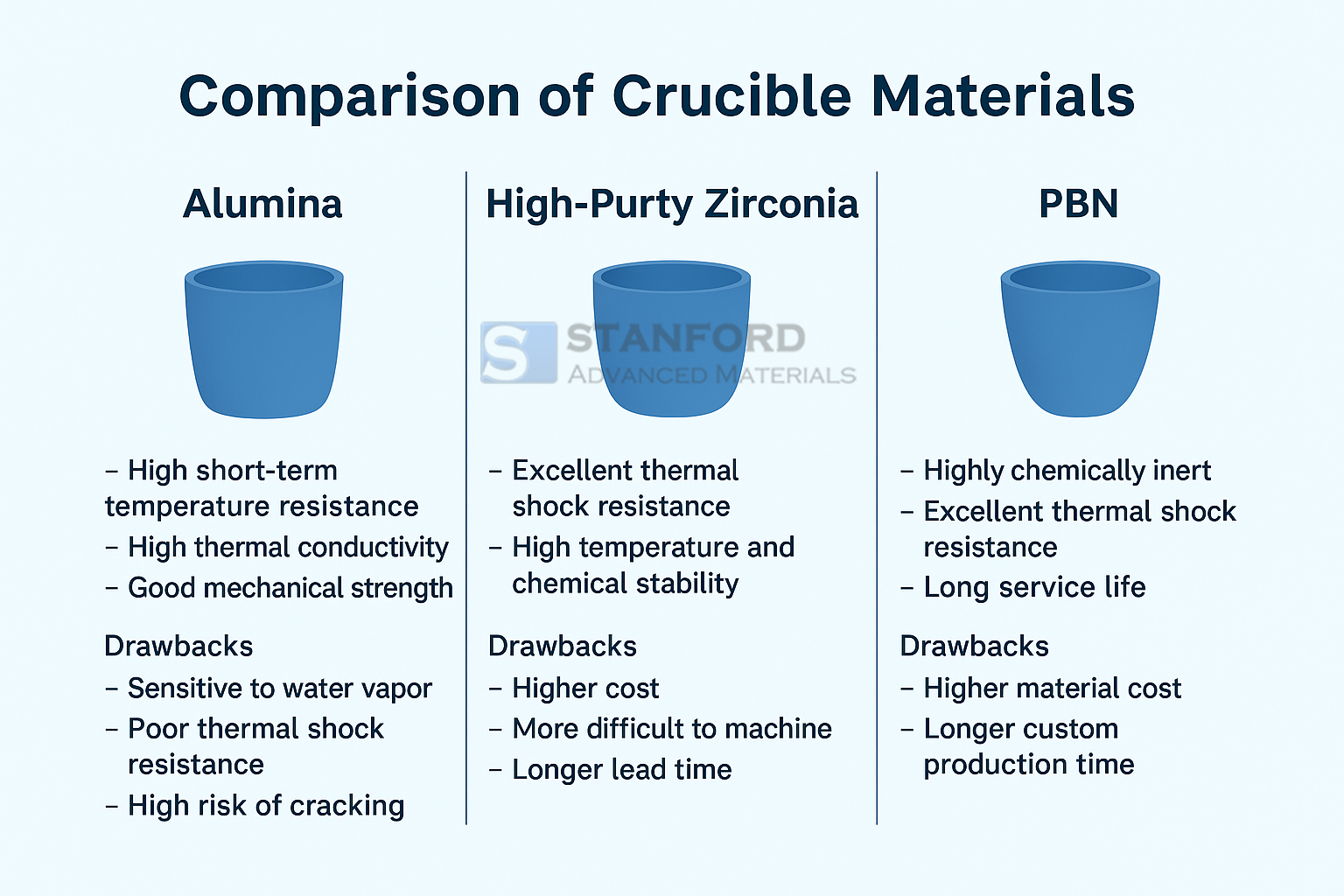
Material Comparison and Selection
| Material | Strengths | Limitations |
|---|---|---|
| Alumina (Al₂O₃) | - Can support up to 1800 °C - Good mechanical strength - Chemically resistant to corrosion |
- Prone to thermal shock - Thermally sensitive to exposure to steam - Brittle, cracking on extreme temperatures |
| Zirconia (ZrO₂) | - Much improved resistance to thermal shock - Extremely high melting point (~2700 °C) - Inert to chemicals in steam |
- Higher cost - Harder to machine - Longer lead time for custom parts |
| Pyrolytic Boron Nitride (PBN) | - Low thermal cycling endurance - Inactive in steam or harsh atmospheres - Stable under high temperature conditions |
- Expensive - Requires custom fabrication for large volumes |
Recommendation and Implementation
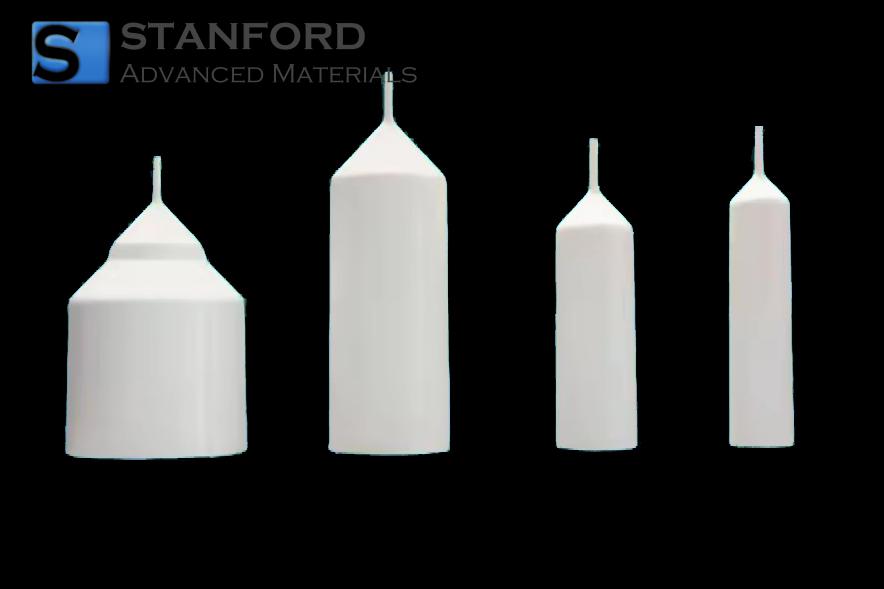
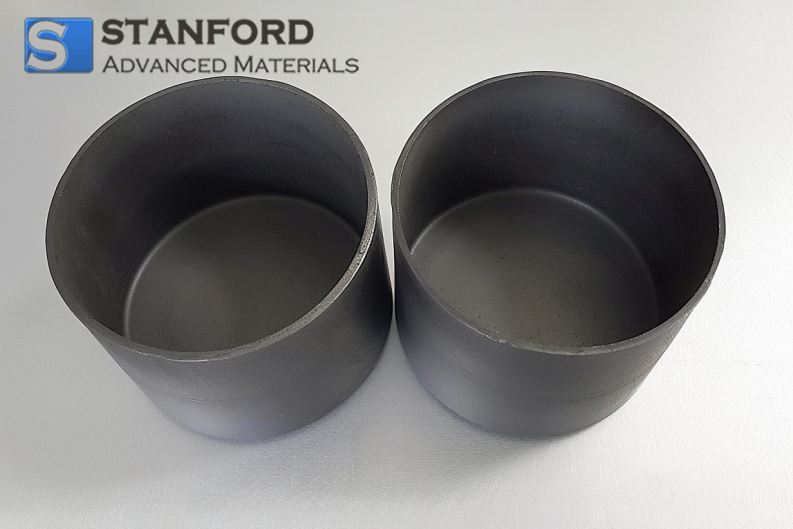
After considering material performance, cost, and lead time, SAM provided a number of alternatives. The customer then chose Pyrolytic Boron Nitride (PBN). PBN is not water-absorbing, as opposed to alumina, and its microstructure of layers responds thermal stress well. While the upfront cost per crucible was higher, the customer valued long-term reliability and process continuity at the expense of short-term economics.
Lisa Ross, senior engineer at SAM, noted:
“Our goal wasn't just to suggest a stronger material, but to match the crucible to the specific stress conditions. PBN fit this case perfectly—heat, humidity, and repeat cycles are where it thrives.”
Customer Feedback
After several weeks of use, the customer reported:
- No cracking or deformation under repeated thermal cycles
- Greater confidence in running high-temperature dehydration steps
- Fewer process interruptions and better consistency across batches
“We had no idea the atmosphere could affect the crucibles this much. SAM not only pinpointed the issue, they walked us through multiple material options until we landed on the right one. The improvement was immediate.”
Conclusion
Material selection isn't just a question of temperature ratings—it's selecting the overall setting: atmosphere, cycle rate, chemical exposure, and mechanical stress.
Here, a standard high-temp ceramic—alumina—fared badly from steam exposure and thermal shock. By switching to a more suitable material, the customer eliminated failure points, reduced downtime, and improved process stability.
Stanford Advanced Materials provided more than a material—we helped the customer rethink how their crucibles interact with the process environment. That's the difference between supplying and solving.
Ready to work with us? Send an Inquiry today.
Also, see our crucible category here.
 Chin Trento