
 Products
 Bars
Bars
 Beads & Spheres
 Bolts & Nuts
 Crucibles
 Discs
Discs
 Fibers & Fabrics
 Films
Films
 Flake
Flake
 Foams
Foams
 Foil
Foil
 Granules
 Honeycombs
 Ink
Ink
 Laminate
 Lumps
Lumps
 Meshes
 Metallised Film
 Plate
Plate
 Powders
 Rod
Rod
 Single Crystals
 Sputtering Target
 Tubes
Tubes
 Washer
 Wires
Wires
 Converters & Calculators
 Write for Us



Sterling Silver 925 Powder for Precision AM in Jewelry and Functional Metal Parts

Customer Background
A well-established manufacturer based in Germany, specializing in both precision jewelry and high-end functional metal components, required a material solution that could meet the increasingly rigorous demands of additive manufacturing. Their operations depended on producing intricate jewelry pieces with tight tolerances as well as functional parts that must perform reliably in final applications.
Historically, the customer had experience using standard metal powders. However, as market pressures grew and designs became more intricate, the need for powder that offered both predictable flow characteristics and minimal variability became clear. The existing powders were insufficient in delivering the level of detail required during powder bed fusion or binder jetting processes. After thorough internal evaluations of potential suppliers, the customer turned to Stanford Advanced Materials (SAM) to revisit their powder specifications, aiming to achieve both aesthetic and structural excellence.
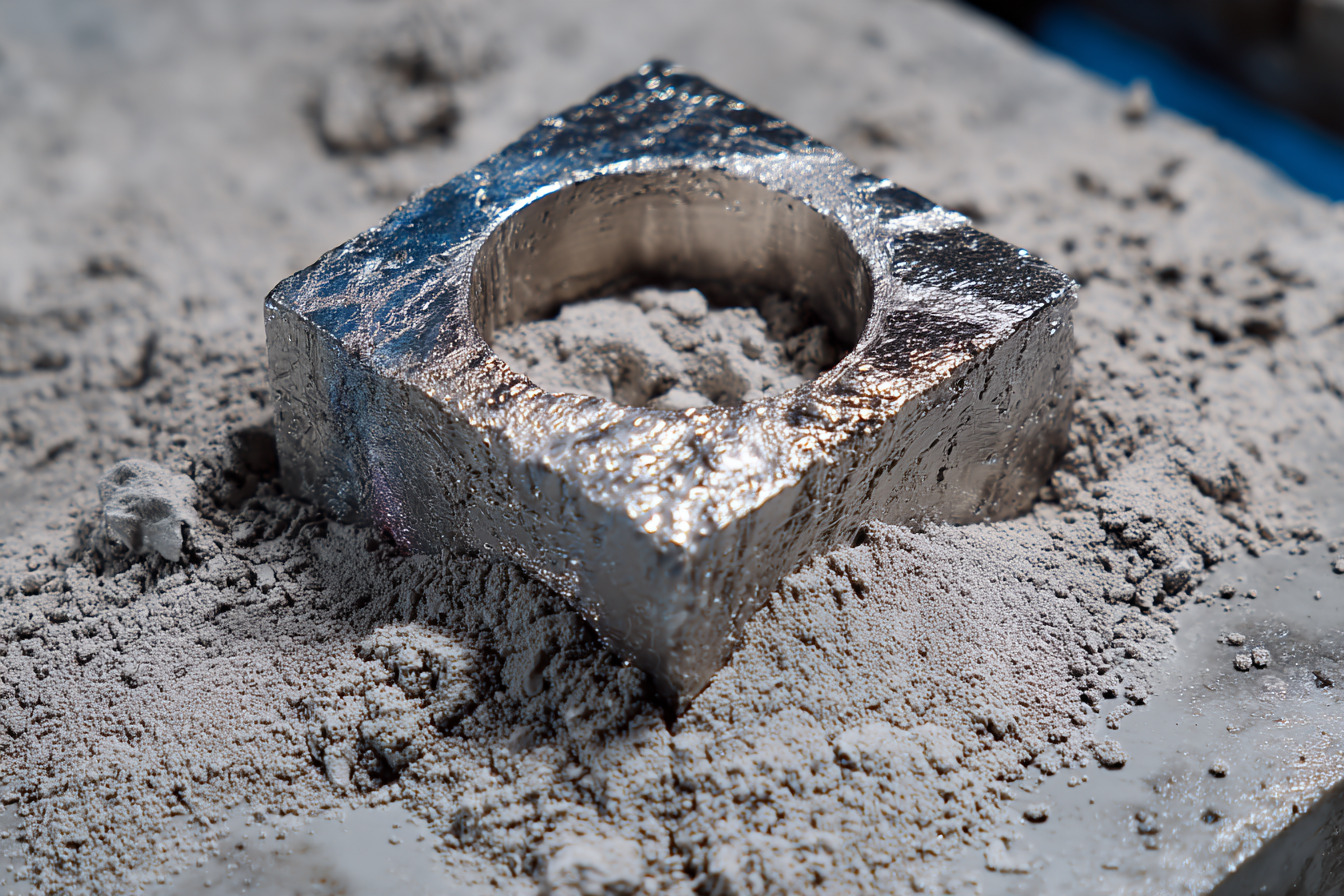
Challenge
The challenges were multifaceted. The customer required a Sterling Silver 925 powder characterized by:
• Consistent composition – ensuring the alloy contains precisely 92.5% silver and 7.5% copper with controlled trace impurities.
• Spherical morphology – to guarantee uniform layer spreading and optimal packing density during additive manufacturing, promoting smooth energy absorption during either powder bed fusion or binder jetting.
• Tight particle size distribution – aiming for a D50 value around 25 µm, with a narrow spread (approximately ±5 µm), to balance melt pool stability and resolution in printed parts.
Besides achieving these technical criteria, the customer faced real-world constraints. Their production schedule had limited lead time to run extensive trial batches, meaning any variation could lead to costly production delays. Additionally, the powder had to be stable enough to avoid oxidation during both storage and the high-temperature AM processes, which would otherwise compromise the printed parts' integrity.
Why They Chose SAM
The decision to engage with Stanford Advanced Materials (SAM) stemmed from our three decades of experience supplying advanced materials across a global supply chain. Our team's capability to customize materials to strict technical specifications stood out during the qualification process.
We offered detailed pre-production consultations that included an in-depth review of the customer's AM process parameters, such as energy input and printing speed, to help determine the ideal powder characteristics. Our ability to discuss practical issues—such as powder bonding, surface oxidation, and thermal stability under rapid heating and cooling cycles—gave the customer confidence that SAM could manufacture a powder meeting both aesthetic and functional requirements.
Furthermore, SAM demonstrated flexibility in packaging options. Recognizing the risks associated with prolonged storage and transport conditions, we offered vacuum-sealed packaging designed to minimize oxidation and moisture uptake. This packaging consideration proved critical given the customer's need for a consistent material supply on short notice.
Solution Provided
At SAM, we adapted our standard processing protocols to create a custom batch of Sterling Silver 925 powder that met the precise requirements demanded by the customer. Our solution involved several technical improvements and process controls:
• Material Purity and Composition: We ensured the powder conformed to the Sterling Silver 925 standard by thoroughly controlling the alloy composition. The final composition featured 92.5% silver and 7.5% copper, with trace elements kept below 0.05% to avoid any adverse effects during the AM process.
• Controlled Particle Morphology and Size: To achieve ideal flowability and packing density, we employed a gas atomization process capable of generating spherical particles. The resulting powder exhibited a tight particle size distribution centered around a D50 of 25 µm and a tolerance of ±5 µm. This consistency contributed directly to more uniform energy absorption during melting, which is critical for both powder bed fusion and binder jetting processes.
• Surface Stability and Packaging: A noted risk with silver powders is the potential for surface oxidation. We introduced a controlled atmosphere cooling phase post-atomization and implemented vacuum-sealed packaging to curb oxidation, preserving particle integrity over extended periods. Additionally, our modifications in heat treatment protocols ensured that the powder maintained a stable surface, thereby reducing variability during scanning laser or binder jetting operations.
• Delivery under Tight Lead Time Constraints: Recognizing the customer's need for a fast turnaround, we restructured our production scheduling to ensure that the custom batch was ready within the short lead time, without compromising on quality. Our modified supply chain protocols allowed for rapid quality control checks and expedited packaging.
Results & Impact
The performance improvements were measurable. Post-implementation, the manufacturer reported a distinct enhancement in the consistency of printed layers, resulting in precision details that met the stringent quality demands of both precision jewelry and functional metal components. Specifically:
• Improved layer fidelity and resolution during additive manufacturing runs were observed, thanks to the uniform particle size and spherical shape which minimized scattering and energy loss during the melting process.
• The controlled purity and composition led to predictable mechanical properties in printed parts, reducing post-processing efforts.
• The optimized packaging meant that the material maintained its stability for longer durations, enabling batch-to-batch consistency despite logistic challenges.
The customer's production cycle experienced less downtime due to material inconsistencies. Such operational improvements allowed them to further refine their printing parameters and achieve higher yields with reduced variability in part quality. Overall, this translated into enhanced end-use performance of the final components, bolstering both aesthetic quality and durability.
Key Takeaways
This case underscores the necessity of meticulous material customization in additive manufacturing, particularly when working with alloys like Sterling Silver 925. Our experience at SAM shows that addressing technical specifics—such as particle size distribution, morphology, and surface stability—can systematically improve production outcomes.
Attention to detailed engineering parameters, combined with rapid manufacturing adjustments, proved critical in meeting both aesthetic and functional requirements. It also highlighted that a supplier's ability to adapt production schedules while maintaining strict quality and packaging controls is essential when dealing with complex additive manufacturing constraints.
The collaboration emphasizes that technical expertise and supply chain flexibility are paramount in ensuring that custom materials perform reliably under demanding applications.
 Dr. Samuel R. Matthews