Products
 Bars
Bars
 Beads & Spheres
 Bolts & Nuts
 Crucibles
 Discs
Discs
 Fibers & Fabrics
 Films
Films
 Flake
Flake
 Foams
Foams
 Foil
Foil
 Granules
 Honeycombs
 Ink
Ink
 Laminate
 Lumps
Lumps
 Meshes
 Metallised Film
 Plate
Plate
 Powders
 Rod
Rod
 Single Crystals
 Sputtering Target
 Tubes
Tubes
 Washer
 Wires
Wires
 Converters & Calculators
 Write for Us



Achieving Precise 0.2µm Filtration: Custom 316L Sintered Stainless Steel Filter for Laboratory Applications

Customer Background
A major U.S. national laboratory, renowned for its rigorous chemical research and testing protocols, required a filtration element capable of handling extremely aggressive chemical environments. Their operations involved processing corrosive laboratory mixtures, where uniform filtration performance is critical for experimental repeatability. While the lab's internal team excelled in chemical analysis, they had limited in-house expertise in developing precision-engineered filtration hardware. Prior attempts using standard filters led to performance variability, making it difficult to maintain consistent pore size distribution under repeated backflush cycles.
Challenge
The laboratory faced several intertwined challenges:
· Precisely engineered pore structure: They needed a filter with a uniform 0.2µm pore size distribution. Achieving this level of consistency in a sintered stainless steel material was nontrivial.
· Material resilience: Frequent exposure to aggressive chemical environments meant that the filter material had to offer exceptional corrosion resistance. The solution had to be durable enough to withstand rigorous cleaning processes, including backflushing.
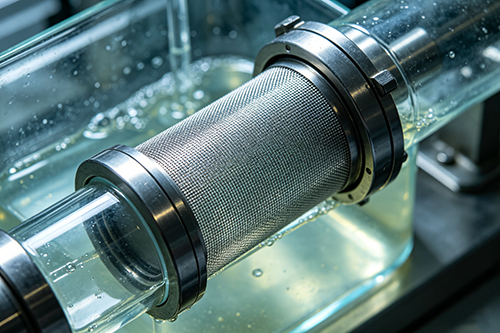
· Mechanical integrity: Maintaining a stable cylindrical shape with dimensions of 0.5-inch OD, a wall thickness of 0.062-inch, and a length of 6 inches was critical. The design had to balance high flow rates with robust mechanical strength.
· Turnaround time: The laboratory's experimental schedules introduced rigid timing constraints. Any delay in producing a custom filter could have caused setbacks in their research timelines.
With these needs in focus, the laboratory required a partner capable of delivering a custom-designed filter with meticulous attention to detail in pore structure and material performance.
Why They Chose SAM
Stanford Advanced Materials (SAM) was approached because of our extensive experience with advanced materials over the past 30 years and our ability to customize solutions for demanding applications. Our 10,000+ global customers trust us for both our technical rigor and our understanding of complex supply chain demands. The lab was particularly reassured by our proven track record in fabricating components that require uniform material properties and precise dimensions.
During early evaluation meetings, our engineering team noted the importance of achieving a uniform 0.2µm pore size without compromising mechanical durability. Sharing our observations, we discussed potential adjustments to the sintering process to maintain consistent flow rates even during backflush cycles. These informal yet critical insights provided the laboratory team with confidence in our approach.
Solution Provided
Our solution hinged on the use of 316L sintered stainless steel—a material known for its excellent resistance to corrosive chemicals and mechanical fatigue. Here's how we addressed the challenge:
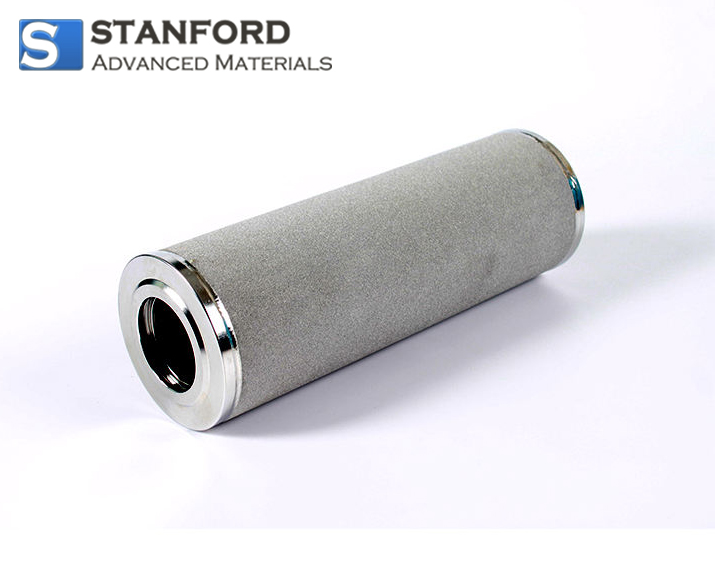
· Material selection and preparation: We started with high-grade 316L stainless steel, which inherently provides excellent corrosion resistance. Our engineers confirmed that the base material met the stringent chemical stability requirements, ensuring long-term durability even in aggressive laboratory environments.
· Precision sintering process: The heart of our solution was a meticulously controlled sintering process. We focused on achieving a uniform 0.2µm pore size distribution throughout the cylindrical filter. During initial testing of prototype batches, we noticed slight variations at the filter edges. To address this, we fine-tuned the sintering temperature profiles and pressure parameters. The final process effectively balanced pore consistency with the 0.5-inch outer diameter and 0.062-inch wall thickness, ensuring overall structural reliability.
· Backflush capability: To ensure reliability under repeated cleaning cycles, we optimized the microstructural design. The design maintained sufficient pore interconnectivity to allow high flow rates, while preserving the mechanical strength required for backflushing. As our team noted during early trials, slight adjustments in the pore connectivity significantly improved the filter's durability.
· Custom dimensions and packaging: The final design was a cylindrical filter measuring 6 inches in length. Each filter was individually inspected for pore uniformity and dimensional accuracy. Our quality control systems, which include inline measurement protocols, confirmed that the pore sizes were within the target ±0.02µm range. Given the laboratory's tight timeline, we ensured the entire process—from design confirmation to final packaging—was completed within the lead time constraints.
· Quality assurance: We used rigorous in-house testing protocols to verify that the filters maintained their structural integrity under operational stresses. Testing included backflush cycle simulations to confirm that no degradation in pore uniformity occurred, even after multiple cleaning cycles.
Results & Impact
The laboratory observed several measurable improvements after integrating the custom filter into their processes:
· Consistent performance: The filter maintained a tight pore size distribution at 0.2µm throughout its service life. This consistency was vital in reducing experimental variability.
· Enhanced durability: The 316L sintered stainless steel construction provided excellent resistance to the aggressive chemicals used during research. Even under prolonged exposure and repeated backflush cycles, the filters showed minimal signs of wear.
· Process reliability: By eliminating the unpredictable performance seen in previous filter batches, the laboratory's experimental setups ran smoother. The reliable filtration enabled quicker turnaround in data collection, which, in turn, allowed the research team to focus more on chemical analysis and less on equipment troubleshooting.
· Delivered on time: The custom solution was delivered within the prescribed lead time, ensuring that ongoing experiments faced no delays. The rigorous quality control procedures ensured that every unit met the specified mechanical and chemical resistance standards.
In our final review, the laboratory's technicians commented, "It's not just the material quality; it's how the performance remains stable even after each backflush." Such feedback confirmed that the custom approach worked exactly as intended.
Key Takeaways
Our work with this national laboratory underscores the importance of detailed engineering oversight in developing custom filtration solutions. By focusing on precise process control—especially during the sintering stage—and by understanding the specific challenges posed by aggressive chemical environments, we could deliver a filter that met all operational requirements without cutting corners. Some lessons include:
· Material choice matters: 316L stainless steel proved to be a solid choice in balancing corrosion resistance with mechanical strength.
· Process control is critical: Fine-tuning sintering conditions ensured that the target pore size distribution was achieved consistently.
· Timeliness is essential: With a tight lead time, a responsive supply chain and customized production approach were mandatory for success.
Stanford Advanced Materials (SAM) remains committed to providing custom-engineered solutions that address complex industrial challenges. The insights gained from this project continue to inform our approach to similar challenges in advanced materials applications.
 Dr. Samuel R. Matthews