
 Products
 Bars
Bars
 Beads & Spheres
 Bolts & Nuts
 Crucibles
 Discs
Discs
 Fibers & Fabrics
 Films
Films
 Flake
Flake
 Foams
Foams
 Foil
Foil
 Granules
 Honeycombs
 Ink
Ink
 Laminate
 Lumps
Lumps
 Meshes
 Metallised Film
 Plate
Plate
 Powders
 Rod
Rod
 Single Crystals
 Sputtering Target
 Tubes
Tubes
 Washer
 Wires
Wires
 Converters & Calculators
 Write for Us



Metal Hardness and the World's Strongest Metals

Hardness is one of the most significant mechanical properties of metals. It defines a material's capacity to resist deformation under localized conditions—predominantly indentation, scratching, cutting, or wear.
Let's discover these questions: what is metal hardness, how is measured, and how to improve it. You can also get a handy metal hardness chart and learn the ten strongest metals ever known to human beings.
What Is Metal Hardness?
Metal hardness refers to the ability of a metal to resist deformation, i.e., permanent deformation such as scratching or indentation. It is associated with other mechanical properties like toughness and strength but is not one and the same.
There are several types of hardness:
- Scratch hardness — scratch resistance (e.g., Mohs scale).
- Indentation hardness — resistance to permanent indentation by a non-moving object (e.g., Brinell, Rockwell, Vickers).
- Rebound hardness — resistance to elastic deformation, measured by rebound height following impact (e.g., Leeb test).
Tungsten, titanium, and hard steel metals are typically linked with high hardness and therefore are optimum for wear-resistant applications.
Measurement of Metal Hardness
- Brinell Hardness Test (BHN): Utilizes a tungsten carbide or steel ball to indent the surface. Used for softer metals; provides average hardness over a larger surface area.
- Rockwell Hardness Test (HR): Common in industry, applied to test indentation depth on a range of scales (e.g., hard steel's HRC). Quick and easy to perform.
- Vickers Hardness Test (VHN): Utilizes diamond pyramid indenter to precisely test thin or small specimens. Highly precise but more time-consuming.
- Mohs Hardness Scale: Quick scratch test ranging from 1 (talc) to 10 (diamond). Convenient for quick qualitative testing.
- Leeb Hardness Test (HL): A rebound speed measuring tool carried in the hand. Ideal for big or mounted items.
Metal Hardness Chart
To better understand how different metals compare with each other regarding hardness, here is a reference chart giving a list of materials commonly encountered on different hardness scales. These values give a rough guide but may be influenced by some alloy combinations, manufacturing methods, and heat treatment.
|
Metal/Alloy |
Brinell (HB) |
Rockwell (HRC) |
Vickers (HV) |
Mohs |
|
Lead |
~5 |
— |
~10 |
1.5 |
|
Aluminum (pure) |
~15 |
— |
~25 |
2.5 |
|
Copper |
~35 |
B20–30 |
~50–60 |
3 |
|
Mild Steel |
~120 |
B70 |
~140 |
4 |
|
Stainless Steel (304) |
~200 |
B85–95 |
~250 |
5.5 |
|
Hardened Steel |
~600 |
C60 |
~700 |
7 |
|
Titanium Alloy |
~340 |
C36–40 |
~380 |
6 |
|
Tungsten Carbide |
>1500 |
— |
>1600 |
9 |
|
Chromium |
~1120 |
— |
~1100 |
8.5 |
|
Diamond (for ref.) |
— |
— |
— |
10 |
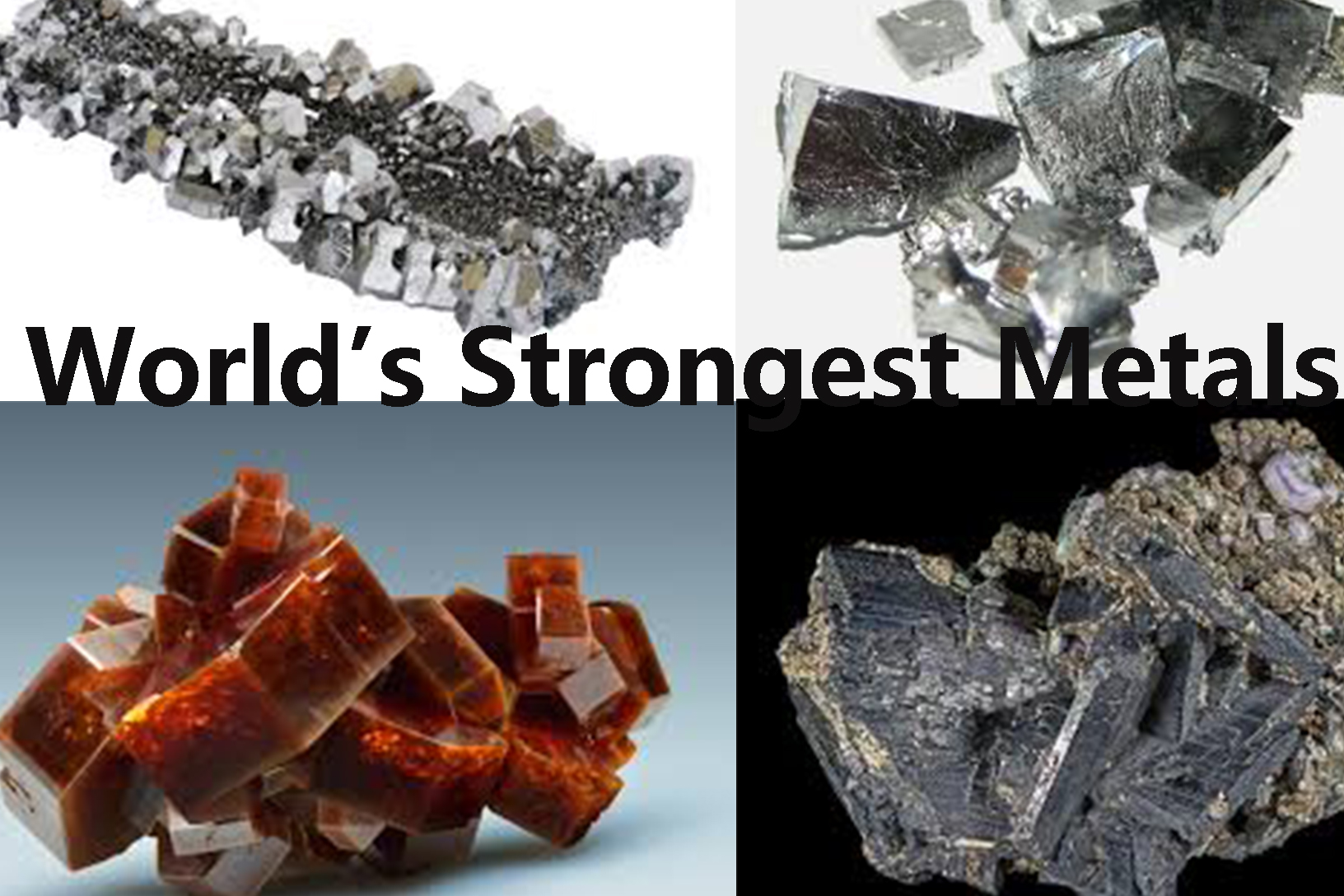
Top 10 Strongest Metals in the World
Strength and hardness are not identical but close. However, the strongest metals are largely the hardest ones. Here is the list of the top 10 most striking:
1. Tungsten (Tensile Strength: ~1510 MPa, Mohs Hardness: ~9)
Tungsten possesses the highest tensile strength among pure metals and possesses extreme hardness. It doesn't lose its strength even at very high temperatures, which is why it's of vital importance to aerospace components, cutting tools, and military applications.
2. Inconel (Tensile Strength: >1000 MPa, Mohs Hardness: 6.5–7)
Inconel is a family of nickel-chromium superalloys which are resistant to high temperature and hardness. It is used in jet engines, gas turbines, and chemical plants due to its resistance to corrosion as well as oxidation.
3. Titanium (Tensile Strength: ~1000 MPa, Mohs Hardness: ~6)
Titanium possesses tensile strength along with low density and moderate hardness. Its strength-to-weight ratio and corrosion resistance render it the best to be utilized in aerospace, implantation devices, and sea environments.
4. Tool Steel (Hardened Steel) (Tensile Strength: 700–1000 MPa, Mohs Hardness: ~7)
Steels such as A2, D2, and H13 are heat-treated to achieve high surface strength and hardness. These are widely used in tooling, die casting, and wear parts.
5. Vanadium (Tensile Strength: ~800 MPa, Mohs Hardness: ~6.7)
Vanadium possesses high tensile strength and is strengthened and hardened when alloyed with steel. It finds wide usage in aerospace components, armor plating, and high-speed tooling.
6. Chromium (Tensile Strength: ~418 MPa, Mohs Hardness: 8.5–9)
Although tensile strength of chromium is average, it is the hardest naturally occurring metal on the Mohs scale. It is an essential element in stainless steel production and provides excellent wear and corrosion protection in plating applications.
7. Osmium (Tensile Strength: ~600 MPa, Mohs Hardness: ~7)
Osmium is among the densest and hardest materials. Despite brittleness, it is highly wear-resistant and used in specialized industries such as fountain pen nibs and electrical contacts.
8. Iridium (Tensile Strength: ~540 MPa, Mohs Hardness: ~6.5)
Iridium is an extremely hard and corrosion-resistant metal even at high temperatures. It is highly utilized in spark plugs, crucibles, and deep sea communication equipment, although it is highly brittle.
9. Niobium (Tensile Strength: ~275 MPa, Mohs Hardness: ~6)
Niobium finds applications predominantly as an alloying addition to enhance structural steels' strength and in making superconductors. Although it is not the strongest metal in its elemental form, it significantly strengthens other materials.
10. Tantalum (Tensile Strength: ~200 MPa, Mohs Hardness: ~6.5)
Tantalum might be less resistant to tensile strength, but it is extremely resistant to corrosion and has good hardness. It is used extensively in electronics (especially capacitors), medical implants, and aerospace components where chemical stability is a must.
Note: This sequence proves that while tensile strength is one of the key markers of metal performance, hardness, corrosion resistance, and thermal stability are equally important in determining the most suitable material for a given industrial or engineering requirement.
Conclusion
Metals' hardness is an important parameter in assessing the suitability of a material to be used for certain industrial or structural applications. Understanding what hardness, measuring it, and enhancing it enables engineers to make more informed decisions and maximize metals for tools, structures, machines, and sophisticated devices. Hardness leaders are tungsten, chromium, and hardened steel, but the choice of metal always depends on the specific set of properties to get the job done. For more information, please check Stanford Advanced Materials (SAM).
 Chin Trento