Products
 Bars
Bars
 Beads & Spheres
 Bolts & Nuts
 Crucibles
 Discs
Discs
 Fibers & Fabrics
 Films
Films
 Flake
Flake
 Foams
Foams
 Foil
Foil
 Granules
 Honeycombs
 Ink
Ink
 Laminate
 Lumps
Lumps
 Meshes
 Metallised Film
 Plate
Plate
 Powders
 Rod
Rod
 Single Crystals
 Sputtering Target
 Tubes
Tubes
 Washer
 Wires
Wires
 Converters & Calculators
 Write for Us



Top 10 Thermally Conductive Materials

Thermal conduction is essential for controlling heat in devices and machinery. Materials with high thermal conductivity transfer heat efficiently, improving performance and reliability. Below is a ranked guide to ten notable materials, starting with the most conductive.
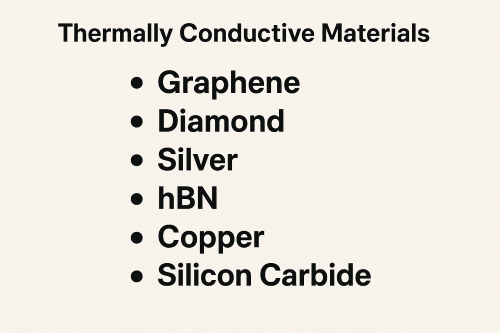
1. Graphene (in-plane) (~5000 W/m·K, 3000°C)
At the top is graphene, a single molecule of carbon atoms. Its unparalleled in-plane heat conductivity makes it quite suitable for microchips, flexible electronics, and proof-of-concept thermal systems. Somewhat stalled in research stages, graphene can become a force for revolutionary improvement in high-performance electronics.
2. Diamond (~2200 W/m·K, 2000°C)
Diamond realizes outstanding thermal conductivity with hardness. Diamond has become a staple in a diverse array of applications, including high-performance cutting tools, laser heat spreaders, and aerospace heat sinks for whom ultra-high reliability performance in extreme environments is a must.
3. Silver (~430 W/m·K)
Silver is the best metallic heat conductor. Applied in such items as printed circuit boards, thermal pastes, and heat exchangers, silver serves well to transfer heat away from electronics but is costly for large-scale thermal applications.
4. Graphite in plane (~400 W/m·K, 150°C)
Graphite provides excellent in-plane conductivity at a much lower cost compared with either diamond or silver. Graphite has a planar structure, and this is where the good dispersion of heat occurs in batteries, lubricants, and electronic heat spreaders.
5. Hexagonal Boron Nitride (h-BN, in-plane) (~400 W/m·K, 250°C)
h-BN is unique due to its high thermal conductivity while providing electrical insulativity. Its applications include high-temperature insulation, liquid cooling systems, and semiconductor packaging.
6. Copper (~400 W/m·K)
Copper is a compromise on cost versus performance. Being electrically and mechanically used, copper is a general-purpose thermal conductor for wiring, plumbing, and cooling applications.
7. Silver-Diamond Composites (~1000 W/m·K, 600°C)
The goal of attaining high conductivity and the capability of operation at very high temperatures leads engineers to prepare a composite of silver with diamond. It is used in aerospace electronics and defense systems where the requirements for metal and diamond properties are needed.
8. Silicon Carbide (SiC) (~270 W/m·K, 120°C)
SiC is known for its resistance to stress and its thermal conductivity. This material is applied in the production of power electronics, ceramics, and systems requiring heat resistance and durability.
9. Aluminum (~205 W/ m·K)
Aluminum resists corrosion well and is both light and easy to work with. The material has been utilized in the automotive and radiator markets due to its suitable conductivity for use where weight is a concern.
10. Aluminium Nitride (AlN)(180 W/ m·K, 140°C)
It has superb thermal conductivity, coupled with electrical insulation, making it useful for applications in microelectronics, high frequency, thin thickness, and more.
Summary Table
|
Rank |
Material |
Thermal Conductivity (W/m·K) |
Max Temp (°C) |
Key Uses |
|
1 |
Graphene (in-plane) |
~5000 |
3000 |
Microchips, flexible electronics |
|
2 |
Diamond |
~2200 |
2000 |
Cutting tools, heat sinks |
|
3 |
Silver |
~430 |
— |
PCBs, thermal pastes |
|
4 |
Graphite (in-plane) |
~400 |
150 |
Batteries, heat spreaders |
|
5 |
h-BN (in-plane) |
~400 |
250 |
Insulators, cooling systems |
|
6 |
Copper |
~400 |
— |
Wiring, plumbing |
|
7 |
Ag-Diamond Composite |
~1000 |
600 |
Aerospace, advanced electronics |
|
8 |
SiC |
~270 |
120 |
Power electronics, ceramics |
|
9 |
Aluminum |
~205 |
— |
Automotive, electronics |
|
10 |
AlN |
~180 |
140 |
Microelectronics, substrates |
For more specific data and tech support, please check Stanford Advanced Materials (SAM).
Conclusion
From graphene's groundbreaking in-plane conductivity to aluminum nitride's pairing of insulation with heat conduction, these materials meet a wide spectrum of engineering specifications. The selection between the appropriate material depends on the temperature range, electrical properties, expense, and specific performance needs.
Frequently Asked Questions
F: Why does a material have thermal conductivity?
Q: Atomic bonding and structure affect the ability of a material to conduct heat.
F: How is high thermal conductivity used in electronics?
Q: It helps to dissipate excess heat, protects against components, and maintains device operation.
F: Are these materials used under extreme temperature conditions?
Q: Yes, many perform quite well even at high temperatures, ensuring reliability in tough environments.
 Chin Trento