
 Products
 Bars
Bars
 Beads & Spheres
 Bolts & Nuts
 Crucibles
 Discs
Discs
 Fibers & Fabrics
 Films
Films
 Flake
Flake
 Foams
Foams
 Foil
Foil
 Granules
 Honeycombs
 Ink
Ink
 Laminate
 Lumps
Lumps
 Meshes
 Metallised Film
 Plate
Plate
 Powders
 Rod
Rod
 Single Crystals
 Sputtering Target
 Tubes
Tubes
 Washer
 Wires
Wires
 Converters & Calculators
 Write for Us



Top 8 Highest Thermal Stability Ceramics

Introduction
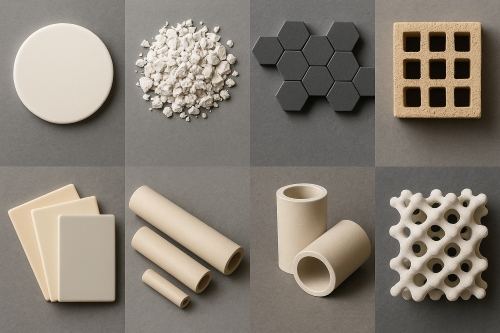
Extreme heat-resistant ceramics find wide usage in the majority of technical applications. They are utilized in furnaces, aerospace parts, and heavy industry machinery. They offer strength, chemical stability, and durability even under extremely high temperatures. The following are the top eight excellent thermal resistance ceramics.
Hafnium Carbide – Working Temperature: 3900 °C
Hafnium Carbide is a top choice for the most heat-resistant ceramic. It is able to withstand temperatures of as much as 3900 degrees Celsius. It's employed both within engines as well as high-end aerospace components. It is desirable when temperatures exceed ordinary limits. Its enhanced thermal stability is helpful in scientific equipment requiring steady, accurate operation.
The hard nature of Hafnium Carbide makes it used in small amounts in composites. It increases the overall temperature resistance of certain alloy systems as well. The material does not undergo deformation and maintains its structure at extreme temperature levels.
Tantalum Carbide – Working Temperature: 3800 °C
Tantalum Carbide is one of the temperature-resistant ceramics. It can survive temperatures of approximately 3800 degrees Celsius. The ceramic finds its use in high-temperature furnaces where excessive heat is always a matter of concern. It is also utilized in aerospace and engine components. Its resistance to wear makes it stable even in the most harsh environments. Engineers choose this material because it can be stable even if metal components can get melted.
Tantalum Carbide has found applications in the real world where high temperatures are the norm. Its structure does not deteriorate with sudden heat shocks. It caters to the demands of applications where a material has to perform without deterioration.
Zirconium Carbide – Working Temperature: 3400 °C
Zirconium Carbide shares a number of heat-resistant characteristics with its hafnium counterpart. It is extremely stable when heated. This ceramic is used in tools that are constantly subjected to heat, e.g., reactor and furnace parts. Zirconium Carbide is also used in protective coatings that protect engines operating at high temperatures.
This compound has been used in various industrial processes. Its capacity to withstand rapid heat changes has been beneficial. Zirconium Carbide helps prevent wear and tear on vital metal surfaces.
Hafnium Diboride – Working Temperature: 3250 °C
Hafnium Diboride is another high-temperature-resistant compound. While not as well known to the general public as some of the other compounds, it is more and more vital in thermal applications. It is used in high-tech heat shields and industrial parts where temperature surges occur. Its properties help to reduce thermal expansion problems that accompany heat.
Hafnium Diboride is used by engineering teams in high-tech aerospace designs. In the design, the ceramic ensures enhanced safety in demanding thermal applications. Its resilience makes it a favorite among specialists who work with harsh environments.
Tantalum Nitride – Operating Temperature: 3000 °C
Tantalum Nitride is resistant in harsh thermal conditions. The ceramic is desired for use where high temperature and extreme chemical interactions are concerns. It appears in industrial furnace equipment hardware and electrical component coatings. The material remains stable when temperatures exceed what is normal for other ceramics.
Applications in the real world uncover Tantalum Nitride in high-end electronics. Cyclic heating performance has been well-documented. It is a suitable option in applications that demand thermal resistance of high quality.
Boron Nitride – Working Temperature: 2000 °C (inert atmosphere)
Boron Nitride is a versatile ceramic, which is highly thermally stable. It can operate at temperatures ranging around 2000 degrees Celsius in an inert atmosphere. It is utilized in lubrication, high-temperature insulators, and electronic componentry. The chemical resistance of Boron Nitride makes it a desirable product. This ceramic is also very light in weight, offering benefits for aerospace and electronic applications.
Its smooth texture renders Boron Nitride used as a coating to different industrial processes. It serves to reduce friction in high-temperature stress. Its proven track record of enduring high temperatures renders it a trusted material in the sight of many engineers.
Boron Carbide – Operating Temperature: 2000 °C
Boron Carbide possesses ideal thermal stability with maximum operating temperatures suitable between 1800 and 2000 degrees Celsius. Boron Carbide is also renowned for hardness and lightness. Boron Carbide is widely used in wear-resistant applications. It is also found in protective armor and abrasive tools where there is high heat produced while operating.
Engineers prefer Boron Carbide because it is resilient. It increases the life span of many high-stress mechanical parts. Its capacity to endure not only heat but also chemical corrosion has made it a favorite in a broad range of industries.
Silicon Carbide – Operating Temperature: 2000 °C
Silicon Carbide performs best in most industrial applications. It has the resistance to 1900-2000 degrees Celsius temperature. Silicon Carbide is found in motor parts, brake pads, and heat components. Its thermal stability and high strength are responsible for improved performance. It further has excellent wear resistance, another plus while in extended service.
Silicon Carbide application to car uses has long been reported. Its excellent durability to harsh conditions is ideal for energy and transportation enterprises alike. It is the choice material for designers to utilize whenever no failure whatsoever can be afforded.
Frequently Asked Questions
F: For what functions are high-temperature ceramics employed?
Q: They are used in furnaces, aerospace parts, and industrial machinery to withstand extreme heat.
F: Can the ceramics take sudden changes in temperature?
Q: Yes, they preserve structure under high-speed change in pressure and heat.
F: Are the ceramics applied in extensive common usage?
Q: They are used in specialized industries and high-tech applications but not in common household products.
 Chin Trento