
 Products
 Bars
Bars
 Beads & Spheres
 Bolts & Nuts
 Crucibles
 Discs
Discs
 Fibers & Fabrics
 Films
Films
 Flake
Flake
 Foams
Foams
 Foil
Foil
 Granules
 Honeycombs
 Ink
Ink
 Laminate
 Lumps
Lumps
 Meshes
 Metallised Film
 Plate
Plate
 Powders
 Rod
Rod
 Single Crystals
 Sputtering Target
 Tubes
Tubes
 Washer
 Wires
Wires
 Converters & Calculators
 Write for Us



Types of Tantalum Mesh and Their Applications

Introduction to Tantalum Mesh
Tantalum is a metal used in many high-performance applications. Tantalum mesh is a woven or fused mesh of tantalum wires. Tantalum mesh is highly resistant to high temperature and corrosive chemicals. Its inherent characteristics predispose its use in many industrial processes.
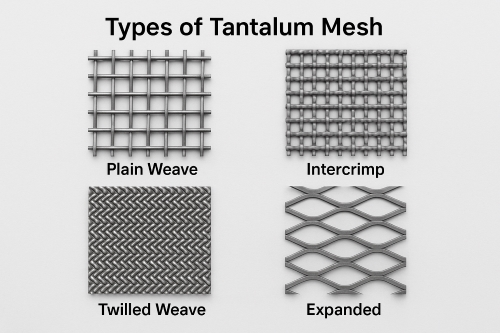
Types of Tantalum Mesh
Standard tantalum mesh is a woven material made from tantalum wire and is valued for strength, corrosion resistance, and stability at high temperatures. Uses include chemical reactors, rocket nozzles and heat shields in aerospace applications, and capacitors where electrical stability is crucial.
Tantalum alloy mesh, which is alloyed with tungsten or niobium, has better durability and heat stability. It serves demanding military and aerospace requirements and is also found in medical implants and surgical instruments that are made to be biocompatible.
Tantalum expanded mesh is produced through slitting and expanding tantalum sheets into a porous, rigid mesh. Its strength and permeability make it suitable for chemical filtration systems and furnace linings at high temperatures.
Sintered tantalum mesh, which is produced by bonding tantalum powder, possesses high surface area and chemical stability and is utilized as catalyst support and for fine filtration in nuclear and high-purity chemical industries.
Finally, tantalum foil mesh is a thin, pliable mesh with fine perforations, good conductivity, and biocompatibility, and finds application in stents, bone scaffolds, and precision electronics.
Advantages of Tantalum Mesh
Tantalum mesh has a number of advantages. The material is resistant to corrosion. This makes it compatible in chemical and biological environments. Its resistance to high temperature is another benefit. It stands up well to severe conditions such as in engines or reactors. The mesh is also extremely ductile, i.e., it will bend but will not break. This is an useful characteristic in applications where flexibility is required. Engineers appreciate that tantalum mesh will keep performing predictably over extended periods of time. Its long service life reduces maintenance and replacement expenses.
Tantalum components have an impeccable safety record. Different industries rely on its stability for severe applications. Generally, these advantages make tantalum mesh a strong candidate in niche applications.
Conclusion
Tantalum mesh is a solid material with a proven track record. Its different forms meet different industrial needs. Its properties, which include excellent corrosion resistance, excellent high-temperature characteristics, and flexibility, allow it to function under extreme conditions.
Frequently Asked Questions
F: What are the fundamental types of tantalum mesh?
Q: There exist woven, sintered, and expanded forms of tantalum mesh, each for specific applications.
F: Why is tantalum mesh favored for application in industrial high-temperature environments?
Q: It resists corrosion and is stable at high temperatures where other materials may degrade.
F: Oh, is tantalum mesh used in surgery?
Q: Yes, its high biocompatibility makes it perfect for surgical implants and instruments.
 Chin Trento