Products
 Bars
Bars
 Beads & Spheres
 Bolts & Nuts
 Crucibles
 Discs
Discs
 Fibers & Fabrics
 Films
Films
 Flake
Flake
 Foams
Foams
 Foil
Foil
 Granules
 Honeycombs
 Ink
Ink
 Laminate
 Lumps
Lumps
 Meshes
 Metallised Film
 Plate
Plate
 Powders
 Rod
Rod
 Single Crystals
 Sputtering Target
 Tubes
Tubes
 Washer
 Wires
Wires
 Converters & Calculators
 Write for Us



List of Earth's Powerful Magnets

1.N52 Neodymium Iron Boron – BHmax 52 MGOe, Field Approximately 1.48 Tesla
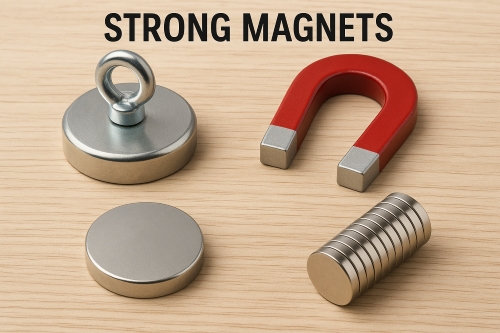
Neodymium iron boron magnets are among the marvels of permanent magnets in the contemporary world. The N52 grade magnet has a maximum energy product of 52 megagauss-oersted and produces a magnetic field of nearly 1.48 tesla. These magnets have widespread application in motors, generators, and other advanced devices. They excel in applications where size and efficiency are factors because of their high strength. In everyday devices, they are useful where space is limited but high performance is a requirement.
2.Samarium Cobalt – BHmax 14 to 32 MGOe, Field Around 1.2 Tesla
Samarium cobalt magnets possess decent resistance to high temperatures. With a 14 to 32 megagauss-oersted maximum energy product and a field of around 1.2 tesla, they are utilized in applications where other magnets would be compromised by heat. Their stability earns them a place as the preferred choice for aerospace and military applications. They are also used in devices where a stable magnetic field is needed despite harsh environments. Their performance is reliable over a very extended life.
3.Alnico Magnets – BHmax 4 to 12 MGOe, Field Approximately 0.8 Tesla
Alnico magnets, made from aluminum, nickel, and cobalt, have been used for decades. They possess a maximum energy product of four to 12 megagauss-oersted, with a field of about 0.8 tesla. Though weaker than neodymium magnets, alnico magnets are temperature-stable and durable. Alnico magnets are utilized in sensors, guitar pickups, and other industrial devices. They are a trustworthy component in many older systems due to their reliability and predictable performance.
4.Ferrite and Ceramic Magnets – BHmax 1.2 to 1.6 MGOe, Field Around 0.4 Tesla
Ferrite, or ceramic, magnets are low-cost. With a maximum energy product of typically 1.2 to 1.6 megagauss-oersted and a field of about 0.4 tesla, these magnets are used in most household applications. These magnets are used in speakers, refrigerator magnets, and other electronic devices. They make electronics cheaper through their simplicity of production and stable operation. They work well where the maximum magnetic power is not required.
5.Other Powerful Magnets
Terfenol-D is a magnetostrictive alloy that mechanically alters shape in a magnetic field, offering about 1.2 MGOe and about 1 tesla—perfect for actuators, sensors, and precision devices where response time matters. For research, Bitter and resistive electromagnets are the best steady-field champions at around 45.5 tesla and 42 tesla, respectively, but with heavy power and cooling requirements. Superconducting magnets match those strengths but with essentially zero energy loss when cooled, making them crucial in MRI machines and labs. To create extreme bursts, pulsed electromagnets can reach up to 1,200 tesla, opening up phenomena no static magnet can match. And far from Earth, magnetars push magnetism to the cosmic extreme, with fields of approximately 10^15 tesla—by far the strongest known in the universe.
Conclusion
The world of magnetism offers a fascinating spectrum from everyday applications to cosmic extremes. Permanent magnets such as neodymium iron boron and samarium cobalt provide dependable energy to household appliances and high-tech industries. Additionally, electromagnets – including Bitter, resistive, and superconducting – enable scientists to push the limits of magnetic field strength.
Frequently Asked Questions
F: Why are neodymium magnets so strong?
Q: They have high energy product and good magnetic alignment, making them excellent at small sizes.
F: Can magnets lose their strength over time?
Q: Yes, when exposed to high temperatures or physical abuse, they will lose some of their magnetism.
F: Are pulsed electromagnets safe to use in the laboratory?
Q: Yes, with proper controls and timing, they are safe and essential tools in research.
 Chin Trento