
 Products
 Bars
Bars
 Beads & Spheres
 Bolts & Nuts
 Crucibles
 Discs
Discs
 Fibers & Fabrics
 Films
Films
 Flake
Flake
 Foams
Foams
 Foil
Foil
 Granules
 Honeycombs
 Ink
Ink
 Laminate
 Lumps
Lumps
 Meshes
 Metallised Film
 Plate
Plate
 Powders
 Rod
Rod
 Single Crystals
 Sputtering Target
 Tubes
Tubes
 Washer
 Wires
Wires
 Converters & Calculators
 Write for Us



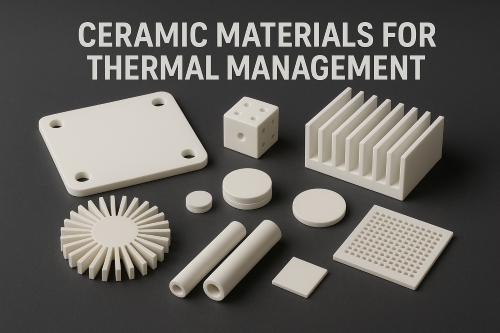
Top 10 Ceramic Materials for Thermal Management

What is thermal conductivity?
Thermal conductivity is how well a material conducts heat. In simple words, it shows how fast heat passes through a substance. High thermal conductivity means heat moves quickly. Low thermal conductivity means the material keeps heat better. This property is important. It affects how materials are used in engineering and daily devices. Engineers often look at thermal conductivity when choosing materials for electronics or engine components.
Thermal conductivity table of common ceramic materials
Below is a simple table listing some common ceramics and their thermal conductivities. These numbers are approximate and may vary with purity and production method.
|
Material |
Thermal Conductivity (W/m·K) |
|
Alumina |
20-35 |
|
Silicon Nitride |
20-30 |
|
Beryllium Oxide |
200-250 |
|
Aluminum Nitride |
140-180 |
|
2-3 |
|
|
Magnesium Oxide |
40-60 |
|
Cordierite |
3-4 |
|
Silicon Carbide |
70-120 |
|
Titanium Diboride |
40-60 |
|
Boron Nitride (Hexagonal) |
30-60 |
These values are average values measured in laboratory settings. The actual figures depend on factors such as processing and structure.
Top 10 ceramic materials with high thermal conductivity
Let us now look into the ceramic materials that perform best in transferring heat.
1. Beryllium Oxide – 200–250 W/m·K
Beryllium Oxide stands out with its thermal conductivity of 200-250 W/m·K. It is used in high-performance ceramic insulators. Engineers favor it for electronic packaging because of its heat dissipation properties.
2. Aluminum Nitride – 140–180 W/m·K
Aluminum Nitride works well for thermal management. Its conduction rate is 140-180 W/m·K. It is suited for high-power electronics. It also finds use in heat sinks and substrates.
3. Silicon Carbide – 70–120 W/m·K
Silicon Carbide is known for a conductivity of 70-120 W/m·K. It also has good mechanical strength. The material is often applied in high-temperature environments, such as industrial furnaces.
4. Magnesium Oxide – 40–60 W/m·K
Magnesium Oxide conducts heat at a rate of 40-60 W/m·K. It is commonly used in refractory applications and insulation parts for kilns.
5. Titanium Diboride – 40–60 W/m·K
Titanium Diboride has a thermal conductivity range between 40-60 W/m·K. It is used where both high strength and good heat conduction are needed. Examples are armor systems and heating elements.
6. Hexagonal Boron Nitride – 30–60 W/m·K
Hexagonal Boron Nitride, with a conduction range of 30-60 W/m·K, is valued for its stable performance even at high temperatures. It also functions as an electrical insulator, which is a plus in electronics.
7. Alumina (Aluminum Oxide) – 20–35 W/m·K
Regular Alumina shows thermal conductivity of 20-35 W/m·K. It is abundant and cost-effective. Components made from alumina are integrated into various heat management systems.
8. Silicon Nitride – 20–30 W/m·K
Silicon Nitride offers a conductivity of 20-30 W/m·K. Despite not being the highest, it balances strength, durability, and thermal management. It works well in automotive engine parts.
9. Cordierite – 3–4 W/m·K
Although cordierite has a lower thermal conductivity (3-4 W/m·K) compared to others in this list, its low coefficient of thermal expansion makes it ideal for thermal shock-resistant applications.
10. Zirconia (Stabilized) – 2–3 W/m·K
Stabilized Zirconia does not have high thermal conductivity (2-3 W/m·K). However, in some applications, its unique thermal expansion properties make it useful. It is critical in some high-temperature systems that require minimal deformation.
The top five materials listed here (Beryllium Oxide, Aluminum Nitride, Silicon Carbide, Magnesium Oxide, and Titanium Diboride) offer the highest performance in terms of thermal conduction. The rest provide useful properties when thermal stability or cost issues are considered.
Applications of thermally conductive ceramic materials
Thermally conductive ceramics have many uses.
They serve in electronics, where heat from microprocessors must be dissipated. Aluminum Nitride and Beryllium Oxide are common in circuit boards and packaging for chips. In power electronics, proper heat removal can extend device lifetimes.
In high-temperature industrial settings, Silicon Carbide and Magnesium Oxide perform well. They are found in heating elements, kiln components, and furnace linings. Engines and automotive parts sometimes use Silicon Nitride due to its balance of thermal conductivity and strength.
Ceramics also play a role in aerospace. Their ability to handle high heat loads makes them ideal for components in jet engines and spacecraft. The materials keep temperatures in check, allowing sensitive instruments to run safely.
Some medical devices benefit from ceramics. Their biocompatibility and controlled heat conduction suit implantable devices and diagnostic equipment. Additionally, materials like Hexagonal Boron Nitride help manage heat in laser systems and high-power lighting.
Industrial heat exchangers sometimes use ceramic composites. These mixtures are designed to hold shape even at high temperatures while providing reliable heat dissipation. The choice of material depends on thermal loads, mechanical strength required, and cost limitations.
Conclusion
Thermally conductive ceramics serve an essential role in modern engineering. Their ability to move heat efficiently is crucial in electronics, industry, aerospace, and medicine. Materials like Beryllium Oxide, Aluminum Nitride, and Silicon Carbide lead the list for high performance. Other ceramics offer benefits such as durability, low thermal expansion, and cost effectiveness.
Frequently asked questions
F: Why is thermal conductivity important in ceramics?
Q: It affects the material performance in electronics and high-temperature applications by efficiently transferring heat.
F: How is thermal conductivity measured?
Q: It is measured in watts per meter-kelvin using a controlled temperature difference and heat flux.
F: What applications use high thermal conductivity ceramics?
Q: They are used in electronics, industrial heating elements, aerospace components, and medical devices.
 Chin Trento