
 Products
 Bars
Bars
 Beads & Spheres
 Bolts & Nuts
 Crucibles
 Discs
Discs
 Fibers & Fabrics
 Films
Films
 Flake
Flake
 Foams
Foams
 Foil
Foil
 Granules
 Honeycombs
 Ink
Ink
 Laminate
 Lumps
Lumps
 Meshes
 Metallised Film
 Plate
Plate
 Powders
 Rod
Rod
 Single Crystals
 Sputtering Target
 Tubes
Tubes
 Washer
 Wires
Wires
 Converters & Calculators
 Write for Us



Top 10 Metal Conductors of Electricity

Introduction
In our daily life, all the devices and machinery rely upon metals to conduct electricity in an effective manner. Metals are the backbone of electrical wire, circuits, and other technologies. Let's discuss the list item by item.
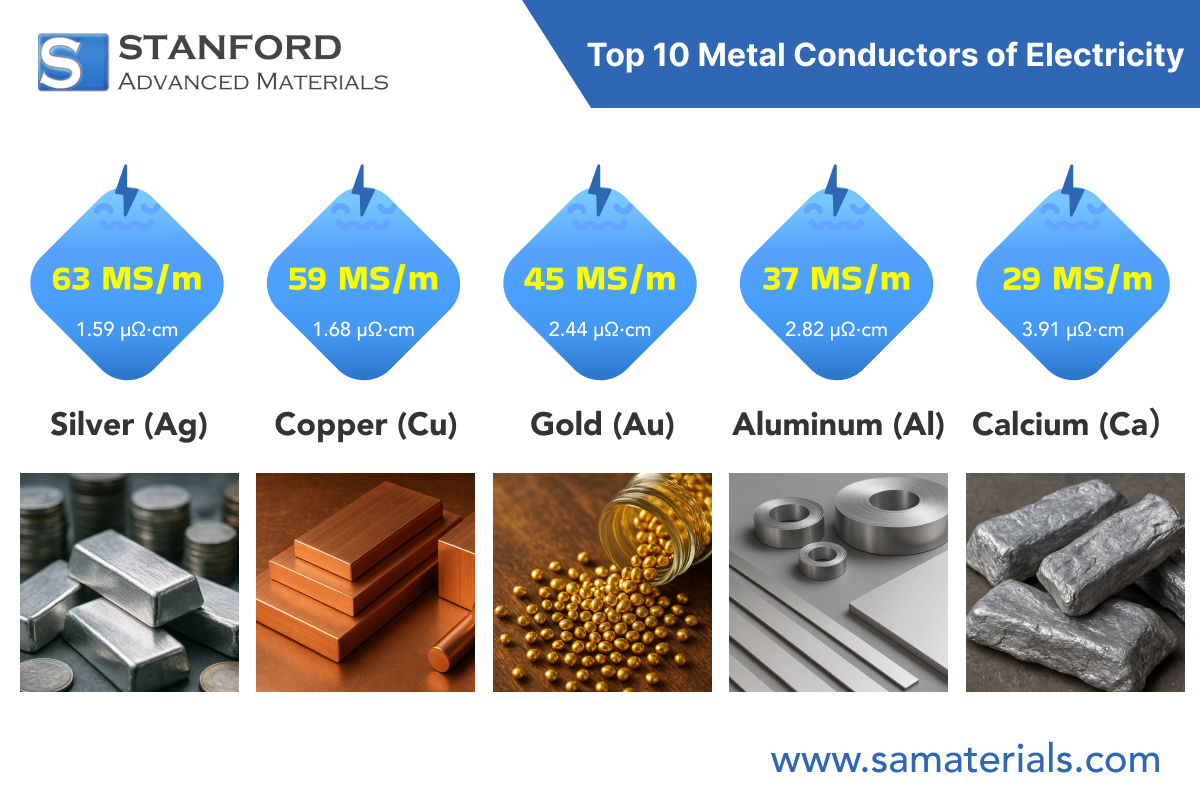
Silver (Ag) – 63 MS/m / 1.59 µΩ·cm
Silver is the best of all general conductors. Silver is very conductive and is suited for applications of high-quality and precision connectors. Silver is used where minimal energy loss is critical, though it is costly. Silver improves performance in applications such as radio frequency connectors and certain industrial circuits.
Copper (Cu) – 59 MS/m / 1.68 µΩ·cm
Copper is nearly as good a conductor as silver. Its biggest selling point is that it is cheap and plentiful. Copper wire is found in almost every electrical system. The metal is the preferred choice for household wiring, power distribution lines, and printed circuit boards. It provides efficiency with long life.
Gold (Au) – 45 MS/m / 2.44 µΩ·cm
Gold is not the best conducting metal when compared to copper or silver but does possess corrosion resistance. Such a characteristic makes gold widely used in electronic components that must provide reliable performance over decades. Gold plating is regularly seen in contacts, connectors, and high-reliability circuits. The industry depends on it since it is stable in unfriendly environments.
Aluminum (Al) – 37 MS/m / 2.82 µΩ·cm
Aluminum is less heavy than copper and possesses satisfactory conductivity per unit weight. For high-voltage transmissions, aluminum is also used due to its low weight and price. Overhead transmission lines and busbars often employ aluminum, as reduced weight reduces the loading on sustaining members without any deterioration in the resistance.
Calcium (Ca) – 29 MS/m / 3.91 µΩ·cm
Though not as well-known as the metals above to be used for conducting electricity, calcium does have average conductivity. More reactive, calcium has uses in specific alloy applications. Researchers and engineers will sometimes mix calcium with other metals to tailor conductivity and toughness. Its application in advanced materials just demonstrates that even the lesser-known metals play a role in today's technology.
Tungsten (W) – 18 MS/m / 5.65 µΩ·c
Tungsten is best known for its strength and its ability to sustain a high melting point. It may not be as conductive as silver, copper, or aluminum, but it is utilized in situations where it must withstand high temperatures. It is found in many light bulb filaments and certain high-temperature applications. Tungsten's resistance to heat makes it suited for these applications.
Zinc (Zn) – 17 MS/m / 5.90 µΩ·cm
Zinc possesses a considerable degree of electrical conductance. It is mostly employed for galvanization to prevent rusting. Zinc is sometimes used in batteries and as an alloying element in the area of electrical applications. Zinc hardens other metals and provides corrosion resistance in electrical contacts.
Nickel (Ni) – 14 MS/m / 6.90 µΩ·cm
Nickel is yet another useful conductor. Though lower in conductivity, nickel offers wear resistance and hardness. Nickel occurs in many alloys and is often used to extend the life of metal components in machinery and electrical parts that have constant use. Its magnetic properties also make it useful for some industrial applications.
Lithium (Li) – 11 MS/m / 9.30 µΩ·cm
Lithium is also very famous for use in rechargeable batteries, powering the majority of appliances today. Its electrical conductivity is mediocre, but its lightness and unique chemical characteristics render it useful for energy storage. Lithium offers performance as well as weight savings, thus it is critical for portable devices, electric cars, and grid energy storage.
Iron (Fe) – 10 MS/m / 10.0 µΩ·cm
Iron takes the tenth place in our top metal conductors list. It is abundant and strong. Though its conductivity is the lowest among these top ten, iron's workability and strength ensure it finds its way in different applications. Steel, an iron alloy, constitutes the core of modern structures and machinery and is thus a vital material in most structural and electrical components.
Conclusion
Metals and alloys constitute the backbone of modern electric systems. Each conductor on this list has distinct traits that are suited for particular uses. Silver conducts the best but is costly. Copper and aluminum offer the optimal balance of price and quality. Gold, tungsten, and lithium are metals used for specialized purposes where their respective properties are essential. These characteristics would be countered by a seasoned engineer with the right specifications to achieve the optimal performance in equipment and infrastructure.
Q: Yes, aluminum is light weight and has been used for high voltage transmission lines for decades.
 Chin Trento