
 Products
 Bars
Bars
 Beads & Spheres
 Bolts & Nuts
 Crucibles
 Discs
Discs
 Fibers & Fabrics
 Films
Films
 Flake
Flake
 Foams
Foams
 Foil
Foil
 Granules
 Honeycombs
 Ink
Ink
 Laminate
 Lumps
Lumps
 Meshes
 Metallised Film
 Plate
Plate
 Powders
 Rod
Rod
 Single Crystals
 Sputtering Target
 Tubes
Tubes
 Washer
 Wires
Wires
 Converters & Calculators
 Write for Us



Common Marine Grade Metals

Causes of Marine Corrosion
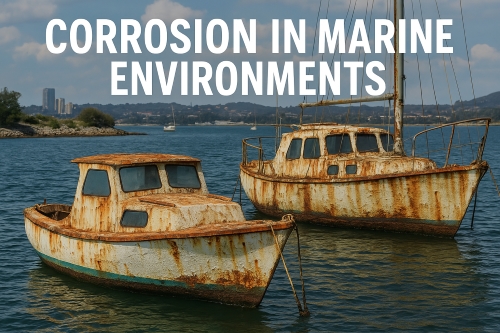
Marine environment corrosion is mostly caused by seawater and moisture. The salt will immediately react with the metal surface. Water worsens the situation. Chemical impurities in the water add to the complexity. Corrosion decreases the equipment life. The problem starts with small surface cracks which allow salt penetration. Sun and heat speed up the reaction. Constant exposure leads to more damage. Maintenance and proper choice of metals reduce these issues.
Forms of Corrosion in Seawater Environments
Corrosion in seawater environments happens in several forms.
Uniform corrosion is uniform over the whole surface.
Pitting corrosion creates small pits and is hard to spot.
Crevice corrosion occurs within joints and narrow spaces.
Galvanic corrosion happens where two disparate types of metals encounter each other in the presence of seawater.
Stress corrosion arises due to a mixture of stress and corrosive environment.
All these categories possess a group of signs and dangers. Knowing them helps in choosing the right materials for the job.
Factors for Choosing Marine Grade Metals
The right metal needs to be chosen. The metal needs to be salt- and moisture-resistant. The metal needs to be strong and long-lasting. The cost is also a factor. Ease of fabrication and joining techniques are also important. The use to which the metal is put differs significantly. A structure built in shallow water, for instance, presents a different exposure to risk than one built several miles out to sea. Durability and maintenance frequency are considerations. Achieving the right balance between these concerns makes a safe and long-lasting marine facility.
Stainless Steels (316, 317, 2205 Duplex)
Stainless steels are widely used in marine applications. Grade 316 stainless steel offers good corrosion resistance. Grade 317 offers extra resistance in the most severe conditions. 2205 Duplex stainless steel offers high strength and super resistance. They are applied to piping, fasteners, and structure components for many coastal and off-shore installations. These steels retain their strength when exposed to salt. They meet normal tests and satisfy all. The numbers (316, 317, 2205) are pointing towards the difference in the composition of the alloys. Their composition allows them to serve in the most critical marine areas.
Nickel-Based Alloys (Inconel 625, Monel 400)
Nickel-based alloys are best when high temperature and corrosive chemicals are a factor. Inconel 625 contains the combination of nickel, chromium, and molybdenum to counteract corrosion. Monel 400 stands out with high resistance in seawater. Both of them are used widely in marine pumps, valves, and marine heat exchangers. They are dependable to be used where other metals are not dependable. Their dependability has seen them become the engineer's favorite. The corrosion resistance and strength are optimally balanced in the composition of the alloy.
Copper and Copper Alloys (C70600, C71500 Naval Brass, Aluminum Bronze)
Copper and copper alloys are used in structures that are marine and require strength and antimicrobial functionality. C70600 and C71500, or Naval Brass, are used in ships and sea water applications. Aluminum Bronze has superior toughness and excellent saltwater corrosion resistance. These alloys are common in seawater systems, propeller shafts, and fittings for ships. Their unique properties reduce biofouling. Mechanics have at times remarked that the natural tendency of copper alloys to prevent growth provides extra life to the system. Their performance enables composite material producers to maintain them as dependable options for decades.
Aluminum Alloys (5083, 5052, 6061-T6)
Aluminum alloys are lightweight yet strong. The 5083 alloy is widely utilized in ship structures with good resistance to seawater. The 5052 alloy provides good formability and weldability for boat structures. Alloy 6061-T6 is a general-purpose alloy and used on structural components, supporting frames, and other boat parts. These alloys provide an excellent strength-to-weight ratio. They are applied most generally when weight reduction is the main requirement. Performance of pressure tests has been demonstrated under actual conditions. Their application in different marine uses is evidenced by decades of field use. For more corrosion resistant materials, please check Stanford Advanced Materials (SAM).
Frequently Asked Questions
F: Why does corrosion happen in marine environments?
Q: Salt, water, and contaminants in water lead to corrosion of metal.
F: Why are marine grade metals anti-corrosion?
Q: They use specialized combinations of alloys that possess high resistance to salt and moisture.
F: Are there different prices for these metals?
Q: Yes, price is based on composition and intended application.
 Chin Trento