Products
 Bars
Bars
 Beads & Spheres
 Bolts & Nuts
 Crucibles
 Discs
Discs
 Fibers & Fabrics
 Films
Films
 Flake
Flake
 Foams
Foams
 Foil
Foil
 Granules
 Honeycombs
 Ink
Ink
 Laminate
 Lumps
Lumps
 Meshes
 Metallised Film
 Plate
Plate
 Powders
 Rod
Rod
 Single Crystals
 Sputtering Target
 Tubes
Tubes
 Washer
 Wires
Wires
 Converters & Calculators
 Write for Us



What Are the Different Types of Thermocouple Wire?

Introduction to Thermocouple Wires
Thermocouple wires are the basis of temperature-measuring systems. They join two dissimilar metals and produce a voltage proportional to temperature gradients. Thermocouple wires have quick response and work in severe conditions. Thermocouple wires are used very widely in furnaces, kilns, engines, and many other devices. They come in many varieties with different metal combinations for operation in many different conditions.
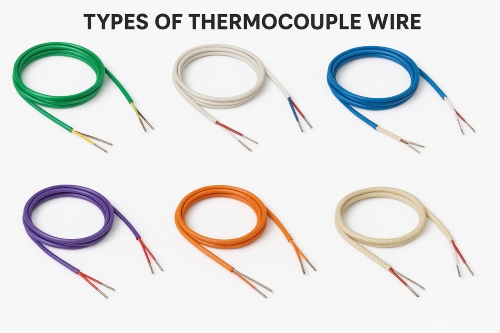
Type K (Chromel–Alumel)
Type K wires utilize Chromel for the positive leg and Alumel for the negative leg. They are mostly used in conditions that never rise above 1260°C (2300°F). A number of industries utilize them because they are inexpensive and heavy-duty. They have good precision within a wide range of temperatures. Type K is usually chosen by engineers for metal heat treatment and manufacturing processes. They can be applied in oxidizing atmospheres as well as inert atmospheres. It is easy for people with basic technical expertise to install and maintain.
Type J (Iron–Constantan)
Type J wires have iron paired with constantan. They are adequate to about 760°C (1400°F) in air. They find use in antique machinery or for specific applications when the environment is not too hostile. Their simplicity is one of their best features, and most repair shops still stock them. The primary drawback is that the iron leg will rust when it comes into contact with water. However, their inexpensiveness and simplicity result in their being utilized frequently in most industrial applications.
Further reading: Thermocouple Wires 101 Types, Applications, and Properties
Type T (Copper–Constantan)
Type T wires are produced by combining copper and constantan. Their span is suitable for temperatures up to 370°C (700°F). They are, however, good enough even in sub-zero temperatures. They are used extensively in laboratories and low-temperature measurement. Their hardiness in cold temperatures and steadiness over a time frame make them a safe choice. Laboratories and food processing plants utilize Type T wires due to their reliable performance.
Type E (Chromel–Constantan)
Type E wires consist of Chromel and constantan. They are very sensitive. Their temperature range goes up to 900°C (1650°F). Their high thermoelectricity output makes them best suited for precise measurement of temperature. Some scientific equipment and industrial machines use this high sensitivity to measure small temperature changes. Their voltage output is almost twice the amount of other types when used over the same range of temperature.
Type N (Nicrosil–Nisil)
Type N wires are made of nicrosil and nisil. They were created to be more stable. They work well within temperatures of up to 1300°C (2370°F). They are designed to reduce errors known as drift. They are used in high-temperature engines and combustion systems. Type N wires are preferred by engineers because they are more stable and have a longer life. They are best suited for use when a high degree of accuracy is required over a long duration.
Type R and S (Platinum–Rhodium)
Type R and Type S wires utilize platinum and rhodium alloys. They are excellent at very high temperatures, as much as 1600°C (2900°F) for Type S. They are highly stable and accurate. They find extensive use in laboratories and high-end industrial uses such as aerospace and metallurgy. The cost of such wires is generally higher. They are stable and precise and thus a very good choice for accurate temperature measurement.
Type B (Platinum–Rhodium)
Type B wires are also members of the platinum–rhodium family. They are employed in temperature ranges similar to Types R and S, specifically in very high temperature applications. They are not afflicted with the same shortcomings at lower temperatures as their platinum–rhodium cousins. When dependability needs to be ensured in severe heat, Type B wires offer a rugged solution. Their cost usually restricts them to special industrial and laboratory uses where reliability is a requirement.
Special Thermocouple Wires
In addition to the common types stated above, there are some special thermocouple wires. There are some that are made with special coatings to be resistant against corrosion and enhance life in situations where they will encounter chemicals and moisture. Some are made to have less drift for applications in the long term. These wires provide extra protection in situations where exposure is more harsh than normal in laboratory or industrial settings. They are most often used in chemical plants, marine use, or wherever there is the possibility of contamination.
Thermocouple Wire Selection Criteria
Selecting the proper thermocouple wire involves some considerations.
First, consider the temperature range of your application. Certain wires prefer colder temperatures, while others are meant for use with high temperatures.
Second, think about your environment. Will the thermocouple need to withstand oxidation, chemical exposure, or moisture?
Thirdly, you must ensure precision. If you require extremely precise readings, a high-sensitivity type like Type E would be perfect.
Finally, your budget might restrict you. Better wires such as platinum–rhodium types cost more but last longer and are more reliable. Real-world applications include their use in average industrial furnaces using Type K wires and their use in lab cooling systems using Type T.
The selection should always be based on both the conditions under which it operates and the level of urgency of the temperature readings needed.
Frequently Asked Questions
F: Why is Type K wire so well-liked?
Q: It has good durability and accuracy across a broad temperature range for low cost.
F: What is the typical application for Type T wire?
Q: It is mainly utilized in the laboratory and low-temperature uses.
F: Why use special thermocouple wires?
Q: They offer added corrosion protection and increased stability in harsh conditions.
 Chin Trento