
 Products
 Bars
Bars
 Beads & Spheres
 Bolts & Nuts
 Crucibles
 Discs
Discs
 Fibers & Fabrics
 Films
Films
 Flake
Flake
 Foams
Foams
 Foil
Foil
 Granules
 Honeycombs
 Ink
Ink
 Laminate
 Lumps
Lumps
 Meshes
 Metallised Film
 Plate
Plate
 Powders
 Rod
Rod
 Single Crystals
 Sputtering Target
 Tubes
Tubes
 Washer
 Wires
Wires
 Converters & Calculators
 Write for Us



Dielectric Constant and Top Material

Introduction
We will cover the basics of dielectric properties and top materials. Let’s learn about how these materials store and handle electrical energy.
What It Is and How It Works
Dielectric constant is a figure denoting the capacity of a material to store electrical energy. It is a measurement of a material's permittivity in relation to a vacuum. The greater the constant, the more energy the material stores. The smaller the constant, the less energy it stores. This property is important in the design of capacitors and insulating materials. It helps choose the right material for a specific electrical use.
Factors Affecting the Dielectric Constant
Some factors affect the dielectric constant. Temperature is one of them. Temperature variation can alter the molecular structure. Frequency is also a factor. Impurities present in the material can modify the constant, which is measured. Physical structure and production process are factors too. All these must be considered while selecting a material for electrical applications.
Dielectric Constant and Types of Materials
Materials are divided into several types based on their dielectric properties. We see a range from high to low dielectric constants. They are composites or polymers in some cases or ceramics in others. Metals have other properties and would not typically be applied for this function. In comparing several types, engineers have the ability to choose the best material for energy storage and insulation.
High Dielectric Constant Materials
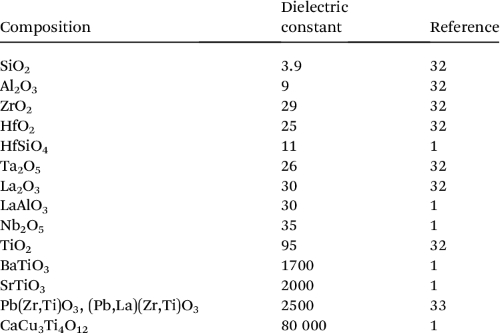
High dielectric constant materials can be much greater than 100 in some applications. Examples of such materials include barium titanate and lead zirconate titanate, which are utilized in sensors and capacitors. They are excellent in energy storage. Their ability to store charge makes them useful in many high-performance devices. The materials have their applications in advanced electronics where space is a factor and there is a necessity for efficient storage of energy.
Low Dielectric Constant Materials
Low dielectric constant materials have values between 2 and 3. Plastics and polymers come under this category mostly. They are applied to cable insulation and printed circuit boards. These materials help limit unwanted energy loss as well as cut down interference. They have low energy storage and stability, making them ideal for the majority of electrical insulators. They are applied widely to consumer electronics as well as to wiring in homes.
Vacuum
Vacuum is an area that contains no matter. Its dielectric constant is always 1. It is a reference for all other substances. Laboratory measurements always start with comparing a substance to a vacuum. The vacuum gives a consistent reference that is not affected by temperature or purity. It is a basic concept in understanding dielectric constants.
Applications of Dielectric Materials
Dielectric materials find applications in a wide field of daily technology. Capacitors in mobile phones, computers, and televisions all rely on the proper dielectric constant to operate best. High voltage cables also depend on insulators made up of these materials. Engineers and designers implement them to make power systems more efficient and reduce energy loss. Proper dielectric constant can be a matter of great importance in sensors and actuators. Correct selection of the material ensures safety, stability, and dependability of electric circuits.
Conclusion
Dielectric constant is a critical factor in the functioning of electrical materials. It dictates how well a material is capable of storing and distributing electrical energy. Optimum materials have a range of dielectric properties. Materials of high dielectric constant are preferred when there is a need for high energy storage. Materials of low dielectric constant are chosen for insulation and minimal energy loss. Even vacuum is employed as the universal reference. For more information, please check Stanford Advanced Materials (SAM).
Frequently Asked Questions
F: What is a dielectric constant?
Q: It is a factor of how much electrical energy is stored in a material relative to a vacuum.
F: Why are high dielectric constant materials important?
Q: They are used on capacitors and sensors for the storage of high energy and good performance.
F: How can temperature change the dielectric constant?
Q: The molecular structure changes due to temperature, which might increase or decrease the dielectric constant.
Reference:
[1] Azadmanjiri, Jalal & Berndt, Christopher & Wang, James & Kapoor, Ajay & Srivastava, V. & Wen, Cuie. (2014). A review on hybrid nanolaminate materials synthesized by deposition techniques for energy storage applications. Journal of Materials Chemistry A. 2. 10.1039/C3TA14034B.
 Chin Trento