Products
 Bars
Bars
 Beads & Spheres
 Bolts & Nuts
 Crucibles
 Discs
Discs
 Fibers & Fabrics
 Films
Films
 Flake
Flake
 Foams
Foams
 Foil
Foil
 Granules
 Honeycombs
 Ink
Ink
 Laminate
 Lumps
Lumps
 Meshes
 Metallised Film
 Plate
Plate
 Powders
 Rod
Rod
 Single Crystals
 Sputtering Target
 Tubes
Tubes
 Washer
 Wires
Wires
 Converters & Calculators
 Write for Us



What to Know about Compressive Strength of Advanced Ceramics

Introduction
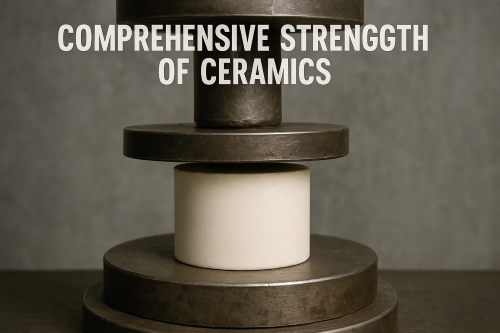
Advanced ceramics are significant materials in various industries. They work under severe environments. Their high compressive strength ensures they are ideal for load-bearing applications.
Which Advanced Ceramics Possess the Greatest Compressive Strength
Zirconium dioxide (zirconia) is among the strongest. It resists high compressive stresses quite effectively. Silicon nitride is another material valued for strength. It tends to exhibit compressive strength figures near two to three gigapascals. Alumina (aluminum oxide) also possesses high strength. It is prevalent in numerous industrial applications.
Other ceramics, like boron carbide, are known for not only high compressive strength but also for being extremely hard. A niche in systems where strength is the preference exists for each of these ceramics. They have been measured, tested, and utilized in a great many ways. Their numbers barely vary with testing techniques and with production techniques.
Why Advanced Ceramics Are Superior in Compressive Strength
Advanced ceramics are robust because of their unique structure. They possess a closely packed crystalline lattice. There is no dislocation motion as in metals. This makes them less prone to deformation. They are chemically resistant to corrosion and wear very well. In short, their internal bonding does not break easily under stress.
Scientists have long observed that ceramics can support loads many times their weight. Their grain size and purity also help. Most processing techniques result in fewer defects in the end product. Fewer defects translate to greater reliability.
Another property is heat resistance. It possesses high compressive strength even at elevated temperatures. Ceramic parts have found their way into engine parts and medical implants. That they retain their hard and stable phase is essential. Advances in compressive behavior via contemporary developments in sintering and powder technology are ongoing. Such advances show that ceramics are no longer the brittle material of yesterday but tough allies in today's design.
Applications of Ceramics with High Compressive Strength
There are many uses. In constructions, ceramics serve as load-bearing supports and protective coatings. In turbine engines, advanced ceramics are applied. They function well under high pressure and temperature. In the automotive sector, ceramic components help in braking systems and engine parts. For instance, brake discs sometimes apply ceramic composites because of their lightness and strength.
For aerospace, these ceramics lighten but strengthen. This contributes to fuel efficiency and overall performance. Cutting tools in numerous applications use ceramics like silicon nitride and boron carbide. They hold an edge for longer when machining conditions are challenging. Medical uses have high compressive strength ceramics in dental implants and bone replacement. High strength and inertness give longevity along with compatibility with human tissue.
In electronics, ceramics may serve as insulators and substrates for circuits. Their stable performance is crucial. Many industry case studies have used zirconia prosthetic components. The parts have performed well under repeated heavy loads. So, everyday applications and high-end cases both benefit from these advanced materials.
Summary Table of Properties
|
Ceramic Material |
Compressive Strength (Gigapascals) |
Hardness (Vickers) |
Density (g/cm³) |
|
Zirconium Dioxide |
2.0 - 2.5 |
1200 - 1400 |
5.8 - 6.1 |
|
Silicon Nitride |
2.0 - 3.0 |
1500 - 1700 |
3.1 - 3.3 |
|
Aluminum Oxide |
1.8 - 2.2 |
1500 - 2000 |
3.9 - 4.1 |
|
Boron Carbide |
3.0 - 4.0 |
2500 - 3000 |
2.5 - 2.6 |
The values in the table are representative ranges. They may differ with processing conditions and exact composition.
Conclusion
Advanced ceramics rank high in compressive strength. They are newly developed using new technology. Their heaviness in withstanding loads cannot be equaled by a number of other materials. This qualifies them for use from aerospace to everyday tools.
Frequently Asked Questions
F: What is the material of ceramic with the highest compressive strength?
Q: Boron Carbide has some of the highest compressive strength values.
F: Can these ceramics be used at high temperatures?
Q: Yes, they maintain compressive strength even under high-temperature conditions.
F: Are these ceramics utilized in day-to-day applications?
Q: Yes, they are widespread in industries such as automotive, aerospace, and medical devices.
 Chin Trento