Products
 Bars
Bars
 Beads & Spheres
 Bolts & Nuts
 Crucibles
 Discs
Discs
 Fibers & Fabrics
 Films
Films
 Flake
Flake
 Foams
Foams
 Foil
Foil
 Granules
 Honeycombs
 Ink
Ink
 Laminate
 Lumps
Lumps
 Meshes
 Metallised Film
 Plate
Plate
 Powders
 Rod
Rod
 Single Crystals
 Sputtering Target
 Tubes
Tubes
 Washer
 Wires
Wires
 Converters & Calculators
 Write for Us



What Are the Strongest Metals?

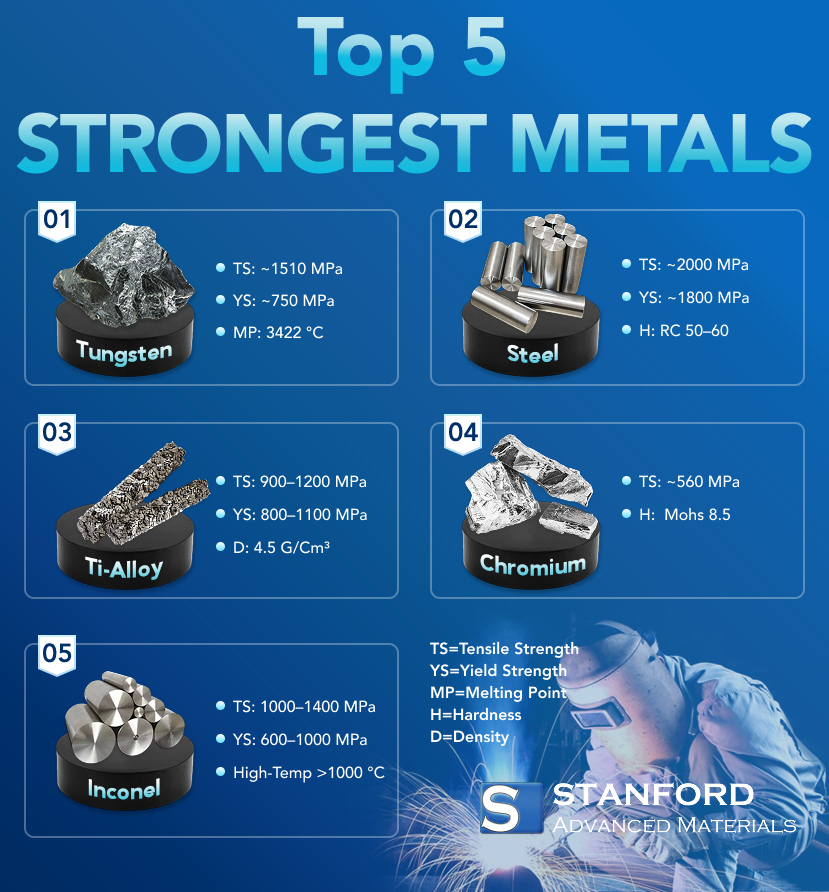
1. Tungsten – The Metal with the Highest Tensile Strength
• Tensile Strength: ~1510 MPa (219,000 psi)
• Yield Strength: ~750 MPa (109,000 psi)
• Melting Point: 3,422 °C (6,192 °F)
Tungsten is one of the metals known for its outstanding strength. It has a very high melting point of 3422°C. Many engineers put it to use in harsh environments. In many cases, tungsten is used when a high load is expected. Its tensile strength can be higher than 1510 megapascals, a number that impresses even experienced mechanics. Components such as electrical contacts and heavy-duty furnace elements benefit from tungsten’s durability. In the field, tungsten is prized for its ability to retain strength at high temperatures. I have seen tungsten parts work steadily in industrial furnaces. Its mechanical properties make it a prime choice for situations where failure is not an option.
2. Maraging Steel – Ultra-High Strength Alloy
• Tensile Strength: up to 2,000 MPa (290,000 psi)
• Yield Strength: ~1,800 MPa (260,000 psi)
• Hardness: ~Rockwell C 50–60
Maraging steel is another high-performance material. This alloy has undergone special heat treatments that give it impressive strength. Its yield strength can reach close to 2000 megapascals. Engineers use this steel when they need reliability over long periods. The aerospace industry values maraging steel for its light weight combined with strength. It is also used in high-performance sports equipment and high-end tools. I have worked with parts that benefit from the toughness of maraging steel in the construction of bridges and aircraft. Maraging steel is a blend of iron with nickel and other small amounts of elements that help achieve an ultra-strong state.
3. Titanium Alloys – Strong Yet Lightweight
• Tensile Strength: 900–1,200 MPa (130,000–174,000 psi)
• Yield Strength: ~800–1,100 MPa (116,000–160,000 psi)
• Density: ~4.5 g/cm³ (about 60% of steel’s density)
Titanium alloys bring together strength and light weight. They are widely used in aircraft parts and medical implants as well. Titanium alloys can have a strength-to-weight ratio that is greatly superior to many other metals. The most common titanium alloy is one that includes aluminum and vanadium. With less density than steel, this alloy helps design engines and frames that need to be light and strong. For example, many bicycle frames and airplane components use these alloys. Titanium alloys are well tolerated in harsh conditions. They resist corrosion and exhibit a friendly strength that is easy to use in everyday applications. This makes them ideal for projects where every gram counts.
4. Chromium – High Hardness and Corrosion Resistance
• Tensile Strength: ~560 MPa (81,000 psi)
• Hardness: ~8.5 on Mohs scale
Chromium stands out due to its very high hardness and resistance to corrosion. This metal is not often used in its pure form for construction. Instead, chromium is applied as a coating. Car bumpers or plumbing fixtures often get a layer of chromium. This layer gives a shiny finish and ensures that the object stays intact for a long time. The hardness of chromium is around 800 to 1000 on the Vickers scale. Its use in stainless steel provides resistance to rust and wear. In practice, chromium plating is common in the automotive industry.
5. Inconel – Nickel-Based Superalloy
• Tensile Strength: 1,000–1,400 MPa (145,000–203,000 psi)
• Yield Strength: ~600–1,000 MPa (87,000–145,000 psi)
• High-Temp Resistance: Maintains strength above 1,000 °C (1,832 °F)
Inconel is a group of nickel-based superalloys. They are known for stability in extreme conditions. Inconel can retain its strength even when exposed to temperatures over 700°C. Such metals are used in the construction of gas turbines, rocket engines, and chemical processing equipment. The high resistance to oxidation and corrosion sets Inconel apart from many other alloys. The use of Inconel is not new, but its performance in extreme settings remains unmatched. This superalloy is prized by engineers who work in the most challenging environments.
Conclusion
Strong metals have defined our modern way of life. They help create safer and more efficient systems in transportation, construction, and high-tech industries. Each metal discussed here has a role.
Frequently Asked Questions
F: What makes tungsten stand out among metals?
Q: Tungsten is prized for its exceptional tensile strength and very high melting point.
F: Why is maraging steel preferred in aerospace applications?
Q: Its heat-treated properties yield ultra-high strength and toughness, ideal for high-stress parts.
F: How do titanium alloys benefit modern engineering projects?
Q: They offer an unmatched balance of strength and light weight for critical components.
 Chin Trento