Products
 Bars
Bars
 Beads & Spheres
 Bolts & Nuts
 Crucibles
 Discs
Discs
 Fibers & Fabrics
 Films
Films
 Flake
Flake
 Foams
Foams
 Foil
Foil
 Granules
 Honeycombs
 Ink
Ink
 Laminate
 Lumps
Lumps
 Meshes
 Metallised Film
 Plate
Plate
 Powders
 Rod
Rod
 Single Crystals
 Sputtering Target
 Tubes
Tubes
 Washer
 Wires
Wires
 Converters & Calculators
 Write for Us



5 Highest Tensile Strength Materials

Introduction
When we refer to tensile strength, we refer to the ability of a material to resist forces that try to pull it apart. Material has evolved over the years to fulfill the needs of technology and industry. Engineers and designers today make use of numerous high-strength materials to create safer buildings and more reliable devices.
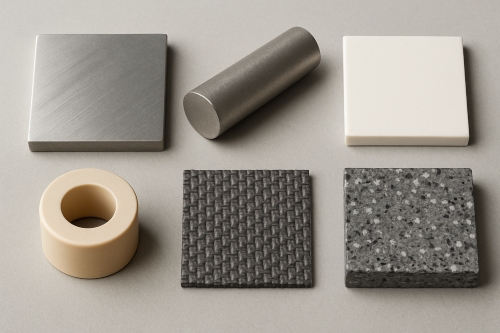
Metals (Maraging Steel, Tungsten, Titanium Alloys)
Metals have always been a priority in structural design. Maraging steel is one of the most popular high-strength steels. It provides tensile strength in the range of 2,000 megapascals. Maraging steel exhibits good toughness as well, making it suitable for critical components in tooling and aerospace applications.
Tungsten is yet another metal that stands out. Because of its high density and extremely high heat resistance, tungsten finds applications in high-heat conditions. Its strength remains uniform even in the worst conditions. Tungsten is often selected by engineers when they are designing hard and reliable parts.
Titanium alloys are a strong yet light solution in most sectors. Titanium alloys contain tensile strengths greater than 1,000 megapascals. Aircraft, sporting equipment, and medical appliances use titanium alloys. Durability coupled with lightness gives titanium alloys unique advantages that certain traditional metals do not possess.
Advanced Ceramics (Silicon Carbide, Boron Carbide)
Ceramic substances possess excellent wear resistance and tensile strength. Silicon carbide possesses hard surfaces and strain resistance. Silicon carbide can endure drastic abrasion and heat. Silicon carbide occurs in kiln hardware and brake rotors under normal conditions.
Boron carbide is yet another excellent ceramic. The compound is hard but light. It has been widely described to be used in armor plating and wear-resistant products. Silicon carbide and boron carbide have a strength-light balance. They perform well when heat and wear are significant considerations.
Carbon-Based Materials (Graphene, Carbon Nanotubes)
Carbon materials are superior in tensile strength. Graphene is a single carbon atom sheet in honeycomb structure. Tests show graphene can have a tensile strength of up to 130 gigapascals. Graphene is thus one of the strongest known materials. Uses can range from flexible electronics to high-strength coatings.
Carbon nanotubes are also extremely strong in tension. These tiny tubes of carbon are used in a variety of high-technology fields. Their resilience, combined with their light weight, allows engineers to design complex structures. Carbon nanotube development is currently taking place as they hold immense potential to aid industries such as the aerospace and electronics sectors.
High-Performance Polymers (Polyamide-imide, Polyetherimide, Polyether Ether Ketone)
For the majority of applications today, high-performance polymers are excellent choices. Polyamide-imide is engineered to endure under heat and wear uses. It most often winds up in components that need to be strong at high operating temperatures.
Polyetherimide possesses clarity and heat resistance. Tensile strength is what qualifies it for use in industry and household appliance application. For example, parts of medical equipment and car parts sometimes rely on polyetherimide for durability.
Polyether ether ketone, or PEEK, provides a strength-to-weight ratio. It is widely used in aerospace, automotive, and implantable medical device applications. The material's strength in high-stress, long-duration applications demonstrates its superior tensile property and resistance.
Composite Materials (Kevlar, Carbon Fiber Reinforced Polymers)
Composite materials are created when two or more materials are blended into one system. Kevlar is a well-known composite material utilized in safety gear. Its strength under tension makes it an ideal pick for bulletproof jackets. Many protective and sporting apparel makers use Kevlar due to its shock-absorbing properties.
Carbon fiber-reinforced polymers are a blend of carbon fibers and a polymer matrix. The blend yields products with high tensile strengths and low weight. They are applied in most racing vehicles and aircraft parts. The materials exhibit tensile strengths of more than 3 gigapascals when designed appropriately. Their strength with low weight is of great application in modern engineering designs.
Conclusion
Briefly, the majority of materials are defined by tensile strength. Metals like tungsten and maraging steel are long-lasting, ceramics like silicon carbide are hard to wear and heat, and carbon materials like graphene are the strongest. High-performance polymers provide solidity and heat resistance, and composites like Kevlar and carbon fiber provide strength but not heaviness.
Frequently Asked Questions
F: What is tensile strength?
Q: What is tensile strength?
F: Which metal possesses the very high tensile strength?
Q: Maraging steel is one of the very high tensile strength metals, usually about 2,000 megapascals.
F: Where are composite materials such as Kevlar applied?
Q: Kevlar is applied in bullet-resistant vests, safety gear, and other safety purposes.
 Chin Trento