Products
 Bars
Bars
 Beads & Spheres
 Bolts & Nuts
 Crucibles
 Discs
Discs
 Fibers & Fabrics
 Films
Films
 Flake
Flake
 Foams
Foams
 Foil
Foil
 Granules
 Honeycombs
 Ink
Ink
 Laminate
 Lumps
Lumps
 Meshes
 Metallised Film
 Plate
Plate
 Powders
 Rod
Rod
 Single Crystals
 Sputtering Target
 Tubes
Tubes
 Washer
 Wires
Wires
 Converters & Calculators
 Write for Us



The List of Materials for Infrared Applications

Introduction
Infrared applications have grown in importance over many years. Engineers and scientists often need materials that work well under infrared light. Let's look into several classes of materials. Each group has its own strengths.
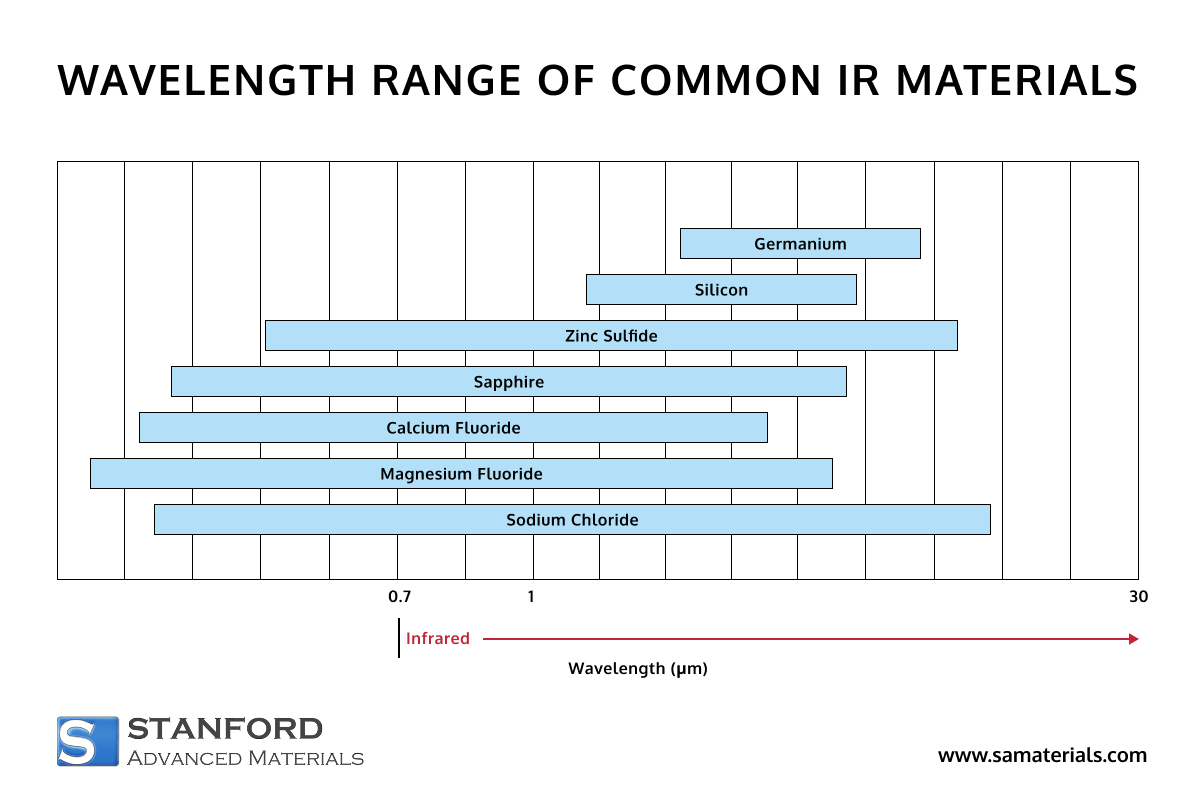
Fluoride Crystals (Calcium Fluoride, Barium Fluoride, Magnesium Fluoride)
Fluoride crystals such as calcium fluoride, barium fluoride, and magnesium fluoride are used in many optical systems. Their key property is high transparency in the infrared region. In many cases, these crystals are preferred for lenses and windows in high-power laser systems. For instance, calcium fluoride works well in the near infrared range from 0.15 to 8 microns. Barium fluoride can cover a range up to 12 microns. Magnesium fluoride is known for its durability and ease in coating surfaces. These features make fluoride crystals popular in fields like space optics and advanced spectroscopy.
Chalcogenide Materials (Zinc Selenide, Zinc Sulfide, Germanium)
Chalcogenide materials such as zinc selenide, zinc sulfide, and germanium offer excellent transmission in the mid to far infrared regions. Germanium, for example, is used in thermal imaging because of its effective transmission between 2 and 14 microns. Zinc sulfide and zinc selenide are common in infrared windows and domes for missile guidance systems or thermal cameras. Their non-linear optical properties also make them useful in laser frequency conversion. Each of these materials has a high refractive index and a specific transmission band that fits certain infrared applications very well.
Oxide Materials (Sapphire, Fused Silica, Yttrium Oxide)
Oxide materials are well known for their stability and durability. Sapphire is a favorite for high-stress applications where toughness is needed. It has excellent optical clarity from the ultraviolet up to the mid infrared range. Fused silica is another common oxide. It is renowned for its low thermal expansion and the ability to work across a wide range of temperatures and wavelengths. Yttrium oxide is often used in high-temperature environments and shows useful infrared transmission beyond 3 microns. The stability and optical quality of these oxides make them ideal for harsh environments, including aerospace applications.
Further reading: Sapphire, Ruby, and Alumina Substrates, How to Choose
Semiconductors for Infrared (Silicon, Gallium Arsenide, Indium Antimonide)
Semiconductor materials such as silicon, gallium arsenide, and indium antimonide have found a special place in infrared technology. Silicon works well in the near infrared and is widely used in camera sensors and communication devices. Gallium arsenide provides efficient light conversion and high-temperature operation, making it common in space applications. Indium antimonide is a key material for longwave infrared detectors, often used in thermal imaging cameras. These semiconductors offer the right balance of electrical and optical properties to support sensitive infrared applications in many modern devices.
Specialty Glasses and Composites (Chalcogenide Glasses, Infrared-Grade Glass, Polymer Composites)
Specialty glasses and composites complete the list of materials used for infrared applications. Chalcogenide glasses are well suited for mid and far infrared light. They have high refractive indices and can be molded into complex shapes for lenses and fibers. Infrared-grade glass is specially processed to remove impurities that absorb infrared radiation. Such glasses are popular for high precision optical tests and laser systems. Polymer composites designed for infrared use show promise in reducing weight while maintaining optical performance. These materials are especially useful in wearable optics and lightweight imaging devices where space and weight are crucial.
Applications across Infrared Spectrum
The choice of material depends on the specific infrared range needed and the environment in which the device will operate.
Fluoride crystals, with their low absorption, are favored in ultraviolet and short-wave infrared devices. Chalcogenide materials excel in high-end medical imaging systems, especially in thrust areas like thermal sighting and quality control. Oxide materials have a securing spot in high-stress and high-temperature environments, including industrial processing and aerospace applications. Semiconductors are the building blocks for detectors and sensors in both consumer and specialized equipment. Finally, specialty glasses and composites offer designers flexibility while ensuring precise performance in imaging, sensing, and communication systems.
Each material type meets strict criteria set by optical engineering practices and cost considerations. For more material list and comparison, please check Stanford Advanced Materials (SAM).
Frequently Asked Questions
F: Which material is best for thermal imaging?
Q: Indium antimonide is very common for longwave infrared thermal imaging.
F: Can silicon be used in all infrared ranges?
Q: Silicon works well in the near infrared range but has limitations in the mid and far infrared.
F: Why is fused silica popular in harsh environments?
Q: Fused silica has low thermal expansion and high durability, ideal for tough settings.
 Chin Trento