Products
 Bars
Bars
 Beads & Spheres
 Bolts & Nuts
 Crucibles
 Discs
Discs
 Fibers & Fabrics
 Films
Films
 Flake
Flake
 Foams
Foams
 Foil
Foil
 Granules
 Honeycombs
 Ink
Ink
 Laminate
 Lumps
Lumps
 Meshes
 Metallised Film
 Plate
Plate
 Powders
 Rod
Rod
 Single Crystals
 Sputtering Target
 Tubes
Tubes
 Washer
 Wires
Wires
 Converters & Calculators
 Write for Us



Which Known-Property Materials Have the Best Fracture Toughness?

Introduction
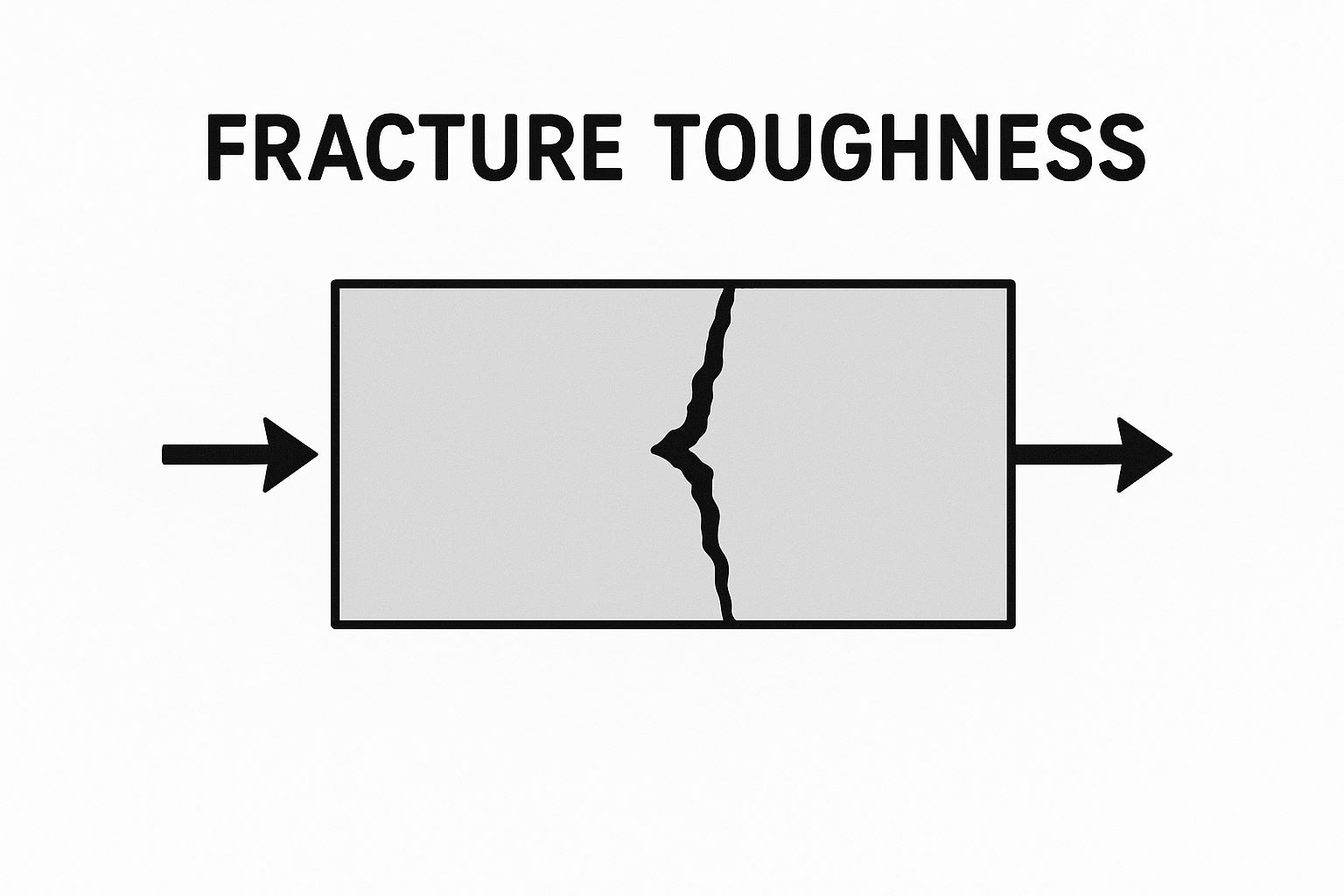
Fracture toughness is a value that indicates the energy that can be absorbed by a material before it fractures. Scientists and engineers rely on this number to choose materials for bridges, aircraft, and everyday tools. Let's talk about several categories of materials in simple terms and how they react when there is an accumulation of stress.
Metals and Alloys: Toughness Champions
Metals have long usage history where fracture toughness is required and extremely high. They are likely to show a very good strength-to-ductility ratio.
• Maraging Steel: It shows fracture toughness of 100–200 MPa√m. It is greatly ductile with high strength and employed for high-performance parts and structural components.
• High-Toughness Steels: These steels offer about 80–150 MPa√m. These steels are crack growth resistant under careful microstructure control and are used in applications where reliability is the key.
• Titanium Alloys (Titanium-6Aluminum-4Vanadium): With values for 55–110 MPa√m, these alloys are widely used due to their low weight and corrosion resistance. They are used extensively in aircraft production and medical devices.
• Metallic Glasses: These have about 80–100 MPa√m. They possess localized shear deformation as a result of their amorphous character, leading to their unusual mixture of strength and toughness.
Metals are prone to being best in fracture toughness because their atoms can rearrange themselves when placed under stress. This rearrangement blunts cracks and distorts energy prior to a catastrophic failure.
Ceramics: Toughest Among Brittle Materials
Ceramics are extremely well known for their strength at high temperatures. They are still not as resistant to fracture as metals. Ceramic toughness has been worked tirelessly to be made stronger by engineers.
• Yttria-Stabilized Zirconia (Y-TZP): It has a fracture toughness of 10–15 MPa√m. It uses transformation toughening, where minimal alteration in crystal structure makes it more resistant to crack growth.
• Zirconia-Toughened Alumina (ZTA): With values of around 7–10 MPa√m, ZTA represents an enhancement on pure alumina with advantages of both zirconia and alumina together.
Plain ceramics like silicon carbide, plain alumina, and even diamond have tougher numbers. Transformation toughening, microcrack bridging, and the inclusion of second-phase particles which slow down or stop crack growth are the significant toughening methods here.
Composites: Directional Toughness
Composite materials combine two or more different materials into one. This can transfer properties like fracture toughness to specific needs.
• Carbon Fiber Reinforced Composites: These possess fracture toughness values around 20–40 MPa√m in the direction of the fibers. Their strength and lightness are the reason for using them in aerospace and high-performance sporting equipment.
• Aramid Composites and Glass Fiber Reinforced Composites: They have a cost around 10–20 MPa√m. Automotive panels and protective gear utilize them due to their reasonable trade-off between toughness and economic expense.
• Hybrid Composites: With the exploitation of the different fibers, hybrid composites offer tailored toughness. Hybrid composites tap the best features of each material.
Mechanisms by which these composites become crack growth resistant include fiber pull-out, bridging, and crack deflection. Such mechanisms slow the progressing crack as it moves through the material, improving toughness overall.
Superlative / Advanced Materials
Advanced materials are not all typified by usual trends for toughness.
• Diamond: Because of its hardness, diamond has a quite low fracture toughness of approximately 5 MPa√m. This means that it chips or breaks under certain conditions even though it is very hard on the surface.
• Nanostructured Ceramics and Composites: These are being tested experimentally to see if they can be toughened. The fine structure can close off crack paths.
• Graphene-Improved Metals or Metallic Nanocomposites: Research in both areas is likely to bear fruit. These next-generation materials combine metals with nanoscale properties or graphene. Early indications are of extraordinary toughness and strength.
High-performance materials continue to set higher standards for fracture toughness. Their development may lead to safer, more efficient designs in the future.
Conclusion
Materials with high fracture toughness are at the center of a vast majority of engineering applications. Metal and alloys are the leaders in toughness due to their ability to deform lightly when subjected to load, blunting the crack tips ahead of their extension. Ceramics are currently, even though traditionally brittle, enhancing through toughening mechanisms. Composites provide directional toughness and advanced materials hold promise on the horizon. Every group has its merits and drawbacks. For more comparison and material list, please check Stanford Advanced Materials (SAM).
Frequently Asked Questions
F: What does fracture toughness measure?
Q: It is a measure of how much energy a material can withstand before it cracks.
F: Why are metals used in high toughness applications?
Q: Metals have the ability to deform at the crack tip, inhibiting crack growth.
F: Can ceramics be utilized in high stress environments?
Q: Yes, though they employ mechanisms such as transformation toughening to enhance resistance.
 Chin Trento