Products
 Bars
Bars
 Beads & Spheres
 Bolts & Nuts
 Crucibles
 Discs
Discs
 Fibers & Fabrics
 Films
Films
 Flake
Flake
 Foams
Foams
 Foil
Foil
 Granules
 Honeycombs
 Ink
Ink
 Laminate
 Lumps
Lumps
 Meshes
 Metallised Film
 Plate
Plate
 Powders
 Rod
Rod
 Single Crystals
 Sputtering Target
 Tubes
Tubes
 Washer
 Wires
Wires
 Converters & Calculators
 Write for Us



High, Medium, and Low Coefficient of Thermal Expansion (CTE) Materials

Introduction
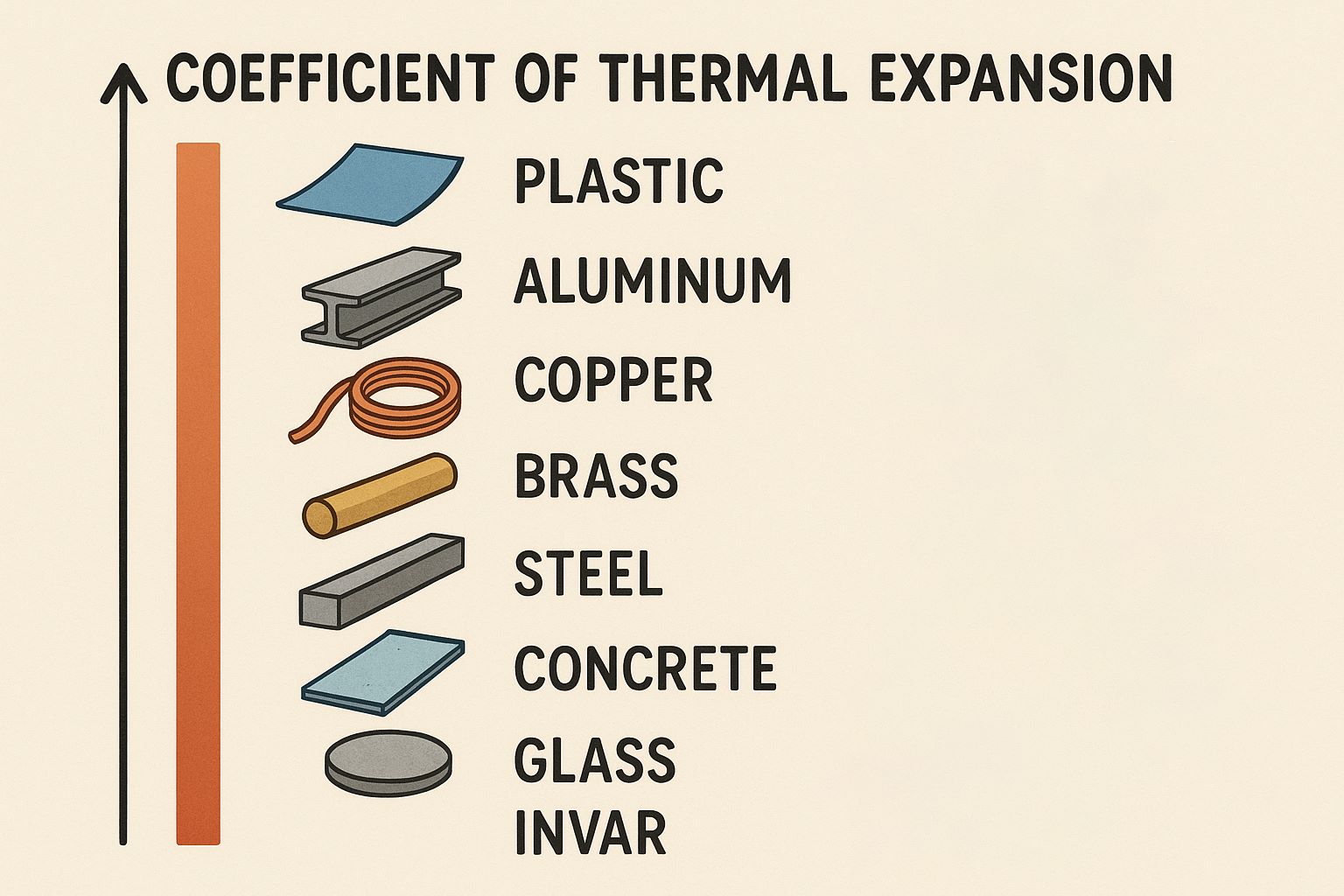
Materials change size when they are heated or cooled. To what extent is measured by the coefficient of thermal expansion. High CTE means a material expands a lot when it is heated. Low CTE means that it hardly changes at all.
High CTE Materials
High CTE materials expand noticeably when temperatures change. Some metals and most plastic are in this category.
Metals
Aluminum typically has a CTE of about 23 x10⁻⁶/K. Copper is usually 17 x10⁻⁶/K. Steel is from about 11 to 13 x10⁻⁶/K.
Polymers and Plastics
Plastics are likely to have extremely high thermal expansion. An example includes Polyethylene, Polypropylene, and Polytetrafluoroethylene (PTFE), which usually have CTEs of between 50 and 200 x10⁻⁶/K. These types of materials are used in most plastic parts and domestic applications where expansion needs to be taken into consideration during the design process.
High CTE materials are used in everyday things. An aluminum door frame may need gaps so that it will not stick on hot days in the summer. Plastics on packages balloon greatly in sunlight.
Medium CTE Materials
Medium CTE materials do not balloon as much as plastics or some metals but will still change with temperature. Some ceramics and composite materials fall into this category.
Ceramics
Ceramics like Alumina have CTE of 5 to 8 x10⁻⁶/K. Silicon Nitride's value is lower at 3 to 4 x10⁻⁶/K. These are greatly prized since they are resistant to high temperature usage. Ceramic parts are employed in engines and electronic devices.
Composite Materials
Composites such as Carbon Fiber Reinforced Polymer (CFRP) and Glass Fiber Reinforced Polymer (GFRP) are made to trade off between strength and lowest thermal expansion. They are used in aerospace components and sporting goods where precision in dimensions matters.
Medium CTE materials are a trade-off between high expansion and rigid stability. Engineers choose these materials when moderate thermal change is permissible or if cost consideration exists.
Low CTE Materials
Low CTE materials alter very slightly in dimension with temperature change. These types of materials have widespread usage in precision applications.
Special Alloys and Metals
A specific alloy like Invar, which is an iron-nickel alloy made of about 36% nickel, typically has a CTE of about 1 x10⁻⁶/K. Invar is used in scientific instrumentation, clocks, and other precision components where minimal change is paramount.
Glasses and Ceramics
Fused silica, a glass, has a CTE value of about 0.5 x10⁻⁶/K. Low expansion material Zerodur also falls into this category. These materials are used in telescope mirrors, laboratory equipment, and precision devices. Their low expansion ensures accuracy on temperature change.
Table or Chart Comparing High, Medium, and Low CTE Materials
|
Category |
Example Material(s) |
CTE Range (x10⁻⁶/K) |
|
High CTE Materials |
Aluminum, Copper, Steel; Polyethylene, Polypropylene, PTFE |
Metals: 11–23; Plastics: 50–200 |
|
Medium CTE Materials |
Alumina, Silicon Nitride; CFRP, GFRP |
Ceramics: 3–8; Composites: Moderate |
|
Low CTE Materials |
Invar; Fused silica, Zerodur |
Alloys: ~1; Glasses: ~0.5 |
This chart simply provides important values. It assists in comparing which material could be appropriate for a given design requirement. For more information, please check Stanford Advanced Materials (SAM).
Conclusion
Understand the coefficient of thermal expansion in material selection. Materials with high CTE, like most plastics and most metals, change a lot. Materials with medium CTE, like ceramics and composites, balance expansion against strength. Materials with low CTE, like Invar and fused silica, do not alter much with temperature differences.
Frequently Asked Questions
F: What is the coefficient of thermal expansion?
Q: It is a measurement of the extent to which a material expands or contracts with temperature variations.
F: Why does thermal expansion matter in designing?
Q: It affects the dimensional precision, the performance, and the safety of mechanical or electrical systems.
F: What is the material with the smallest thermal expansion?
Q: Fused silica and special alloys like Invar are known for having low thermal expansion.
 Chin Trento