
 Products
 Bars
Bars
 Beads & Spheres
 Bolts & Nuts
 Crucibles
 Discs
Discs
 Fibers & Fabrics
 Films
Films
 Flake
Flake
 Foams
Foams
 Foil
Foil
 Granules
 Honeycombs
 Ink
Ink
 Laminate
 Lumps
Lumps
 Meshes
 Metallised Film
 Plate
Plate
 Powders
 Rod
Rod
 Single Crystals
 Sputtering Target
 Tubes
Tubes
 Washer
 Wires
Wires
 Converters & Calculators
 Write for Us



Flexural Strength of Composite Materials

Introduction
Composite materials possess at least two disparate substances that are integrated to enhance properties. In this review, we discuss how the materials resist bending loads.
Carbon Fiber Reinforced Polymer
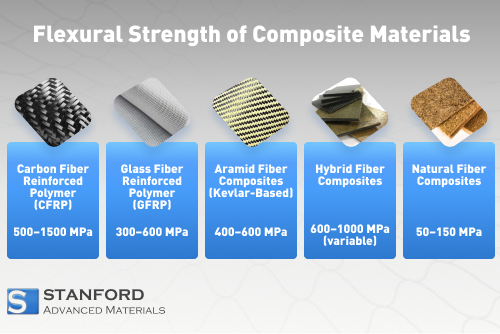
Carbon Fiber Reinforced Polymer typically resists temperatures of roughly 500°C and possesses flexural strengths of roughly 1500 MPa. It is often employed for constructing aircraft and high-performance automobiles. It is very strong but light in weight. For instance, bikes and racing cars use this composite material to deliver better performance. In structural applications, its bending resistance makes it a sought-after material. The carbon fibers are oriented to resist stress effectively. They produce a hard and strong material when blended with resin. Many designers depend on its high strength-to-weight ratio. The flexural strength-thermal resistance balance makes this composite very suitable for harsh applications.
Glass Fiber Reinforced Polymer
Glass Fiber Reinforced Polymer has a working temperature of 300°C with a flexural strength of about 600 MPa. This composite is commonly used in building and in wind turbine blades. It has an appropriate balance between price and performance. The glass fibers confer high strength, and the resin keeps the structure together nicely. You may employ this material in boat hulls and in sports gear. It is more affordable compared to carbon fiber composites. The figures in the performance make it an appropriate cost-effective option where an extreme high strength is not needed. It is commonly used in the majority of applications because design engineers appreciate its strength and ease of production in repair or modification.
Aramid Fiber Composites (Kevlar-Based)
Aramid Fiber Composites, similar to Kevlar-based ones, exhibit good performance up to 400°C and can withstand flexural loads around 600 MPa. They are well known for being tough with good impact resistance. They are employed in protective gear and some components of vehicles. Kevlar composites are the optimal choice in body armor due to their ability to absorb energy. Their flexural strength is sufficient for most moderate loading applications. The inherent fiber structure renders them flexible without being susceptible to shattering easily. Such consistency under stress renders them the first choice in safety-critical applications. They also respond to heat, hence being adaptable.
Hybrid Fiber Composites
Hybrid Fiber Composites are variable in range, with up to 600°C flexural strengths and approximately 1000 MPa. Hybrid materials blend properties of many fibers to fine-tune performance. Typically, there will be a mix of carbon fibers and glass fibers. The intention is to realize the best quality of each material. Designers can customize the mix depending on specified rigidity or flexibility. For instance, hybrid composites are found in sports gear and electronic enclosures. Their versatility in design is attractive to engineers who must weigh cost against strength and weight. Such composites may become integral parts of creative solutions in industries where pure carbon or pure glass fiber alone would not be enough.
Natural Fiber Composites
Natural Fiber Composites perform optimally at lower temperatures up to around 50°C and possess flexural strengths of around 150 MPa. These composites include utilization of fibers like jute, hemp, or flax with a biodegradable resin. They offer a green solution for applications in the automotive interior, packaging, and building panel markets. Although they are below the high level of performance from synthetic products, their renewability and affordability make them an enormous magnet for designers. The rising interest in sustainable materials makes these composites have an exciting development. In less demanding applications in which high temperatures or heavy loads are not an issue, natural fiber composites provide sufficient performance at an added environmental benefit.
Conclusion
There are several choices of composite materials to fulfill a variety of engineering applications. There are benefits and drawbacks to each category.
Carbon Fiber Reinforced Polymer is strong and heat resistant. Glass Fiber Reinforced Polymer is cost-effective and stable for general use. Aramid Fiber Composites are impact and moderate bending load resistant. Hybrid Fiber Composites enable engineers to customize to a particular requirement. Natural Fiber Composites offer an environmentally conscious solution with reduced performance.
Frequently Asked Questions
F: What does flexural strength measure?
Q: It is a measure of resistance of material against bending forces.
F: Can hybrid fiber composites be engineered?
Q: Yes, their properties can be made variable by blending fibers of different nature.
F: Are natural fiber composites suitable for high temperature?
Q: No, they are suitable under low temperature.
 Chin Trento