Products
 Bars
Bars
 Beads & Spheres
 Bolts & Nuts
 Crucibles
 Discs
Discs
 Fibers & Fabrics
 Films
Films
 Flake
Flake
 Foams
Foams
 Foil
Foil
 Granules
 Honeycombs
 Ink
Ink
 Laminate
 Lumps
Lumps
 Meshes
 Metallised Film
 Plate
Plate
 Powders
 Rod
Rod
 Single Crystals
 Sputtering Target
 Tubes
Tubes
 Washer
 Wires
Wires
 Converters & Calculators
 Write for Us



What are Some Typical Compounds of Lithium?

Introduction
Lithium compounds hold a unique position in science and industry. Lithium compounds have been used for decades now in chemical industry, medicine, and batteries. In this article, we scrutinize some of the most common lithium compounds. We discuss their usage in everyday life, variations, and properties.
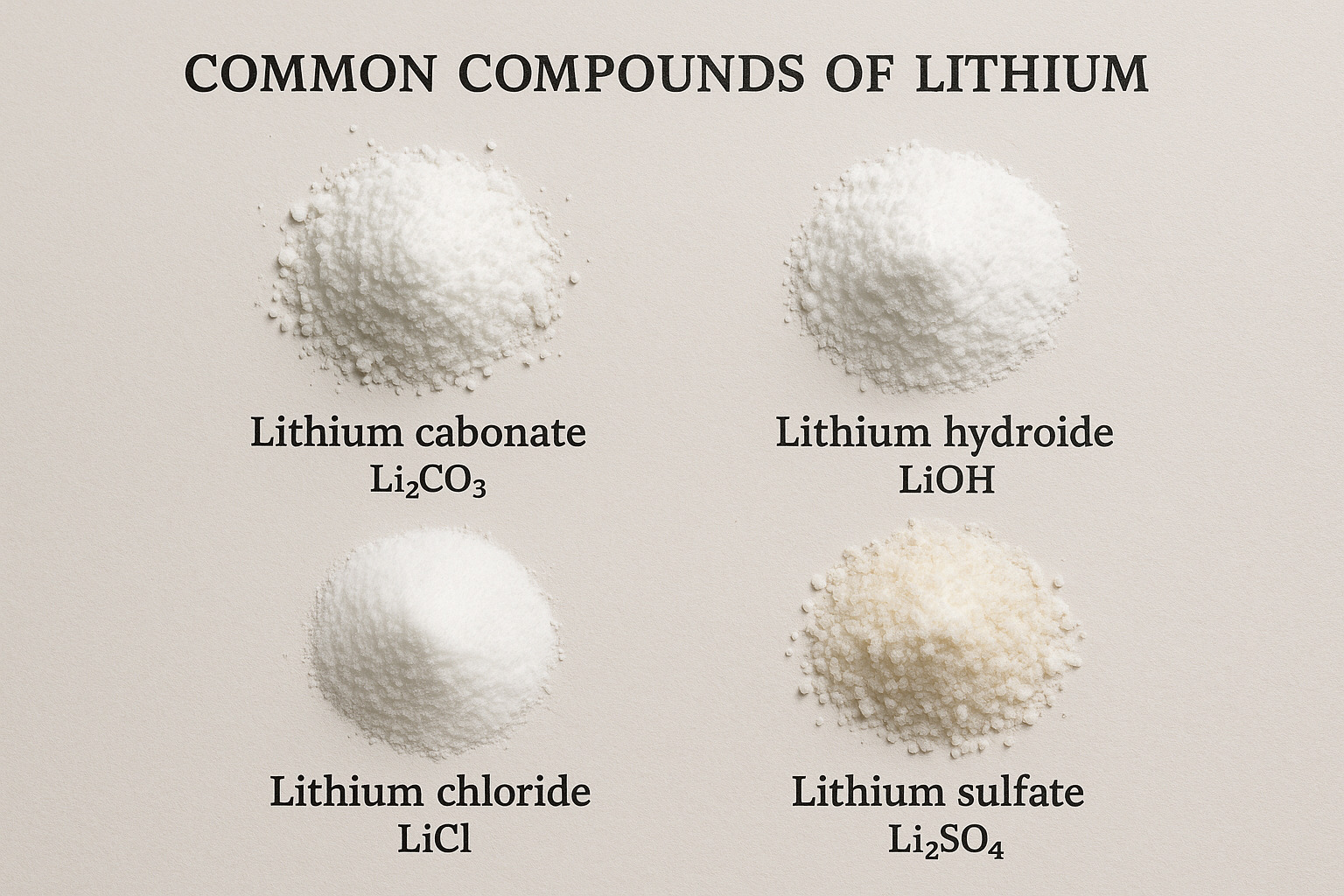
Lithium Carbonate (Li2CO3)
Lithium carbonate is a white, stable powder that can be handled easily. It is most popularly used for treating mood disorders. When prescribed by a physician, lithium carbonate stabilizes mood swings. The chemical is also utilized in the manufacturing of ceramics and glass.
In the manufacture of batteries, lithium carbonate is a raw material for lithium-ion batteries. It is a readily accessible chemical and is the most favored among producers. In ceramics, it decreases the melting point of the blend, making it simpler to control during processing. In the production of glass, lithium carbonate in small quantities can enhance clarity and hardness.
In simple terms, lithium carbonate is versatile. It has attributes that can be applied both in medicine and industrial operations. The chemical is easy to produce on a large scale, hence the reason why it is ordinary and inexpensive.
Lithium Hydroxide (LiOH)
Lithium hydroxide is typically white in solid form. It is soluble in water and also very reactive with carbon dioxide. Lithium hydroxide is used in the manufacturing of other compounds of lithium in various fields of production using chemical reactions.
One of the significant applications of lithium hydroxide is in the production of lithium-ion batteries. Lithium hydroxide is used for the creation of cathode material for the batteries that fuel many devices in current use. Lithium hydroxide is also used in air purification systems to help remove carbon dioxide.
Lithium hydroxide is valued by chemists because it has the ability to neutralize acids quickly. This makes lithium hydroxide valuable in processes that require a set pH level. In most cases, lithium hydroxide is a vital chemical with extensive uses in energy storage and process regulation.
Lithium Chloride (LiCl)
Lithium chloride is a white or colorless compound and is highly soluble in water. Owing to its solubility, it can serve as an efficient desiccant in various drying operations. Lithium chloride drying agents are typically employed in industries and laboratories.
Apart from its dehydrating nature, lithium chloride is used in chemical synthesis. Lithium chloride is a component of many reaction processes that require a source of lithium ions. Lithium chloride is inexpensive and easily available. Because of these features, lithium chloride gets into academia and industries quite frequently.
In short, the high solubility and efficiency of lithium chloride as a drying agent contribute to its popularity. The compound is also used as a supporting substance in numerous chemical reactions, clearly demonstrating its consistent contribution to the area.
Lithium Bromide (LiBr)
Lithium bromide is a less common but extremely important compound in certain uses. It would typically be in the form of a white crystalline solid. Lithium bromide is notoriously utilized in absorption chillers in air conditioning systems.
In chillers such as these, water vapor is taken up by solutions of lithium bromide. This cooling aids in large systems. The compound is used in some chemical synthesis reactions as well. Although it fails to get the same spotlight as lithium hydroxide or lithium carbonate, lithium bromide has its application in the industry.
Due to its unique absorbing property, lithium bromide is highly prized in settings where moisture or temperature management is critical. This property has rendered the compound a trusted fixture in some sectors in the chemical and energy sectors.
Lithium Fluoride (LiF)
Lithium fluoride is a white crystalline compound with excellent thermal stability. Lithium fluoride is generally utilized as a flux in metallurgical processes. Lithium fluoride, in the production of glass and ceramics, inhibits defects in the end products.
Among the lesser but important uses of lithium fluoride is in optical applications. It can be used to create special glass or other optical materials. The material is also recognized for its better resistance to heat. All of these characteristics render it perfect where there are high temperatures.
Lithium fluoride is usually not seen as a stand-alone product in consumer markets. Its application towards enriching industrial processes does indicate that it's an important figure in the industry, however. Its role in high-quality output cannot be overemphasized when purity and strength are required.
Why Lithium Compounds Are Widely Used in Energy, Chemicals, and Medicine
Lithium compounds are essential because they have some positive attributes. Lithium compounds are light and have very high energy density. The lithium compounds charge quickly and retain energy for long intervals. This is why most of the modern devices use lithium-based energy storage.
Lithium compounds are used as catalysts or as reaction step precursors in the production of chemicals. Their chemical stability and reactivity under controlled conditions contribute to efficient production. Lithium compounds like lithium carbonate have been consistently depended on in medicine to control mood disorders. The unquestionable effectiveness in treatment processes has been augmented by five decades of clinical use.
The healthcare, chemical, and energy sectors all favor compounds that bring about reliability and efficiency. Lithium compounds do just that. Their widespread use in everyday gadgets through life-changing medications is proof of their chameleon-like ability.
Distinguishing Common and Specialty Lithium Compounds
It should be known that not all lithium compounds are similar. They are common compounds and specialty compounds. Common lithium compounds include lithium carbonate, lithium hydroxide, and lithium chloride. These compounds are produced on large scales. Their production is highly developed, and they are highly characterized with properties and uses. They are cheap and reliable.
In contrast, specialty lithium compounds are designed for specialty uses. They are tailored to high-performance requirements in new battery technologies and high-end chemistry applications. Specialty compounds can be accompanied by new processing procedures. Their production is usually processed in controlled conditions and special purity levels.
Although both common and specialty compounds are important, the common compounds are generally produced and used on a larger scale. Specialty compounds can be used if performance requirements exceed the capabilities of the common compounds. Both have their application based on the requirements of the application.
Conclusion
Lithium compounds have contributed to human-kind in many ways. They power our devices, aid chemical production, and stabilize mood in medicine. There are unique characteristics for each compound and they are used in unique applications.
Frequently Asked Questions
F: Why is lithium carbonate important in medicine?
Q: It stabilizes mood in bipolar patients.
F: How does lithium hydroxide contribute to air purification?
Q: It effectively captures carbon dioxide from air.
F: Why are lithium compounds preferred in the production of batteries?
Q: They have good performance and high energy density.
 Chin Trento