
 Products
 Bars
Bars
 Beads & Spheres
 Bolts & Nuts
 Crucibles
 Discs
Discs
 Fibers & Fabrics
 Films
Films
 Flake
Flake
 Foams
Foams
 Foil
Foil
 Granules
 Honeycombs
 Ink
Ink
 Laminate
 Lumps
Lumps
 Meshes
 Metallised Film
 Plate
Plate
 Powders
 Rod
Rod
 Single Crystals
 Sputtering Target
 Tubes
Tubes
 Washer
 Wires
Wires
 Converters & Calculators
 Write for Us



Materials for Infrared Optics: From Germanium to Chalcogenide Glasses

Introduction
Infrared optics play an important role in many modern devices. They are found in cameras, sensors, and communication equipment. Over the years, the choice of materials for infrared optics has increased. Early systems used materials like germanium and silicon. Later, materials such as zinc selenide and calcium fluoride entered the picture. Today, chalcogenide glasses and other advanced materials are on the rise. This article offers a friendly discussion about these materials.
Key Material Properties for Infrared Optics
When picking materials for an infrared system, several properties stand out. One important property is transmission. Materials must let infrared light pass through with little loss. For example, germanium can transmit infrared radiation very well from about 2 to 14 micrometers. In contrast, visible light might be blocked by the same material. Another key property is refractive index. This value defines how light bends when it enters a material. Materials with higher refractive indices allow for compact optical designs.
Another property is thermal conductivity. Infrared systems may heat up, and a good material can handle this stress. Mechanical strength is also critical. The component must not break easily under strain or when it faces temperature changes. Durability and resistance to scratching matter as well. For instance, calcium fluoride has a low refractive index and transmits far into the ultraviolet and infrared regions, but it is soft and must be handled carefully.
Cost and availability add to the list of selection factors. Materials like silicon are common in the semiconductor industry, which often makes them more affordable. When comparing choices, engineers must balance optical performance with physical and economic considerations.
Germanium and Silicon: Classic Infrared Materials
Germanium and silicon have long served in traditional infrared optics. Germanium is favored because it has a high refractive index—around 4 in the infrared region. It also has excellent infrared transmission from 2 micrometers to nearly 14 micrometers. Such properties made it prominent in thermal imaging cameras and spectrometers.
Silicon, on the other hand, has a refractive index close to 3.4 and is well-known from the electronics industry. In infrared optics, silicon parts often work in the 1.2- to 6-micrometer range. Its availability in high purity and the resulting low cost has kept silicon in use. Many optical designs make use of both materials. For example, some lens systems use germanium to correct aberrations introduced by silicon elements. Even though these two materials have been around for decades, they continue to be used because of their predictable performance and well-known behavior over a wide temperature range.
Zinc Selenide and Calcium Fluoride in Infrared Systems
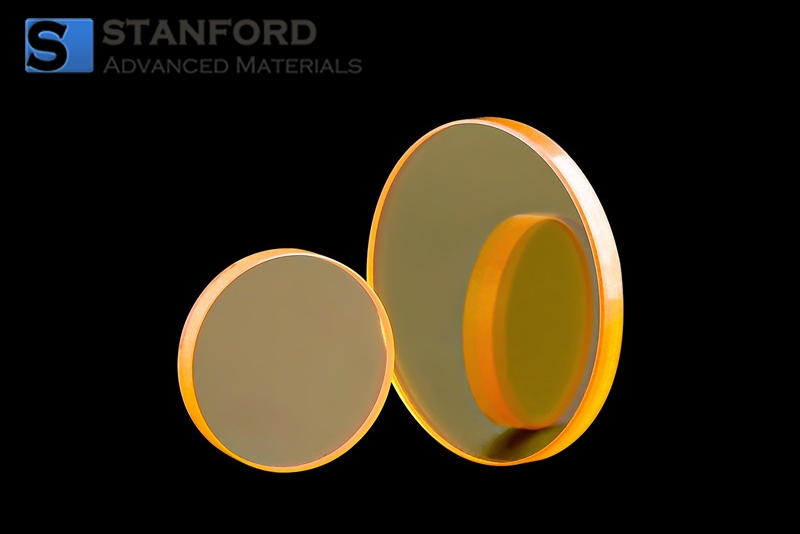
Zinc selenide and calcium fluoride are important in specific infrared applications. Zinc selenide offers low absorption in the infrared region. Its transmission range covers 0.5 to over 20 micrometers. This wide range makes it useful in gas analyzers and thermal imaging. One common case is in carbon dioxide laser systems. Its good thermal properties allow zinc selenide optics to handle varying levels of power.
Calcium fluoride is another key material. It transmits light well from the deep ultraviolet to the mid-infrared range—typically from 0.13 to 10 micrometers. Its low refractive index makes it suitable for anti-reflective coatings. Calcium fluoride lenses are found in high-performance cameras and ultraviolet optical instruments. There is an old yet reliable tradition of using this material in optical systems that require high transmission and low dispersion over a broad spectrum.
Both zinc selenide and calcium fluoride require careful handling and polishing. They are more brittle than common glasses. In practical applications, engineers design mounts and housings that reduce the risk of damage. The choice between the two often depends on the exact wavelength range and the thermal environment in which the optics will operate.
Chalcogenide Glasses: Advanced Infrared Materials
Chalcogenide glasses represent the newer generation of materials used in infrared optics. They are made from elements such as sulfur, selenium, and tellurium, mixed with other elements like arsenic or germanium. These glasses have unique features. They can be tailored to transmit light in wavelengths that range from about 2 micrometers up to 20 micrometers. This range is wider than that of many crystalline materials.
Because chalcogenide glasses form in a glass state, they can be molded into complex shapes that are hard to achieve with crystals. This attribute often allows for lighter and more compact optical systems. For instance, some modern thermal cameras use chalcogenide lenses for a lighter build and simpler assembly. They are also valuable in fiber optics where specific transmission properties are necessary.
Though they offer high performance, chalcogenide glasses can be more sensitive to environmental conditions. They may require protective coatings or controlled use to ensure long-term stability. Over the years, improvements in their formulation have increased their durability and overall performance. Today, these glasses are a choice for advanced scientific instruments and commercial applications alike.
Material Selection Considerations for Infrared Optics
Selecting the right material for infrared optics is not a one-size-fits-all matter. It requires weighing several factors, including optical performance, mechanical strength, and cost. One must begin with the application. For instance, a handheld thermal camera may need materials that perform over several temperature cycles and rough handling. On the other hand, a high-precision spectrometer might be more tolerant toward cost but requires very low dispersion and high transmission quality.
Engineers also look at factors like ease of fabrication and machining. Materials such as silicon and germanium are well understood and widely available. Their behavior over time has been studied thoroughly in many systems. More advanced materials like chalcogenide glasses need additional consideration for factors such as long-term environmental resistance or stress under extreme conditions. Often, coating the surfaces with protective layers improves their robustness.
The manufacturing process plays a role, too. Some materials require more detailed polishing and finishing to reach the desired optical clarity. A slight imperfection may lead to errors in the device performance. In many instances, the relative cost dictates that a balance is found between superior performance and affordable production.
The final choice often rests on a trade-off: the best material for the job from an optical standpoint might be difficult to manufacture reliably. Conversely, some materials bring consistency and are well-proven in many devices but might not offer the cutting edge performance required for some new applications. The selection process involves extensive testing in simulated environments and iterative design adjustments.
As technology improves, the range of materials available for infrared optics grows. Each new development contributes to more efficient, compact, and high-performing optical systems. In the world of infrared optics, experience matters. Over decades, engineers and scientists have built a solid understanding of these materials. This body of knowledge helps guide the practical choices that shape the devices used every day in research and industry.
Frequently Asked Questions
F: What is a key property in selecting infrared materials?
Q: Transmission is critical; materials must pass infrared light with minimal loss.
F: Why are germanium and silicon popular in infrared optics?
Q: They offer good infrared transmission, predictable performance, and are cost-effective.
F: How do chalcogenide glasses differ from traditional materials?
Q: They allow custom wavelength transmission and can be molded into complex shapes.
 Dr. Samuel R. Matthews