
 Products
 Bars
Bars
 Beads & Spheres
 Bolts & Nuts
 Crucibles
 Discs
Discs
 Fibers & Fabrics
 Films
Films
 Flake
Flake
 Foams
Foams
 Foil
Foil
 Granules
 Honeycombs
 Ink
Ink
 Laminate
 Lumps
Lumps
 Meshes
 Metallised Film
 Plate
Plate
 Powders
 Rod
Rod
 Single Crystals
 Sputtering Target
 Tubes
Tubes
 Washer
 Wires
Wires
 Converters & Calculators
 Write for Us



Chromium and Tungsten Sputtering Targets for Optical Lens Coatings

Role of Metallic Coatings in Optical Lenses
Optical lenses function better when coated with a thin metal coating. A coating can change the path of light traveling through the lens. It can either reduce or even improve reflections and change the amount of transmission of light. Layered coatings are often used to combat high intensities of light for most lenses. This is necessary for many such devices as cameras or scientific equipment. A metal layer provides additional benefits for creating a damage resistant surface for the lens. In many cases, specialized manufacturers utilize these coatings as designed according to specific criteria for a final product that will function satisfactorily in real life applications.
Chromium Targets for Optical Coatings
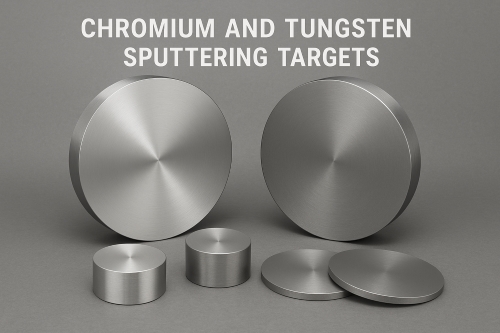
Chromium is a tough metal with outstanding resistance to oxidation. Chromium sputtering targets are used where there is a need for a bright appearance and durability. For optical lenses, chromium targets produce coatings that are resistant to wear and can withstand severe environmental conditions. A chromium coating, for example, can add improved scratch resistance to camera lenses. The chemical stability of chromium is a great benefit. Due to its high melting temperature and excellent adhesion on other layers, chromium renders coatings secure and durable. In most cases, chromium layers are used as overlays on other optical films for improved functionality of the lens.
Tungsten Targets for Optical Coatings
Tungsten has a high melting point and shows good wear resistance. This makes tungsten a good material for optical coatings used in harsh environments. Tungsten sputtering targets are used in systems that must be tough and have special optical properties. Tungsten coats are reported to have excellent abrasion resistance. They also have good thermal stability. In some optical lens applications, tungsten coatings enhance the toughness of the lens. They help the lens maintain unpolluted performance even during conditions of thermal stress. Tungsten, when used as an element in a multi-layer system, may have the entire optical characteristic tailored to meet fastidious design specifications.
Deposition by Sputtering
Sputtering is a pervasive process. Particles with high energy bombard a target during this process and result in the emission of atoms, which deposit upon a substrate. The process takes place within a vacuum chamber. The chromium and tungsten sputtering targets are placed in this controlled atmosphere. Argon, a gas, is used to help knock the atoms off. The atoms travel onto the lens or other substrates and form a very thin, uniform coating. Sputtering also has several advantages. It forms an even layer over a big surface and allows control of the thickness of the film. This choice of deposition process is with the high performance level demanded in optical lenses. Properly done, sputtering leads to layers that tightly adhere to the substrate, which is with the stable coating of the lens lifetime.
Conclusion
The use of sputtering targets to optical lens coating is a known process. The principal materials in the process are chromium and tungsten targets. Chromium provides hardness and stability. Tungsten provides heat and physical strength. Collectively, they can create optical coatings with good durability and performance. Sputtering is one means of depositing these thin films in a controlled process. It is a proven process. The material and deposition selection are most important in creating quality and dependable lenses. I hope that this summary gives you a simple, but clear, explanation of the role of chromium and tungsten in optical coatings.
Frequently Asked Questions
F: What is the role of metallic coating in optical lenses?
Q: They reduce glare, improve the transmission of light, and protect against scratches.
F: What benefit do chromium targets contribute to optical coatings?
Q: They provide hardness, chemical inertness, and greater scratch resistance.
F: Why use tungsten targets for optical lenses?
Q: They provide thermal stability, wear resistance, and general durability of the lens.

 Chin Trento