
 Products
 Bars
Bars
 Beads & Spheres
 Bolts & Nuts
 Crucibles
 Discs
Discs
 Fibers & Fabrics
 Films
Films
 Flake
Flake
 Foams
Foams
 Foil
Foil
 Granules
 Honeycombs
 Ink
Ink
 Laminate
 Lumps
Lumps
 Meshes
 Metallised Film
 Plate
Plate
 Powders
 Rod
Rod
 Single Crystals
 Sputtering Target
 Tubes
Tubes
 Washer
 Wires
Wires
 Converters & Calculators
 Write for Us



Density and Specific Gravity: ASTM D792

ASTM D792 standard outlines a precise procedure for determining a plastic's density and specific gravity by its buoyancy in a liquid—typically water. While it sounds easy, the test can say a lot about what's going on inside the material, homogeneity, and even formulation.
Why Density and Specific Gravity Matter
Density quantifies how much mass is packed into a specific volume, while specific gravity is that same density expressed as a ratio of the density to that of water at some standard temperature. Density then tells you how "heavy" a material is for its size, and specific gravity provides a convenient way of comparing materials free of the baggage of units.
In manufacturing and materials science, these numbers are more than abstract values on a datasheet—there are also identifiers of product purity, quality, and performance. An incorrect density in a polymer, for example, might be tied to voids, impurities, or misbatches of filler. To an engineer, that can mean variations in thermal properties, stiffness, or strength.
The Principle behind ASTM D792
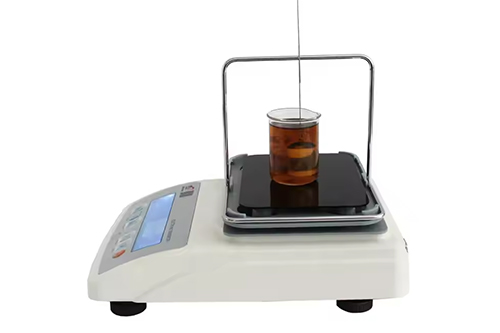
The ASTM D792 test relies on Archimedes' principle that the object submerged is subjected to a buoyant force equal to the weight of the displaced fluid. The simple law underlies one of the most widely used methods in material testing.
In practice, the test involves weighing a solid sample twice: once in air and once while immersed in water. By taking one reading minus the other, it is then possible to work out both the density and specific gravity. The equations used are:
Specific Gravity (SG) = Wₐ/(Wₐ - Ww)
Density = SG × Density of Water at Test Temperature
where (Wₐ) is the weight of the specimen in air, and (Ww) is its weight when partially immersed in water. At 23°C, water density is ca. 0.9975 g/cm³, a figure used in the majority of tests unless specified otherwise.
Test Procedures and Variations
ASTM D792 has several varying procedures lettered A through D to accommodate samples of different types. Procedure A applies to solid plastics that are heavier than water, while Procedure B employs a wire sinker when testing buoyant samples. Procedures C and D apply to more complex situations such as for small pellets, thin films, or powders, which more typically employ a pycnometer or a density gradient column instead of direct immersion.
Temperature control is another primary consideration. Minor temperature variations will make a fairly small change in water and specimen density, so experiments are typically conducted at 23 ± 2°C to provide some consistency.
Interpreting Results of ASTM D792
The values for density and specific gravity from ASTM D792 can have a very wide range based on formulation, material type, and processing. To take a couple of examples, polyethylene (PE) is generally between 0.91 and 0.96 g/cm³, and polycarbonate (PC) is more dense at about 1.20 g/cm³. At the high end, PTFE (Teflon) will have densities greater than 2.15 g/cm³, which corresponds to its close packing molecular structure.
An abrupt shift in measured density from the set reference levels can be indicative of manufacturing issues. Very low values can be a sign of internal voids or gas entrapment, and high values may be indicative of excess fillers or contaminants. Hence, the majority of quality control laboratories utilize ASTM D792 as a quick screening method to spot any anomalies before carrying out full-scale tests.
Applications of ASTM D792 in Industries
The information obtained through ASTM D792 testing is not of academic interest only. In the production of polymers, it enables manufacturers to verify the consistency of batches of resin and detect formulation drifts. In automotive and aerospace applications, awareness of polymer composite density helps verify that parts meet precise weight and performance specifications. Even in the production of medical devices, precise measurements of density help ensure that polymer grades are in compliance with biocompatibility and durability requirements.
Typical Material Densities
To put these values into perspective, here are a few representative values:
• Polyethylene (PE): 0.91–0.96 g/cm³
• Polycarbonate (PC): 1.19–1.22 g/cm³
• Nylon (PA): 1.13–1.15 g/cm³
• Polytetrafluoroethylene (PTFE): 2.15–2.20 g/cm³
• Aluminum: 2.70 g/cm³
• Stainless Steel: 7.90–8.05 g/cm³
• Tungsten: 19.25 g/cm³
As these examples show, plastics and light alloys occupy the lower end of the density scale, and metals—especially heavy metals like tungsten or lead—are at the opposite end.
Typical Density and Specific Gravity Values (ASTM D792 Reference)
|
Material |
Density (g/cm³) |
Specific Gravity |
Notes / Applications |
|
0.91 – 0.96 |
0.91 – 0.96 |
Lightweight, flexible plastic used in packaging and containers. |
|
|
0.90 – 0.91 |
0.90 – 0.91 |
Low-density thermoplastic; automotive parts and textiles. |
|
|
Polystyrene (PS) |
1.04 – 1.06 |
1.04 – 1.06 |
Rigid and brittle; used in insulation and disposable products. |
|
Polyvinyl Chloride (PVC) |
1.35 – 1.45 |
1.35 – 1.45 |
Durable and chemical-resistant; pipes, wire coating. |
|
Polycarbonate (PC) |
1.19 – 1.22 |
1.19 – 1.22 |
High impact resistance; lenses, safety gear, electronics. |
|
Acrylonitrile Butadiene Styrene (ABS) |
1.03 – 1.07 |
1.03 – 1.07 |
Tough and glossy; used in automotive and consumer electronics. |
|
Nylon (PA6, PA66) |
1.13 – 1.15 |
1.13 – 1.15 |
Strong engineering plastic; gears and mechanical parts. |
|
Polyethylene Terephthalate (PET) |
1.33 – 1.38 |
1.33 – 1.38 |
Common in bottles and films; good strength and clarity. |
|
2.15 – 2.20 |
2.15 – 2.20 |
Non-stick and chemical-resistant; seals and gaskets. |
|
|
Polyoxymethylene (POM, Acetal) |
1.40 – 1.42 |
1.40 – 1.42 |
High stiffness; used in precision gears and bearings. |
|
Epoxy Resin (Unfilled) |
1.10 – 1.20 |
1.10 – 1.20 |
Adhesives, coatings, composite matrices. |
|
Glass Fiber Reinforced Plastic (GFRP) |
1.70 – 1.90 |
1.70 – 1.90 |
Structural composites for aerospace and marine use. |
|
Carbon Fiber Reinforced Polymer (CFRP) |
1.50 – 1.60 |
1.50 – 1.60 |
Lightweight and strong; aerospace, sports, and automotive. |
|
Aluminum (Pure, 99.9%) |
2.70 |
2.70 |
Lightweight metal; aircraft and electronics. |
|
Magnesium (Pure) |
1.74 |
1.74 |
Lightest structural metal; aerospace, automotive. |
|
Titanium (Pure, Grade 2) |
4.51 |
4.51 |
High strength-to-weight ratio; medical and aerospace. |
|
Stainless Steel (304) |
7.90 – 8.05 |
7.90 – 8.05 |
Corrosion-resistant; machinery and structural components. |
|
Copper (Pure) |
8.92 |
8.92 |
Excellent electrical conductivity; wiring and electronics. |
|
Nickel (Pure) |
8.90 |
8.90 |
Magnetic and corrosion-resistant; alloys and plating. |
|
Tungsten (Pure) |
19.25 |
19.25 |
Extremely dense; radiation shielding, high-temp components. |
|
Lead (Pure) |
11.34 |
11.34 |
High-density metal; counterweights and shielding. |
Conclusion
ASTM D792 is a straightforward but powerful method of determining the density and specific gravity of plastics and other materials. Far more than a laboratory standard procedure, it is a rich resource to engineers, manufacturers, and researchers who need to know how the structure, formulation, and processing of a material affect its ultimate performance.
 Chin Trento