
 Products
 Bars
Bars
 Beads & Spheres
 Bolts & Nuts
 Crucibles
 Discs
Discs
 Fibers & Fabrics
 Films
Films
 Flake
Flake
 Foams
Foams
 Foil
Foil
 Granules
 Honeycombs
 Ink
Ink
 Laminate
 Lumps
Lumps
 Meshes
 Metallised Film
 Plate
Plate
 Powders
 Rod
Rod
 Single Crystals
 Sputtering Target
 Tubes
Tubes
 Washer
 Wires
Wires
 Converters & Calculators
 Write for Us



ASTM E228: Thermal Expansion in Metals and Ceramics

What Is ASTM E228
ASTM E228 is an ASTM International test method standard for measuring the coefficient of thermal expansion (CTE) in metals and ceramics. The standard ensures consistency and accuracy in testing material expansion or shrinkage with a temperature change—a key factor in engineering design, manufacturing, and quality assurance.
Significance of Thermal Expansion in Ceramics and Metals
Thermal expansion is the material reliability and performance limiting factor in applications that are subject to temperature fluctuations. The property allows engineers and manufacturers to predict size change and avoid thermal stress-induced failure.
For example, in turbine engines, metal blades experience high-speed heating and cooling that may lead to cracking or fatigue if CTE is not properly taken into account. In the ceramic substrate of semiconductor packaging, warping or delamination may occur due to a CTE difference between the silicon chip and the substrate.
Proper knowledge of thermal expansion allows:
• Design optimization: Mechanical parts are optimized to maintain dimensional stability with changing temperatures.
• Material compatibility: Preventing failure or warping of joints during material combination.
• Accuracy manufacturing: Tight tolerances in aerospace parts, optical instruments, and electronic components.
How ASTM E228 Works
Equipment for Measurement
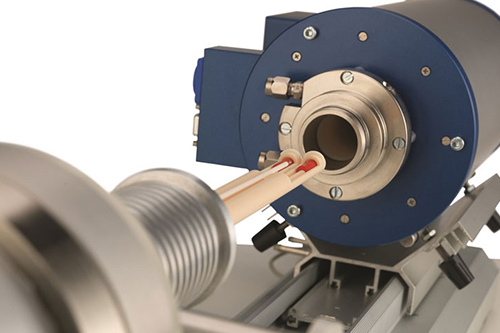
Push-rod dilatometer is the principal equipment utilized in ASTM E228 testing. The test arrangement typically employs a push rod made of vitreous silica for normal temperature ranges or high-purity alumina or isotropic graphite at higher temperatures. The rod transfers the expansion or contraction of the specimen to a displacement transducer with practically very high accuracy.
Procedure
1. Sample Preparation: A specimen of the required geometry and surface finish is prepared.
2. Heating/Cooling: The test sample is placed in the dilatometer and exposed to controlled temperature changes.
3. Measurement: The linear displacement (length change) vs. temperature is measured by the equipment.
4. Calculation: CTE is calculated from the displacement–temperature plot slope.
Applicability
ASTM E228 is generally employed for solid substances with a CTE greater than around 0.5 μm/m⋅℃. It is applied to metals, ceramics, and dense materials in a wide range of temperatures. The method may be modified to apply to low-expansion materials if sensitive apparatus is available.
Applications of ASTM E228
ASTM E228 testing is employed in applications where temperature stability and dimensional stability are significant:
• Aerospace: Jet engine turbine blades and heat shields experience enormous temperature gradients. For instance, nickel superalloys with a CTE of 13–15 × 10^{-6}/℃ are matched carefully to ceramic coatings CTE ≈ (10–12 × 10^{-6}/℃) in order to reduce stress during thermal cycling.
• Vehicle: Aluminum alloy exhaust components and engine blocks CTE ≈ (23 × 10^(-6)/ ℃) are subjected to similar expansion testing. Incongruity between steel bolts CTE ≈ (16 × 10^(-6)/ ℃) and aluminum housings causes repeated thermal cycling to result in mechanical distortion.
• Electronics: Printed circuit board (PCB) and semiconductor package need precise CTE matching of copper traces CTE ≈ (17 × 10^(-6)/ ℃) and alumina or other ceramic substrates CTE ≈ (8 × 10^(-6)/ ℃) to prevent cracking during thermal cycling.
• Energy Systems: In solid oxide fuel cells, without proper CTE data at metal-ceramic interfaces, under operational temperatures higher than 800 °C, delamination does not take place.
Through provision of precise thermal expansion data, ASTM E228 facilitates component life and safety in high-performance usage.
Effects on Thermal Expansion
Several effects govern the manner in which metals and ceramics expand with temperature and in some rather complex ways:
• Material Composition: Alloyants or ceramic additives significantly alter CTE. Silicon addition to aluminum, for example, reduces aluminum's CTE, and aluminum–silicon alloys became the go-to option for pistons in cars exposed to severe thermal cycling.
• Range of Temperature: It is true that most materials exhibit non-linear expansion at high temperatures. Stainless steel, for example, has a CTE of 16.0 × 10^{-6}/°C at room temperature to about 18.5 × 10^{-6}/°C near 700 °C.
• Microstructure: Grain size, porosity, and phase distribution are all factors to be considered. Fine-grained zirconia ceramics, for example, have a lower thermal expansion than coarse-grained ones due to the fact that there is limited lattice vibration freedom.
• Thermal History: Cyclic heating and cooling will modify the structure of a material, which minimally changes its expansion behavior—important for materials operating in cyclic conditions like aircraft engines or furnaces.
Thermal Expansion Coefficients of Common Materials
|
Material |
Coefficient of Thermal Expansion (10⁻⁶/°C) |
|
Aluminum |
23.1 |
|
Stainless Steel |
16.0 |
|
Silicon Carbide |
4.0 |
|
8.0 |
|
|
8.6 |
For more information, please check Stanford Advanced Materials (SAM).
Frequently Asked Questions
What is the coefficient of thermal expansion (CTE)?
CTE defines the rate at which a material expands or shrinks as it is heated or cooled, generally in micrometers per meter per degree Celsius (µm/m·°C).
What makes ASTM E228 valuable in material selection?
It provides uniform, reproducible values that engineers use to offer reliable performance under conditions of fluctuating temperature.
Does ASTM E228 have any use with polymers?
No. ASTM E228 is suitable for metals and ceramics. Polymers require special standards, such as ASTM E831.
How does thermal expansion affect electronic equipment?
CTE differences between parts can create internal stresses, which will lead to solder joint failure, cracking, or delamination.
Is ASTM E228 suitable for high-temperature use?
Yes. The test will accurately measure CTE across broad temperature ranges and is therefore well-suited for aerospace, automotive, and energy technologies.
 Chin Trento